
#SaveAravalli Movement Erupts Nationwide
Outrage grows over Supreme Court ruling narrowing Aravalli protection; protests planned at Tosham Hill

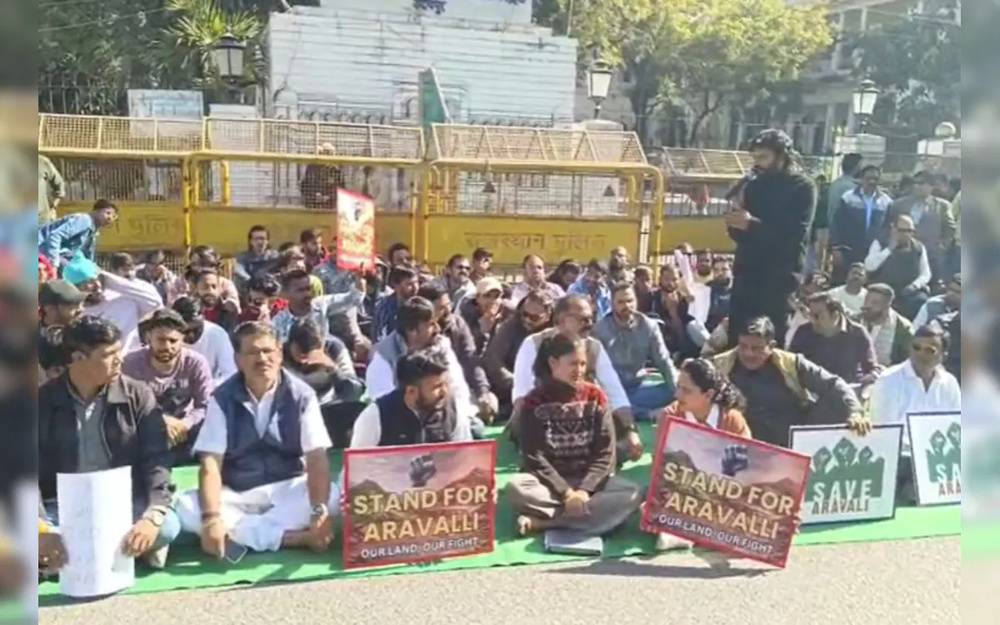
- #SaveAravalli trends nationwide after Supreme Court verdict
- Activists warn over 90% of Aravalli range now exposed to mining
- One-day symbolic fast planned on December 21 in Haryana
- Politicians, environmentalists back full ecological protection
GG News Bureau
New Delhi, 20th Dec: A month after the Supreme Court’s November 20 verdict controversially narrowed the legal definition of the Aravalli hills to landforms rising over 100 metres, the #SaveAravalli movement has surged across social media, triggering nationwide concern over mining and ecological damage.
Hashtags such as #SaveAravalli and #SaveAravallisSaveAQI have flooded digital platforms, accompanied by viral posts and profile picture changes by public figures, including former Rajasthan Chief Minister Ashok Gehlot. The campaign has united rural communities, environmentalists and political leaders, amplifying fears that vast stretches of one of the world’s oldest mountain ranges could now be opened to unchecked mining.
The online mobilisation is spilling into ground action. Environmental groups and rural communities have announced a one-day symbolic fast (upvaas) on December 21, beginning at 10 am, at Tosham Hill in Haryana’s Bhiwani district — the northernmost extension of the Aravalli Range. Protesters are demanding the withdrawal of the height-based definition, warning it leaves lower hills vulnerable.
Stretching nearly 692 km across Delhi, Haryana, Rajasthan and Gujarat, the two-billion-year-old Aravalli range is regarded as northern India’s ecological backbone. It acts as a barrier against desertification from the Thar Desert, recharges groundwater aquifers, and filters air pollution affecting the Delhi-NCR region. Forests in the Aravalli support fuelwood, fodder, grazing land, medicinal plants and water sources for millions across 37 districts.
However, the Supreme Court’s acceptance of a Ministry of Environment, Forest and Climate Change (MoEFCC) committee recommendation defines Aravalli hills as landforms rising at least 100 metres above local relief. An internal Forest Survey of India assessment indicates that this excludes over 90 per cent of the range. In Rajasthan, only 1,048 of 12,081 mapped hills — about 8.7 per cent — meet the threshold.
Neelam Ahluwalia, founding member of People for Aravalli, said the ruling was deeply disappointing. “At a time when courts in countries like Ecuador, Colombia, New Zealand and Bangladesh are recognising legal rights of nature, this decision effectively sentences the Aravalli to death. The range needs strict protection, not narrow definitions,” she said while speaking at the ‘Clean Air – My Right’ conference organised by the Delhi Youth Congress on December 17.
The Aravalli Virasat Jan Abhiyaan, launched on December 11 to mark International Mountain Day, has mobilised wide support. Delegations have met Members of Parliament in Delhi, submitting memorandums seeking a parliamentary debate on the issue.
Virendra Mor of the Rajasthan Kisan Mazdoor Noujawan Sangh said delegations have met senior leaders of the Indian National Congress and Rajya Sabha MP Raj Kumar Roat, who assured support for ground-level opposition, citing the ruling’s impact on tribal livelihoods and cultural identity.
Lokesh Bhiwani, founder of Stand With Nature, warned that the verdict could cause irreversible damage to north-western India’s only natural shield against desertification. He demanded that the entire Aravalli range be declared a significant ecological area and that all mining activities be halted immediately.
While the Supreme Court has paused the issuance of new mining leases pending a sustainable management plan, activists caution that the narrowed definition itself poses a long-term threat to the survival of the Aravalli hills.
