

Anjali Sharma
GG News Bureau
NEW YORK, 1st Feb. Saudi Arabia on Wednesday has announced that the Kingdom in the most water-scarce region and one that is severely affected by desertification and land degradation, will host Riyadh COP16 from 2-13 December 2024.
The session will showcase efforts underway in Saudi Arabia, the Middle East region and beyond towards a green transition based on sustainable land stewardship, it stated in a press statement issued.
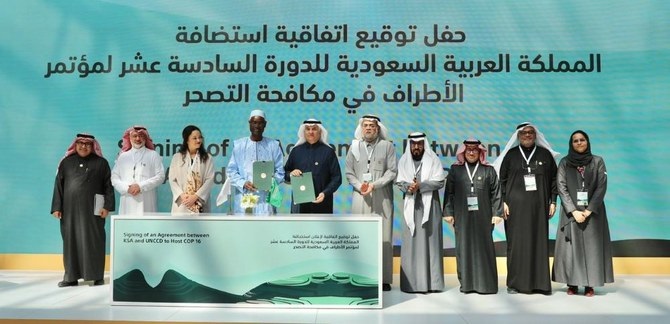
The Kingdom of Saudi Arabia and the UN Convention to Combat Desertification have signed an agreement pave the way for the 16th session of the Convention’s Conference of the Parties (COP16) .
It will be the largest-ever meeting of UNCCD’s 197 Parties, the first to be held in the Middle East region and the largest multilateral conference ever hosted by Saudi Arabia.
The year 2024 marks the 30th anniversary of the UNCCD one of the three major environmental treaties known as the Rio Conventions, alongside climate change and biodiversity.
Eng. Abdulrahman Abdulmohsen AlFadley, Saudi Minister of Environment, Water and Agriculture and COP16 President, said at he ceremony launch said “The hosting of the conference (COP16) in the Kingdom of Saudi Arabia reflects the commitment of the wise leadership to environmental protection at the national, regional, and international levels.’’
Saudi Arabia launched several ground-breaking environmental projects, such as the Saudi Green Initiative and the Middle East Green Initiative, he added.
UNCCD Executive Secretary Ibrahim Thiaw said: “Today, we are losing fertile lands at an alarming rate, jeopardizing global stability, prosperity and sustainability. The Riyadh COP16 must mark a turning point in the way we treat our most precious resource—land—and collectively tackle the global drought emergency.”
According to UNCCD data, up to 40 per cent of the world’s land is degraded, affecting half of humanity and with dire consequences for the climate, biodiversity and livelihoods, he said.
If current trends continue, restoring 1.5 billion hectares of land by 2030 will be necessary to achieve a land-degradation-neutral world.
Ibrahim Thiaw pointed out that ‘’Droughts are hitting more often and harder all over the world—up by 29 per cent since 2000—driven by climate change but also the way we manage our land.
‘’One-quarter of the world’s population is already affected by droughts, with every three out of four people around the world projected to face water scarcity by 2050.’’
The Riyadh COP16 will focus on mobilizing governments, businesses and communities worldwide to accelerate action on land restoration and drought resilience as a cornerstone of food, water and energy security.
Two-week event will feature a high-level segment, as well as associated events including the Gender Caucus and the Business for Land Forum, it added.
