
Sanjay Raut Under Fire for Justifying Terrorism
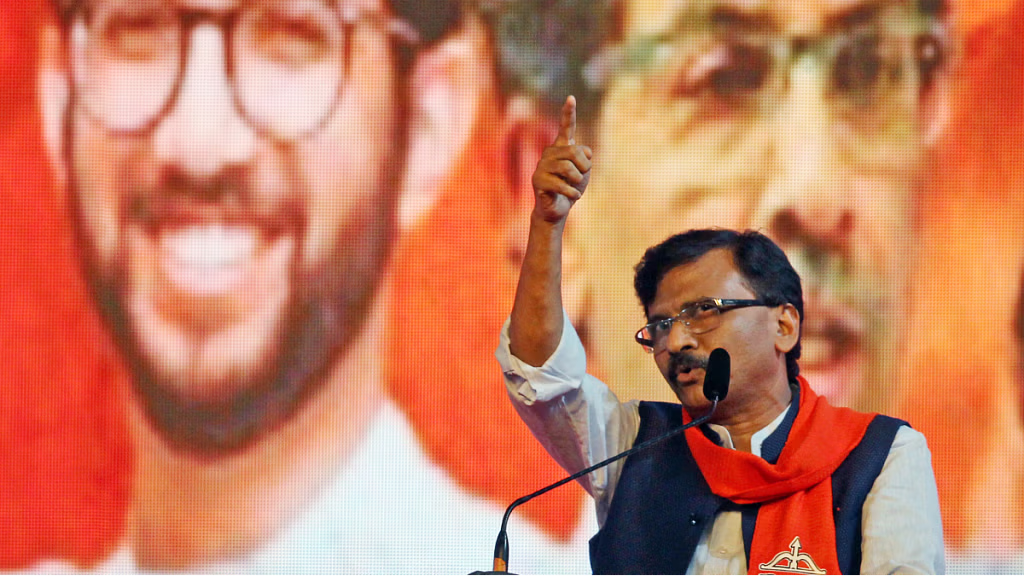
In a shocking political twist, Shiv Sena (UBT)’s Sanjay Raut ignites outrage by linking terrorism to poverty and unemployment—drawing fierce condemnation from across Bharat and exposing the dangerous normalization of extremist violence in electoral rhetoric.

Paromita Das
New Delhi, 6th August: In a country that has endured brutal terror attacks like 26/11 and continues to battle threats from both across borders and within, the words of a national leader carry weight beyond mere opinion. So, when Shiv Sena (UBT) MP Sanjay Raut claimed that terrorism is born out of poverty, unemployment, and lack of education, it wasn’t just a casual remark—it was a political detonation.
Raut’s assertion that “Terrorism has no color… it arises because of economic deprivation,” may have aimed to sound empathetic or analytical. But in doing so, he stirred a storm of outrage, not only for seeming to rationalize mass murder but for dangerously veering into the realm of ideological appeasement. It begs a broader question: are some of Bharat’s once-nationalist political outfits willingly trading security clarity for political posturing? And how do these statements resonate differently across regions like West Bengal, Tamil Nadu, and Maharashtra?
From Mumbai’s Memories to Kolkata’s Caution
Mumbai—the city most scarred by terrorism, with the 26/11 attacks etched permanently into its collective psyche—was ground zero for Raut’s controversial framing. To even hint at socio-economic conditions as justifications for acts like those of Ajmal Kasab, a Pakistani terrorist trained and sent by Lashkar-e-Taiba, is to insult not just the victims but the nation’s resolve.

Contrast this with West Bengal, where political commentary on violence tends to be heavily coded. While Chief Minister Mamata Banerjee has frequently clashed with the Centre over law and order issues, including cross-border infiltration concerns, there is a conscious avoidance of appearing to rationalize terrorism in public forums. In fact, the state, especially border districts like Malda and Murshidabad, often find themselves caught between humanitarian concerns and security anxieties. Yet, even at the height of such debates, Bengal’s leadership rarely offers rhetoric that weakens the national stance on terrorism.
T

his difference in tone reflects something deeper: Maharashtra, under Uddhav Thackeray’s faction of the Shiv Sena, appears to be moving from its traditional nationalist foundation towards a more fluid, Congress-style ideological flexibility—sometimes at the cost of coherence. Bengal, while combative, has stayed closer to the centerline when it comes to matters of national security, even if it remains politically adversarial.
Ideological Drift or Tactical Collapse?
What makes Sanjay Raut’s remarks especially disturbing is the legacy of the party he represents. Shiv Sena, under Balasaheb Thackeray, was synonymous with fierce nationalism, particularly in the post-1993 era when it demanded hardline stances against both internal and external threats. Today, under Uddhav Thackeray’s Shiv Sena (UBT), the party has not only joined hands with the Congress and NCP—both more liberal in their socio-political messaging—but appears increasingly disjointed from its ideological origins.

This is reminiscent of political shifts in other states. In Tamil Nadu, the DMK’s secular narrative often finds itself walking a fine line between inclusivity and perceived apathy on national issues. Yet, even DMK leaders have not gone so far as to equate poverty with terrorism. In contrast, BJP-ruled states like Uttar Pradesh and Assam take a hardline stance, using strong anti-terrorism language in both policy and political rhetoric.

West Bengal offers an interesting middle ground. While Mamata Banerjee frequently positions herself as a champion of minorities and critic of the BJP, her party steers clear of directly rationalizing terrorism—recognizing the political and emotional landmines involved.
The National Cost of Political Recklessness
Sanjay Raut’s assertion that Operation Sindoor—a covert Bharatiya counter-terror mission—was a “failure,” followed by his call for Union Home Minister Amit Shah’s resignation, adds another layer of recklessness. Without classified details, such commentary does more than question the government—it undermines the armed forces and offers rhetorical ammunition to anti-Bharat narratives, both domestic and foreign.

This kind of political theatre—rife in Maharashtra’s current opposition space—stands in stark contrast to Bengal’s more calculated political maneuvering. While Bengal leaders may aggressively challenge central policies on surveillance, citizenship, or federal overreach, rarely do they make remarks that hand strategic talking points to Bharat’s adversaries.
In fact, the opposition in Bengal often uses cultural nationalism and linguistic pride as its rallying cry—fighting the BJP on regional identity grounds rather than challenging the nation’s security framework. This makes Raut’s remarks not only politically tone-deaf but strategically disastrous.
A Dangerous Normalization Must Be Condemned
Let’s be clear: questioning policy or governance is part of democracy. But justifying terrorism, even indirectly, is a line no leader should cross. Raut’s statement reflects not just poor judgment but a chilling willingness to dilute the national consensus against terrorism for political survival.

There is a reason why most regional leaders—even those opposed to the BJP—tread carefully around issues like terrorism and military operations. The national security discourse is sacred in Bharat, shaped by the blood of soldiers and the scars of civilians. To reduce it to a discussion of hunger and jobs, without acknowledging the ideological and operational roots of extremism, is not only naïve—it’s dangerous.
The Fight Against Terror Needs Unity, Not Excuses
Sanjay Raut’s remarks must serve as a red flag—not just for Shiv Sena (UBT), but for all political parties that might be tempted to soften their stance on terrorism in pursuit of vote bank politics. Bharat’s fight against terror—whether Naxalite or Islamist, domestic or foreign—requires moral clarity and bipartisan unity.
Political narratives may vary across regions like Maharashtra, West Bengal, Tamil Nadu, or Delhi, but the message on terrorism must remain uniform: zero tolerance. In an age where national security is as much about perception as it is about policy, careless words can cost more than just political capital—they can cost lives.
The time has come for leaders to choose: uphold the integrity of the nation or gamble it away for short-term headlines. If there’s any respect left for the legacy of Balasaheb Thackeray, Shiv Sena (UBT) must choose the former.
