
Samajwadi Party Battles Election Commission Over UP Voter Rolls

Paromita Das
New Delhi, 22nd August: Bharatiya politics rarely stays quiet for long, and the latest storm has been stirred by none other than Samajwadi Party chief Akhilesh Yadav. In a fiery move that added fuel to the already heated opposition narrative, Yadav accused the Election Commission of India (ECI) of colluding with the ruling BJP to deliberately delete the names of backward and most backward class voters in Uttar Pradesh—communities that form the bedrock of his party’s support base. His allegations, coming just months before crucial elections, have once again placed the ECI under the microscope.
But are these claims credible, or are they just another chapter in Bharat’s charged political playbook?
The Allegations: A Targeted Deletion of Voter Names
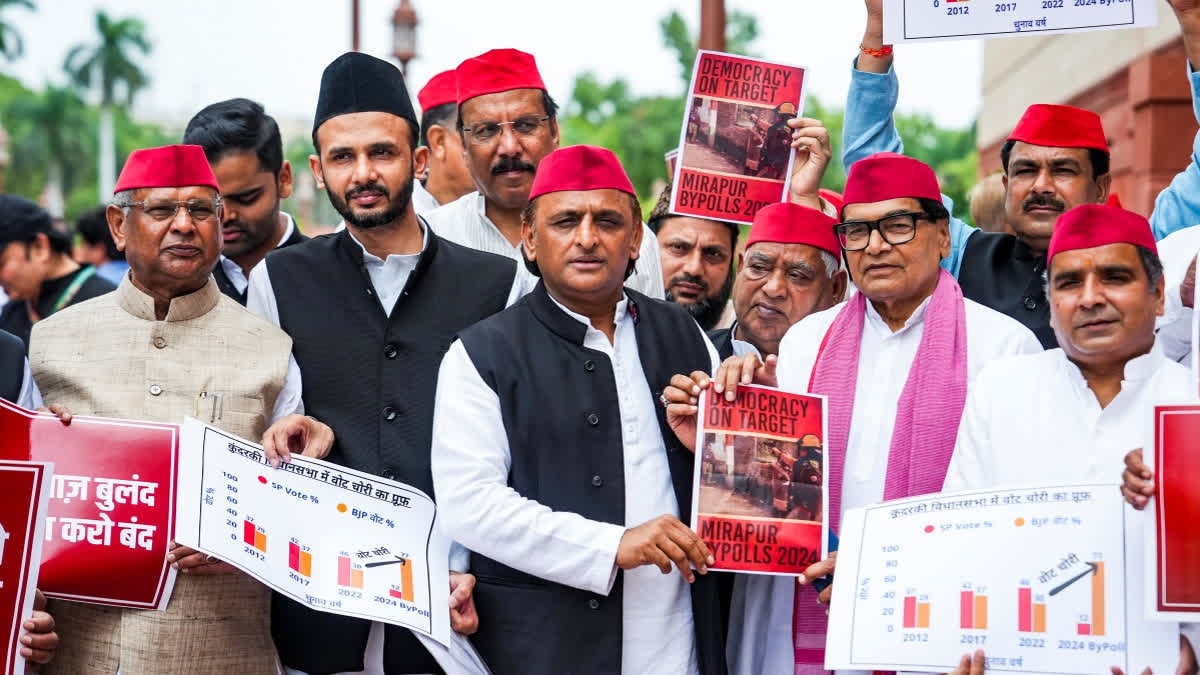
During a demonstration in Parliament on August 18, Yadav distributed copies of affidavits he claimed to have filed with the Election Commission, alleging large-scale discrepancies in electoral rolls. According to him, his party submitted nearly 18,000 affidavits highlighting errors in constituencies such as Amapur, Bakshi Ka Talab, Jaunpur Sadar, and Kursi.
What raised eyebrows further was his claim that while the Election Commission denied receiving any such affidavits, the Samajwadi Party had acknowledgment receipts to prove otherwise. Yadav even demanded that the ECI authenticate these digital receipts, warning that if they were dismissed, not just the Commission but also the credibility of “Digital India” would be at stake.
On social media, he sharpened his attack with a dramatic statement: “If BJP goes, truth will prevail!”
जो चुनाव आयोग ये कह रहा है कि हमें यूपी में समाजवादी पार्टी द्वारा दिये गये ऐफ़िडेविट नहीं मिले हैं, वो हमारे शपथपत्रों की प्राप्ति के प्रमाण स्वरूप दी गयी अपने कार्यालय की पावती को देख ले। इस बार हम मांग करते हैं कि चुनाव आयोग शपथपत्र दे कि ये जो डिजिटल रसीद हमको भेजी गयी है वो… pic.twitter.com/9A4njvF9Tw
— Akhilesh Yadav (@yadavakhilesh) August 17, 2025
The Pushback from District Officials
The counter-narrative was swift. District Magistrates (DMs) and election officers from across Uttar Pradesh publicly rebutted Yadav’s accusations.
In Jaunpur, officials clarified that the five voters cited in Yadav’s complaint had all passed away before 2022. Their names were struck off only after confirmation from family members and local authorities.
ईमेल के माध्यम से जनपद जौनपुर की विधान सभा 366 जौनपुर के अंतर्गत पांच मतदाताओं के नाम गलत ढंग से काटने की शिकायत प्राप्त हुयी थी। वर्णित सभी पांचों मतदाता वर्ष 2022 के पूर्व ही मृतक हो चुके थे। इसकी पुष्टि सम्बंधित मृतक मतदाता के परिवार के सदस्यों, स्थानीय लोगों सहित स्थानीय… https://t.co/waiNov1BJ9
— DM JAUNPUR (@DMjaunpur) August 19, 2025
In Barabanki, the DM explained that the alleged two deletions were false, as the names of those voters were still very much on the rolls.
बाराबंकी जिले के विधान सभा क्षेत्र 266-कुर्सी के 2 मतदाताओं के शपथ पत्र उनके नाम मतदाता सूची से गलत ढंग से काट दिये जाने के संबंध में प्राप्त हुए। जांच में पाया गया कि उपर्युक्त दोनों मतदाताओं के नाम मतदाता सूची में दर्ज हैं। https://t.co/Qk2axJ5UEe
— DM Barabanki (@BarabankiD) August 19, 2025
In Kasganj, officials revealed that seven of the eight names flagged by Yadav were duplicate entries, while the eighth was removed following a Form 7 application submitted by the voter’s wife after his death.
ईमेल के माध्यम से जनपद कासगंज की विधान सभा 101 अमांपुर के अंतर्गत 8 मतदाताओं के नाम गलत ढंग से काटने की शिकायत प्राप्त हुयी थी।जांच में पाया गया कि 7 मतदाताओं के नाम मतदाता सूची में दो बार होने के कारण नियमानुसार एक नाम को विलोपित किया गया था। (1/2) https://t.co/icgH4iyy00
— DM Kasganj (@DmKasganj) August 19, 2025
In Lucknow’s Bakshi Ka Talab constituency, the District Election Officer clarified that 11 out of the 13 contested names were intact. Of the remaining two, one voter had shifted residence years ago, while the other had passed away.
लखनऊ जिले के विधान सभा क्षेत्र 169-बक्शी का तालाब के 13 मतदाताओं के नाम मतदाता सूची से गलत ढंग से काट दिये जाने के संबंध में शिकायत प्राप्त हुयी थी। जांच में पाया गया कि एक मतदाता का नाम अपने क्षेत्र में निवासरत न रहने के कारण वर्ष 2012 में नियमानुसार विलोपित किया गया था। (1/2) https://t.co/14Y4E6S22r
— DEO Lucknow (@LucknowDEO) August 19, 2025
These official responses painted Yadav’s claims as exaggerated, if not outright misleading.
The Larger Political Context

Yadav’s confrontation with the Election Commission is not happening in isolation. It comes as part of a broader INDI Alliance campaign against what they allege is partisan functioning by constitutional institutions under the BJP-led government.
The opposition has been critical of the Special Intensive Revision of electoral rolls, conducted recently in Bihar and other poll-bound states. Leaders across the alliance have questioned whether the process is genuinely transparent or manipulated to favor the ruling party. From filing cases in the Supreme Court to organizing demonstrations in Parliament, the opposition has mounted a multi-pronged attack designed not only to highlight alleged flaws but also to energize their base ahead of elections.
Reading Between the Lines: A Battle of Narratives

At the heart of this controversy lies a classic battle of narratives. On one hand, Akhilesh Yadav seeks to position himself as a defender of backward-class voters, portraying his party as a shield against disenfranchisement. His dramatic language and distribution of affidavits serve a dual purpose: to spotlight alleged irregularities and to reinforce his image as a fighter against what he sees as institutional bias.
On the other hand, the Election Commission and local officials are pushing back firmly, pointing to evidence that undermines Yadav’s claims. Their responses—often posted publicly on social media—show a desire to counter any narrative that questions the neutrality of the election process.
Strategy or Substance?

Looking at the available evidence, Yadav’s allegations appear, at least partially, overstated. The examples he cited have been convincingly rebutted by district administrations, often with clear records of voter deaths or duplicate entries. However, dismissing his claims outright may also be premature.
Electoral rolls in Bharat have historically suffered from inaccuracies—ranging from duplicate entries to wrongful deletions. While officials may be correct in their specific rebuttals, the larger issue of trust in the electoral process remains unresolved. In an era when public faith in institutions is under strain, even the perception of bias can be politically damaging.
Thus, while Yadav’s immediate claims may lack strong backing, his strategy of questioning the Election Commission could still resonate with sections of the electorate that already feel marginalized or suspicious of authority.
A Test of Credibility for Both Sides
This episode is more than a clash between Akhilesh Yadav and the Election Commission. It’s a test of credibility—both for a politician trying to protect his voter base and for an institution tasked with safeguarding the world’s largest democracy.
If the Election Commission can convincingly prove its neutrality and transparency, it may come out stronger, silencing critics who accuse it of bias. But if lapses are indeed uncovered—no matter how small—they could fuel the opposition’s charge and deepen public skepticism.
Ultimately, the controversy underscores a truth central to democracy: elections are not just about votes, but about the trust that citizens place in the system. And once that trust is questioned, the real battle begins.
