

Poonam Sharma
There are few debates in Indian politics as persistent—and as politically convenient for some—as the question of the Rashtriya Swayamsevak Sangh’s role in the freedom struggle. For decades, the Congress Party has repeated a familiar allegation: that the RSS “did nothing” for India’s independence. Yet strangely, it is Congress’s own governments, archives, and committees that have time and again acknowledged the nationalist contribution of the RSS’s founder, Dr. Keshav Baliram Hedgewar. This is no longer a footnote of history but a mirror to the deep intellectual insecurity that has gripped the Congress today.
The Hedgewar Chapter Congress Wants Forgotten
Dr. Hedgewar’s imprint on the freedom movement is not a matter of partisan opinion. It is shaped by documented participation in the Non-Cooperation Movement, records of imprisonment, and colonial intelligence files marking him as a subversive nationalist. Hedgewar’s shift-from active Congress worker to founding the RSS in 1925-did not dilute his belief in the national cause; if anything, his commitment deepened as he mobilised disciplined youth inspired by cultural nationalism.
These details have often been conveniently overlooked by Congress-friendly historians, but the evidence simply would not go away. When archival material, police intelligence, and personal testimonials converge, the narrative of “RSS absence” collapses quickly.
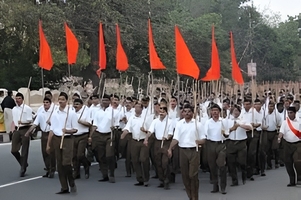
The RSS under Hedgewar functioned not as a political party but as a grassroots force nurturing character, unity, and discipline. For an organization that was barely born during the peak of the freedom struggle, it is remarkable indeed that British authorities still saw it as a symbol of rising nationalist assertion.
When Congress Governments Told the Truth—Quietly
What the Congress leaders dismiss today as “myth” was documented officially under their own watch.
Successive Congress-led governments, both at the state and Centre level, have officially acknowledged Hedgewar’s role for decades. Be it publication in government gazettes, commemorative references, or committee notes, such recognition was bureaucratically cleared, not politically inserted.
Even more telling are the digitized colonial-era intelligence files that became publicly accessible during the years of the UPA. Records reveal Hedgewar’s influence on youth movements, describing the RSS as steeped in nationalist principles that unnerved the British administration.If this is not participation in the freedom movement, then one must ask: what qualifies?
Vande Mataram: A Flashpoint of Historical Convenience
Perhaps nowhere is the selective memory of Congress clearer than in the uncomfortable politics it now plays around Vande Mataram. The national song that electrified the freedom struggle, echoed across rallies, and became the spiritual spine of anti-colonial resistance is today treated by Congress with hesitation, if not outright allergy.
The RSS, on the other hand, has never wavered in its reverence. For decades, shakhas across the country have used Vande Mataram as an invocation of unity and dedication to the nation.
How did the party that once led the freedom movement get squeamish about the song that inspired it?
The answer is uncomfortable: cultural nationalism no longer fits neatly into Congress’s political vocabulary.
Why the Myth Still Survives
Why does Congress persist with the claim that the RSS was absent from the freedom struggle, when its own records contradict it?
1. Political Competition
The RSS’s rise as a powerful socio-cultural force has left the Congress organizationally overshadowed. Delegitimizing the RSS is an easy task compared to rebuilding its own cadre base.
2. Ideological Drift
Congress has changed themes over the decades—from inclusive nationalism to appeasement-driven secularism. In this changed ideological ecosystem, the RSS becomes a convenient “other.”
3. Legacy Management
For long, academia shaped by Congress-era ideologues systematically downplayed organizations that did not align with their worldview. As these once-dominant narratives fade, Congress clings to them more desperately.
History is to be questioned, not erased.
The younger generations of Indians are no longer dependent on curated textbooks to learn about their past. They have access to archives, digitized records, biographies, and declassified intelligence notes. And in this wider information universe, the role of Hedgewar and the nationalist nature of the early RSS are not fringe claims—they are verifiable realities.
The Congress can go on raising the familiar slogans, but it cannot wish away the truth already stamped by its own administrations.
The Real Question Today
The issue is not about whether the RSS fought for independence in the manner Congress likes. The issue is whether Congress is prepared to accept historical facts when those do not flatter its political narrative. In a rapidly changing India—one more aware of its cultural identity and historical continuity—the old propaganda is losing its potency. It is for the Congress to decide whether it wants to remain anchored to outdated rhetoric or evolve with the nation’s expanding understanding of its own past. Because history has already delivered the verdict. What remains is whether Congress is willing to read it.
