
Rohith Vemula Bill 2025: Karnataka’s Fight Against Discrimination or a Political Ploy?

Paromita Das
New Delhi, 26th June: In a political landscape where symbolism often outweighs substance, the Karnataka government’s proposed Rohith Vemula (Prevention of Exclusion or Injustice) (Right to Education and Dignity) Bill, 2025 has entered the public discourse with both praise and skepticism. Touted as a bold step toward eliminating caste- and identity-based discrimination in educational institutions, the bill arrives cloaked in noble intention. But as with many attempts at social reform in Bharat, the name, the timing, and the context surrounding it have sparked deeper questions.
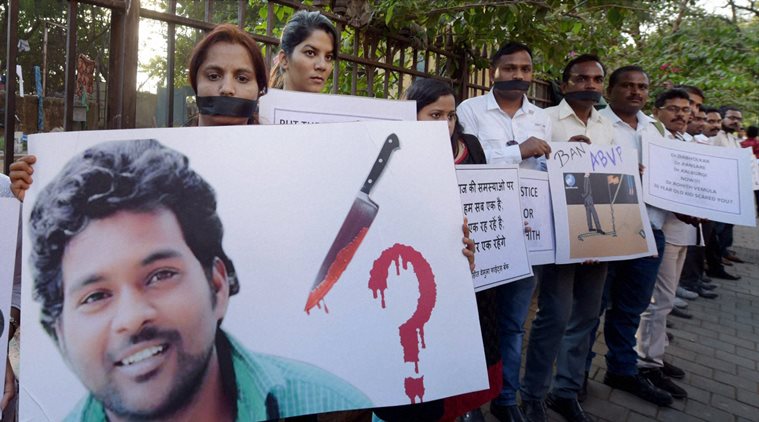
The legislation, which seeks to ensure equal access and dignity for SC, ST, OBC, and minority students, uses the name of Rohith Vemula—an academic whose tragic suicide in 2016 triggered nationwide protests. However, the invocation of Vemula’s name—despite legal ambiguity over his caste status—has complicated the narrative. Is this bill a sincere push for justice, or does it mark a strategic maneuver aimed at securing political capital ahead of the 2028 state elections?
The Ghost of Rohith Vemula
To understand the emotional charge behind this legislation, one must revisit the events of January 2016. Rohith Vemula, a PhD scholar at the University of Hyderabad and a vocal member of the Ambedkar Students’ Association, took his life after what he described as persistent caste-based marginalization. His suicide note, philosophical and aching in its reflections, quickly became a rallying cry across Bharat. The phrase “fatal accident of birth” came to symbolize the lived experience of caste discrimination in modern academic spaces.
But even as protests erupted and political figures scrambled to align themselves with the cause, the foundational premise of his Dalit identity came under legal scrutiny. Investigations raised questions about the validity of his SC status. With no official SC certificate held by either parent and the legal reliance on paternal lineage for caste identification, Vemula’s identity became a matter not just of emotion, but of bureaucratic legality.
In 2024, a closure report filed by the Gachibowli police concluded that Vemula was not a Scheduled Caste member, citing insufficient evidence. For supporters of the movement, this legal conclusion hardly dulled the symbolic power of his death. But for skeptics of the Karnataka bill, it provided fuel to the argument that the legislation is built more on political myth-making than constitutional clarity.
Between Justice and Political Strategy
The bill’s most controversial feature lies not in its intent, but in its punitive architecture. Under its provisions, any educational institution found guilty of discrimination could face harsh penalties: up to one year of imprisonment for responsible authorities, fines of ₹10,000, and the suspension of financial aid to the institution.
These consequences, while ostensibly aimed at deterrence, raise immediate red flags. In a system already strained by bureaucratic delays and politicized oversight, the idea of labeling such offenses as “cognizable” and “non-bailable” creates room for both genuine grievance redressal and malicious exploitation. Could this bill become a tool to settle personal vendettas or suppress ideological dissent on campuses? Could political opponents be targeted under the guise of promoting equity?
These are not idle questions. Bharat’s recent history is full of examples where laws designed to protect the vulnerable have been misused or applied selectively. Critics argue that without clear definitions of what constitutes “discrimination” or “exclusion,” the law remains vulnerable to interpretation—and manipulation.
Moreover, naming the bill after Rohith Vemula—whose caste identity remains legally unsettled—feels like a calculated move. It plays on emotion and collective guilt but risks overshadowing the need for more systemic, less dramatized solutions. It also sets a precedent where complex, unresolved individual cases are used as legislative mascots, blurring the lines between justice and emotional mobilization.
A State Bill with National Echoes
It is also impossible to ignore the national undertones. The bill aligns neatly with Rahul Gandhi’s call for a broader anti-discrimination framework across Bharat. Chief Minister Siddaramaiah’s swift action in drafting and promoting this legislation can be seen as more than state policy—it’s a nod to the Congress party’s broader electoral blueprint. As caste mobilization shapes political contests in state after state, a move like this allows the ruling party in Karnataka to consolidate support among SC, ST, and OBC communities, just as critical electoral cycles loom on the horizon.
But therein lies the paradox. In seeking to ensure inclusion, the bill risks becoming exclusionary in its application. It could alienate academic institutions, create mistrust among educators, and reduce genuine student grievances to political scoring points. Social justice, if pursued through poorly crafted legal threats, can become a weapon rather than a shield.
Between Symbolism and Substance
The Rohith Vemula Bill 2025 is both an opportunity and a warning. It seeks to confront one of Bharat’s most enduring injustices—discrimination within educational institutions. But by grounding itself in a controversial identity and wrapping its enforcement in punitive clauses, it walks a precarious line.
Karnataka has taken a bold step, but boldness must be matched with clarity, balance, and intent. Legislation that aspires to protect must also inspire trust. It must build bridges, not create new battlegrounds. Naming a bill after Rohith Vemula should serve as a solemn commitment to end exclusion—not as a shortcut to electoral validation.
In the final analysis, this is not just about one bill or one name—it is about the kind of republic Bharat wishes to be. Transparent, fair, and inclusive—or reactive, politicized, and performative. The choice, like the consequences, is profound.
