
Rahul’s Last Stand — And the End of Congress’s Dynastic Era?
“Rahul Gandhi Steps Back: The Congress Scion’s Toughest Political Crossroads”

Paromita Das
New Delhi, 28th October: In Bharat’s ever-churning political theatre, surprises rarely surprise anymore. Yet, Rahul Gandhi’s recent decision to step away from active politics has sent tremors through the Congress camp like never before. It’s a twist few saw coming, though whispers had long filled the corridors of 24 Akbar Road. After years spent crafting campaigns, launching yatras, and promising transformations, the man once pitched as the “reluctant prince” of Bharatiya politics appears to have finally accepted his disconnection with the political soil he long struggled to till.
The Reluctant Politician’s Long Goodbye

Sources close to the family suggest that this isn’t an impulsive move. Rahul reportedly expressed his desire to withdraw from politics not once but thrice in the past—to his mother Sonia Gandhi and senior Congress veterans. Each time, he was persuaded to stay, reassured that one more fight, one more election, might change his fate.
But the 2025 Bihar campaign seems to have turned that hesitation into conviction. Once deeply invested in his “Voter Adhikar Yatra,” Rahul expected the campaign to reignite his connect with the masses. Instead, it collapsed—digitally, electorally, and symbolically. His “vote theft” narrative fizzled before it found audience traction, leaving the Congress IT cell clueless and demotivated. The posters stopped, the hashtags died, and Rahul himself went silent.
When the Strategy Backfires

Rahul’s strategy followed a pattern now familiar to Congress watchers—a burst of enthusiasm, aggressive messaging, a few high-decibel press conferences, and suddenly, a retreat. His press briefings in August and September, where he promised politically explosive revelations, ended up weakening his case further.
He described his campaign as a “hydrogen bomb” against the Modi government, but when the dust settled, not even a spark remained. Bihar’s streets did not respond. Digital engagement tanked. Even Congress allies appeared distant. What was planned as a mass awakening turned into an expensive echo chamber. For Rahul, it was more than electoral defeat—it was emotional exhaustion.
The Family Angle: Rift or Redefinition?

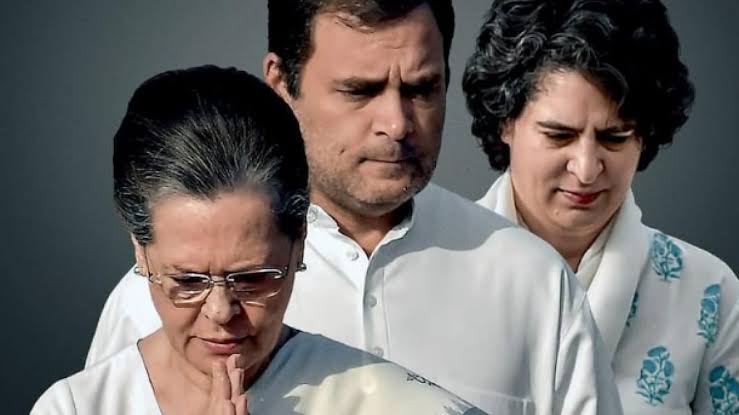
Behind the silence, however, lies another layer—the reported strain between Rahul Gandhi and his sister Priyanka Gandhi Vadra. Party insiders claim that both siblings have been avoiding frontline campaigning, waiting for clarity over who takes charge next.
While Sonia Gandhi remains the moral anchor, her age limits active leadership. This vacuum leaves a leadership conundrum: if Rahul retreats, does Priyanka step forward? Or will the Congress finally seek an identity beyond the Gandhi surname?
The uncertainty has paralyzed Congress strategists. Bihar’s campaign has no clear face, no decisive messenger. Rahul, who once carried the torch of youth politics, now appears fatigued, more philosophical than political—seen at public places casually, but conspicuously missing from the war room when battles begin.
Why Rahul’s Experiment Failed

Rahul’s political journey has often mirrored the story of an earnest student convinced that diligence guarantees success. His campaigns were conceptually strong—anti-corruption, pro-youth, and anti-establishment—but execution consistently faltered. His messaging rarely resonated with the complexity of Bharat’s electorate.
When he framed his narrative around “vote theft,” it sounded more like frustration than reform. Voters found the rhetoric vague; even Congress workers felt the emotional disconnect.
The larger truth may be simpler—Rahul Gandhi never truly adapted to Bharat’s new-age political grammar, one defined by agile narrative shifts and emotional storytelling. In a landscape dominated by populist charisma, precision marketing, and digital mobilization, his idealistic tone often seemed anachronistic.
The Bigger Question: Who After Rahul?

Rahul’s semi-retirement raises existential questions for the Congress. The party’s traditional vote banks have fragmented. Younger voters lean toward regional players or newer narratives, and the party’s organisational machinery remains brittle.
If Rahul pulls out, as sources insist, the Congress might enter its most defining phase since Independence: the possible end of dynastic dominance. Some veteran leaders privately support his decision, arguing that only a post-Gandhi Congress can rebuild credibility.
Yet others fear the opposite—that without the Gandhi name, the party’s emotional appeal might dissolve entirely. For decades, the Nehru-Gandhi lineage has been the pivot around which Congress’s identity spun. Detaching from it may offer renewal but could also mean annihilation.
The Courage to Step Away

In a political culture where leaders cling to power till irrelevance consumes them, Rahul Gandhi’s choice might—ironically—be his first act of genuine leadership. Recognizing one’s limits demands rare courage. His political detachment could be read not as surrender but as realism—a man choosing sanity over symbolism.
If the Congress interprets this moment wisely, it could use it to reimagine itself beyond inherited leadership—to empower new minds and new methods. If not, it risks confirming what critics have long said—the party is less an institution and more a family enterprise caught in self-perpetuating nostalgia.
A Turning Point or a Dead End?
Rahul Gandhi’s withdrawal marks not just a personal decision but a turning point in Bharatiya politics. After two decades of striving to match his lineage’s legacy, he may finally have admitted that politics, at least as practiced today, does not fit his temperament.
Whether this marks renewal for Congress or its slow eclipse will depend on what comes next—if the party dares to reinvent or once again waits for its prodigal leader to return.
History will judge Rahul Gandhi not for the elections he lost, but for whether he left his party adrift—or liberated it from the weight of dynasty.
