
Rahul Gandhi’s Karnataka Mission: Can He Mend a Cracking Congress Wall?
“Power Struggle in Karnataka: Rahul Gandhi’s Visit Amid Congress’s Deepening Rift.”

Paromita Das
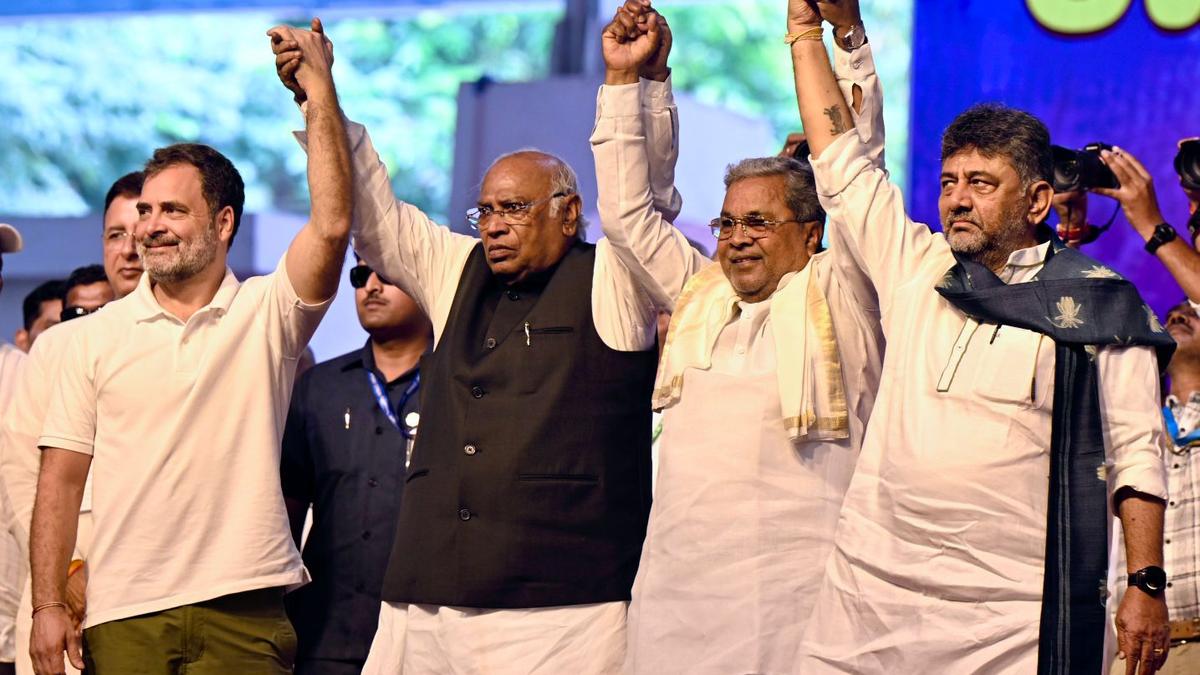
New Delhi, 27th October: As political winds swirl unpredictably over Karnataka, the Congress government finds itself navigating one of its most turbulent phases yet. What began as subtle murmurs of discontent has now evolved into a full-blown power struggle threatening to fracture the state’s ruling setup. Chief Minister Siddaramaiah and Deputy Chief Minister D.K. Shivakumar—the two pillars of Congress’s southern stronghold—stand at a delicate crossroads, their uneasy alliance strained by ambition, perception, and familial missteps. The impending arrival of Rahul Gandhi on November 19 adds both weight and tension to a political stage already trembling with internal discord.
Yathindra’s Remark That Shook the Party

The spark igniting this storm was Yathindra Siddaramaiah’s offhand remark in Belagavi, naming senior leader Satish Jarkiholi as his father’s “successor.” That single declaration shredded the party’s scripted façade of unity and handed rival camps the ammunition they had long been waiting for. Until then, Yathindra had maintained that Siddaramaiah would complete his five-year term. But by publicly hinting at succession, he triggered alarm bells at the party’s high command—especially with the Bihar Assembly election results just around the corner. Delhi’s directive to “maintain unity till November” was now on the verge of collapse.
For Congress, which has been trying to project stability at the national level, Yathindra’s contradiction was nothing short of sabotage. Shivakumar’s loyalists openly questioned the Chief Minister’s camp’s discipline, warning that backdoor politics would destroy the mandate Karnataka handed Congress in 2023.
Siddaramaiah’s Tightrope Walk

Caught between loyalty and legacy, Chief Minister Siddaramaiah is reportedly preparing for a cabinet reshuffle to reassert his control. Political insiders suggest that by mid-November—just before Rahul Gandhi’s visit—Siddaramaiah may replace up to ten ministers to recalibrate factional balance. His goal is simple yet strategic: reward loyalists while placating Shivakumar’s network without actually ceding real power.
His aides insist the Chief Minister is determined to complete his term. Yet whispers within Bengaluru’s Vidhana Soudha suggest he might consider a “controlled transition” later, ensuring any future leadership change stays within his faction’s influence. The calculated timing of this manoeuvre reflects Siddaramaiah’s effort to secure his legacy before potential high command intervention alters the state power matrix.
Shivakumar: The Silent Contender

Deputy Chief Minister D.K. Shivakumar, a man whose silence often speaks louder than his statements, has chosen restraint. Publicly, he preaches discipline; privately, his camp simmers with expectation. His comment—“I will speak wherever I need to speak; discipline is my party’s priority”—revealed both loyalty and clever positioning. For now, Shivakumar appears committed to the Congress’s broader narrative, but his supporters continue to believe he will assume leadership midway through the term.
Behind closed doors, however, the mood isn’t as subdued. Shivakumar knows the stakes. His expanding clout among local leaders, financial strength, and organisational prowess position him as the most formidable challenger Siddaramaiah has ever faced. But he also understands the fine line between ambition and dissidence—especially under Rahul Gandhi’s watchful eye.
Rahul Gandhi’s Visit: Healing or Headache?

Rahul Gandhi’s November 19 visit to Karnataka may prove pivotal. Officially, it is tied to an Anganwadi workers’ rally in Bengaluru. Unofficially, it is a mission to extinguish the fire before it engulfs the state unit. Sources suggest that the visit could become the forum for reshaping the Congress’s internal structure in Karnataka—possibly even finalising a power-sharing formula between the two camps.
For the Congress high command, Karnataka is both a victory symbol and a credibility test. The state remains the party’s most significant southern bastion after repeated losses elsewhere. A leadership crisis here could hand the BJP a crucial political opening just as national elections draw closer.
Rahul’s challenge, therefore, is to assert control without alienating either blockbuster of the Karnataka unit. A miscalculation could mirror Congress’s internal collapses in Rajasthan, Madhya Pradesh, and Punjab—episodes where ambition triumphed over unity, ultimately handing victories to the opposition.
The High Command’s Dilemma

Rahul Gandhi, Sonia Gandhi, and Mallikarjun Kharge find themselves balancing multiple contradictions. Removing Siddaramaiah would risk alienating backward-class voters who view him as their strongest voice. Yet openly backing Shivakumar—a Vokkaliga heavyweight—could appear as a caste shift, unsettling Congress’s fragile social coalition. Adding complexity is Kharge’s own unspoken ambition. As AICC president, he commands influence and represents the Dalit constituency, a factor he might use to position himself as a neutral mediator or, some speculate, a potential successor figure to bridge the divide.
Congress’s Karnataka Knot

The unfolding battle in Karnataka is less about individuals and more about the Congress’s crisis of structure. The party’s central leadership continues to postpone decisive calls, believing time will dissolve tensions. Yet history has proven otherwise—from Punjab to Madhya Pradesh, delayed action has only deepened losses.
Rahul Gandhi must choose between leadership diplomacy and leadership decisiveness. Karnataka’s political temperature demands the latter. His intervention can no longer merely placate factions; it must outline a roadmap for stable governance and disciplined ambition.
A Test of Political Maturity
Karnataka has become Congress’s mirror—reflecting both its strength and fragility. If Rahul Gandhi’s visit restores unity, it could symbolise Congress’s renewed national coherence. But if it exposes deeper fissures, the state could quickly slip into the familiar pattern of rebellion and retreat that has haunted the party in recent years.
As November approaches, all eyes will be on Bengaluru, where strategy, symbolism, and survival will collide. For Rahul Gandhi, this is not just another state tour—it is a leadership test that will define whether Congress commands its destiny or continues to be defined by its divisions.
