
Rahul Gandhi’s Red Book Rhetoric: False Claims on Gandhi, Godse, and Bharat’s Constitution
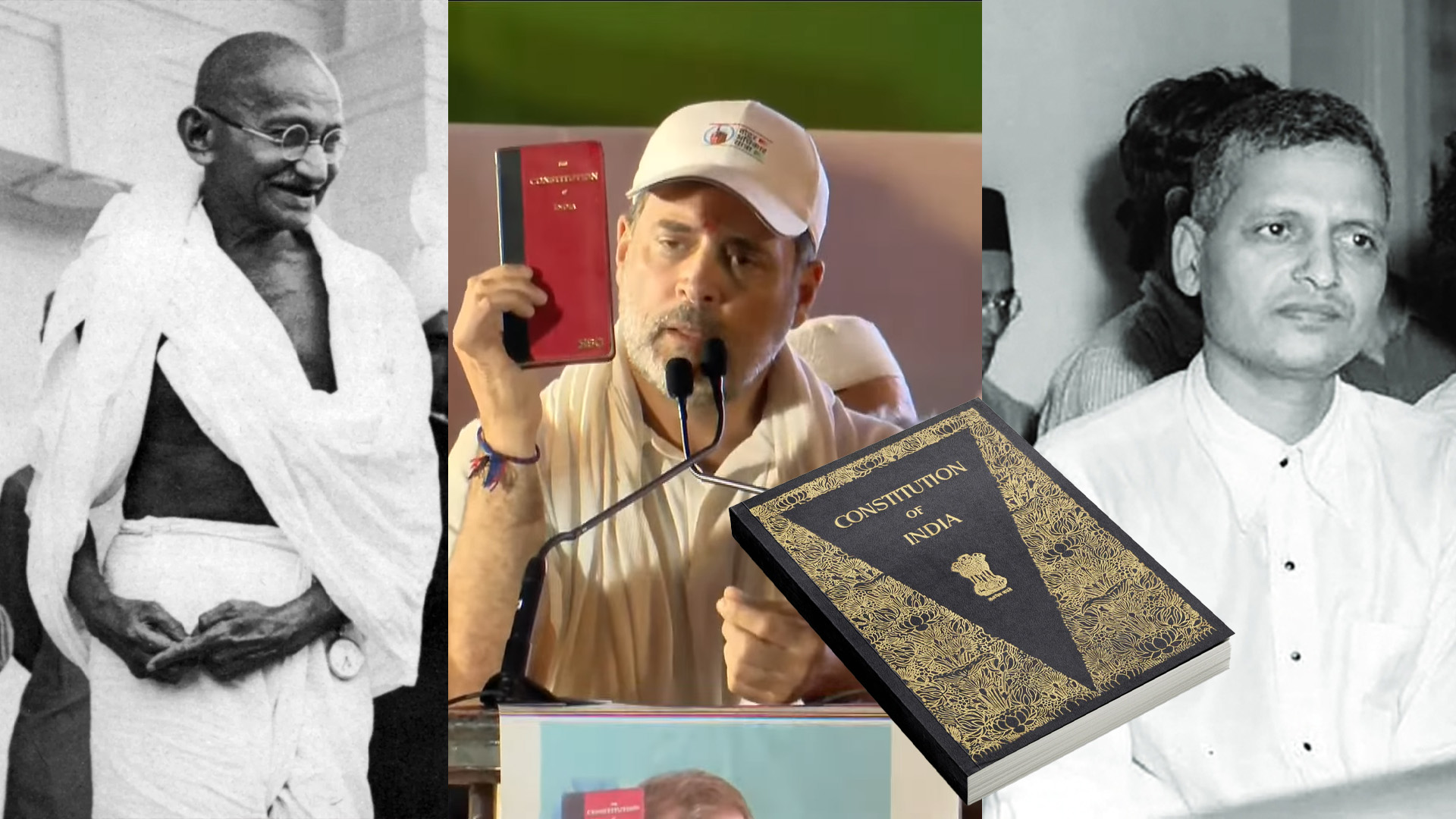
“Rahul Gandhi’s Katihar speech, where he linked Godse’s assassination of Mahatma Gandhi to the Constitution, reveals a troubling pattern of historical distortion—one where rhetoric takes center stage while facts are quietly set aside.”

Paromita Das
New Delhi, 26th August: Rahul Gandhi has, over the years, cultivated a reputation for fiery speeches that often lean more on rhetoric than on fact. His political style thrives on emotional appeals, yet it frequently blurs the line between history and storytelling. This tendency was once again on display on a humid Saturday in Katihar, where the Congress leader reached for his trademark red-bound copy of the Constitution. Holding it aloft before the crowd, he declared that Nathuram Godse assassinated Mahatma Gandhi because he hated the Constitution. He went even further, claiming that Gandhiji had “given his life” for the Constitution and asserting that the RSS and BJP had no role in shaping it.
The remarks were dramatic, designed to leave a lasting echo in the charged political battleground. Yet beneath the oratory lies a deeper problem: the historical timeline itself contradicts these claims. When Gandhi was killed in 1948, the Constitution of Bharat had not even been drafted, let alone adopted. To suggest otherwise is not just an exaggeration—it is a distortion of history. And in moments like this, Rahul Gandhi reveals how easily political passion can be turned into a tool for bending facts to fit a convenient narrative.
महात्मा गांधी जी ने इस देश और संविधान के लिए अपनी जिंदगी दे दी।
गोडसे संविधान के खिलाफ था, उससे नफरत करता था, इसलिए उसने गांधी जी की गोली मारकर हत्या कर दी।
देश में इन दो विचारधाराओं की लड़ाई चल रही है।
: 'वोटर अधिकार यात्रा' में नेता विपक्ष श्री @RahulGandhi
📍 कटिहार,… pic.twitter.com/uLyapwjZd3
— Congress (@INCIndia) August 23, 2025
The Historical Timeline That Refutes the Claim

Mahatma Gandhi was assassinated on January 30, 1948. Nathuram Godse was executed on November 15, 1949. Both these events occurred well before Bharat formally adopted its Constitution on November 26, 1949, which came into effect on January 26, 1950.
When Gandhi was killed, the Constitution quite literally did not exist. The drafting committee led by B. R. Ambedkar was only appointed in August 1947, and the first draft was presented to the Constituent Assembly on February 21, 1948—nearly a month after Gandhi’s assassination.
In other words, Godse could not have hated something that had not been written yet, and Gandhi could not have sacrificed his life defending something that did not exist during his lifetime.
Gandhi and the Constitution: The Reality

It is also crucial to note that Mahatma Gandhi was not a member of the Constituent Assembly. In the period leading up to independence, he was already marginalized from the formal political process. The interim government was formed without him, and the drafting of the Constitution proceeded without his direct involvement.
Yes, Gandhi had ideas about what Bharat’s future governance should look like—most notably, his vision for village-based self-rule—but these ideas were largely set aside by the drafters of the Constitution, who envisioned a centralized parliamentary democracy.
Therefore, to suggest that Gandhi “gave his life for the Constitution” is not only misleading but also disregards the fact that his proposals were never formally adopted.
The Role of Godse and His Affiliations

Rahul Gandhi’s claim also muddles the role of Godse. Nathuram Godse was associated with the Akhil Bharatiya Hindu Mahasabha, a political group that, unlike the RSS, actually had representation in the Constituent Assembly. In fact, contrary to Rahul Gandhi’s accusations, the organization with which Godse was affiliated did participate in the constitutional debates.
This alone contradicts the idea that Gandhi’s assassin was fundamentally opposed to the Constitution. His motivations, documented extensively in his trial and writings, were rooted in ideological opposition to Gandhi’s politics, particularly his stance on partition and his perceived appeasement of Muslims—not any hatred of a document that didn’t yet exist.
The Misuse of History in Political Rhetoric

Rahul Gandhi’s statements reveal a broader issue in Bharatiya politics: the casual manipulation of history for political messaging. His claim that the BJP and RSS “did not bring the Constitution” is itself a distortion. The BJP, as we know it today, did not even exist during the time of drafting; it was founded in 1980. The RSS, meanwhile, is a cultural organization, not a political party, and had no formal role in writing the Constitution.
Ironically, those associated with Godse’s organization—the Hindu Mahasabha—actually did have a role in the Assembly. Thus, the simplified narrative Rahul Gandhi put forward not only misses the truth but also flips the facts on their head.
Why Accuracy Matters in Public Discourse

Political theater often thrives on exaggeration, but when it comes to figures like Mahatma Gandhi and foundational documents like the Constitution, accuracy matters. Gandhi’s assassination is one of the most painful chapters in modern Bharatiya history. To tie it falsely to the Constitution risks not only misleading the public but also diminishing the gravity of the actual historical record.
Rahul Gandhi’s words may have been intended as a passionate defense of constitutional values in today’s political climate. However, defending the Constitution cannot come at the cost of distorting history. If anything, true respect for the Constitution demands an honest reckoning with the facts.
Learning from the Past, Not Rewriting It
The story of Bharat’s Constitution is itself a saga of resilience, debate, and democratic aspiration. Its birth was not tied to Gandhi’s assassination, but to the painstaking work of the Constituent Assembly and the leadership of Ambedkar, Nehru, and others who labored over its drafting.
By inaccurately linking Godse’s actions to the Constitution, Rahul Gandhi risks trivializing both Gandhi’s sacrifice and the actual history of the nation’s founding charter. Bharat’s democracy deserves better than historical shortcuts. It deserves leaders who will uphold truth while defending constitutional values.
History, after all, is not a prop for rhetoric—it is the foundation of a nation’s identity. And on that foundation, facts must stand firmer than slogans.
