
Tarun Chugh’s Attack on Congress
Rahul Gandhi Dancing to the “Deep State’s” Tune

Poonam Sharma
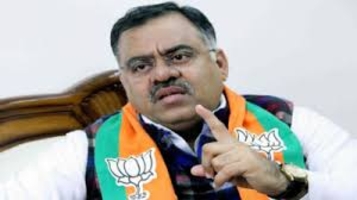
Launching a blistering attack on Congress leader Rahul Gandhi, BJP’s National General Secretary Tarun Chugh accused him of acting under the influence of a “deep state”-a hidden network allegedly working in concert to weaken India’s democratic institutions and destabilize the Modi government. Citing a recent Karnataka High Court judgment, Chugh said the Congress and Rahul Gandhi are guilty of deliberately defaming constitutional institutions for political gain.
The Deep State Allegation
Tarun Chugh’s remarks came amidst the growing tension between the BJP and the Congress over what the BJP termed a “calculated campaign” to defame India’s judiciary, Election Commission, and investigative agencies. In his view, Rahul Gandhi’s recent statements and Congress’s orchestrated attacks on constitutional institutions mirrored the agenda of forces that seek to undermine India’s sovereignty from within.
He said, “Rahul Gandhi is not speaking for India; he is echoing the voice of the deep state. Every time the government moves ahead to protect national interests, the Congress rushes to question the credibility of India’s institutions. This isn’t dissent; it’s a design.”
The BJP leader argued that such actions are part of a global network that has long sought to dent nationalist governments, particularly those which challenge the ideological hegemony of the West. Chugh contended that “the so-called ecosystem”-comprising NGOs, foreign-funded lobbies, and certain media groups-uses leaders like Rahul Gandhi as their political tools.
Reference to Karnataka High Court Judgment
Chugh drew particular attention to the Karnataka High Court’s recent ruling, which criticized Congress’s “reckless political rhetoric” against judicial independence. The court, while dismissing a petition filed by a Congress-linked entity, reportedly observed that politicians must be responsible while commenting on judicial processes, as their words had the potential to dent people’s trust in institutions.
“Even the judiciary has now taken note of Congress’s pattern of disrespect,” Chugh asserted. “It’s clear that Rahul Gandhi’s statements are not accidental. They are part of a deliberate strategy to delegitimize the judiciary whenever it does not favor their political interests.”
He said this was a pattern that had played out in the Congress narrative for years — whether in the response to court judgments on the Ayodhya verdict, Article 370 or corruption investigations involving Congress leaders.
From Criticism to Conspiracy
What makes Congress’s behavior dangerous, according to Chugh, is that it’s no longer limited to political criticism. “They are systematically trying to create public distrust against every pillar of democracy,” he said.
He said that Rahul Gandhi and his advisors have been using the term “institutional capture” to describe India’s governance structure—a phrase Chugh says has been imported from Western liberal circles that refuse to accept India’s rise as a self-confident, nationalist democracy.
“This language of ‘institutional capture’ or ‘democratic backsliding’ is the vocabulary of the deep state,” Chugh added. “They want to weaken the Indian model of democracy, which combines strength with sovereignty. Congress, knowingly or unknowingly, is helping them do it.”
Foreign Hand and Political Opportunism
The BJP leader also hinted at external influence, saying that several foreign organizations and think tanks who praise Rahul Gandhi’s rhetoric are the same ones that have consistently criticized India’s internal security policies and its assertive stand on terrorism.
“Whenever India takes a tough stand on national security-be it against Pakistan, China, or internal threats-the same lobby becomes active,” Chugh said. “It is no coincidence that Rahul Gandhi’s statements abroad mirror the talking points of these groups.”
He added that under Rahul Gandhi, the Congress’s approach has gone beyond opposition politics; it borders on undermining India’s international image: “When a leader of the principal opposition party repeatedly questions the fairness of India’s elections, judiciary, and media before foreign audiences, he isn’t strengthening democracy; he’s weakening it.”
BJP’s Counter-Narrative: Nationalism vs Negativity
Chugh framed the battle between the BJP and Congress not as a routine political rivalry but as one between nationalism and negativity. “The Modi government is working to make India self-reliant, respected, and secure. But the Congress, under the influence of the deep state, keeps projecting India as a broken democracy,” he said.
He contrasted Prime Minister Narendra Modi’s vision of a confident, reforming India with what he called Congress’s “imported pessimism.” According to Chugh, this ideological clash defines the current phase of Indian politics: the BJP represents the will of a resurgent nation, while Congress is stuck in the mindset of dependency and appeasement.
The Provocation Pattern of Rahul Gandhi
Chugh further referred to the earlier controversies of Rahul Gandhi, from remarks about the “death of democracy in India” while talking abroad, to his criticism of the Election Commission and questioning of judicial verdicts in corruption cases.
“Every time the judiciary exposes corruption or upholds the Constitution, Rahul Gandhi claims there is a conspiracy. This is not leadership, this is reckless obstructionism,” Chugh said.
He argued that instead of learning from electoral defeats, Congress has chosen to delegitimize the institutions that hold them accountable. “The people of India have rejected dynasty politics repeatedly. But instead of introspection, the Congress leadership blames the system, the media, and the judiciary,” he added.
The Larger Message Chugh’s attack reflects the BJP’s growing confidence in portraying the Congress as an outdated force trapped between dynastic arrogance and foreign ideological influence. The comments also resonate with a larger narrative within the BJP that tends to speak of the “ecosystem”-a motley mix of political, academic, and media voices-that supposedly conspires in unison to malign the Modi government both nationally and internationally. Concluding, Chugh said the Congress must desist from insulting the democratic framework of the nation in order to achieve political mileage. “Rahul Gandhi needs to decide — will he stand with India’s Constitution or with the forces trying to weaken it?” he said. “The deep state wants a weak India. The BJP wants a strong, self-reliant India. The people must choose which side they stand on.”
