
Rahul Gandhi Abroad: When Optics Outrun Strategy
“Inside Rahul Gandhi’s secretive foreign visits, political optics, and the Colombia slip-up that exposed Congress’s digital misfire.”

Paromita Das
New Delhi, 22nd October: In politics, timing and perception matter as much as intent. And for Congress leader Rahul Gandhi, both seem to slip out of sync whenever he embarks on a foreign visit — especially when those visits spark more curiosity than clarity. His recent and sudden travels to Malaysia and later to Colombia once again ignited speculation, criticism, and confusion — this time not merely about secrecy, but about credibility.
A Journey Cloaked in Secrecy

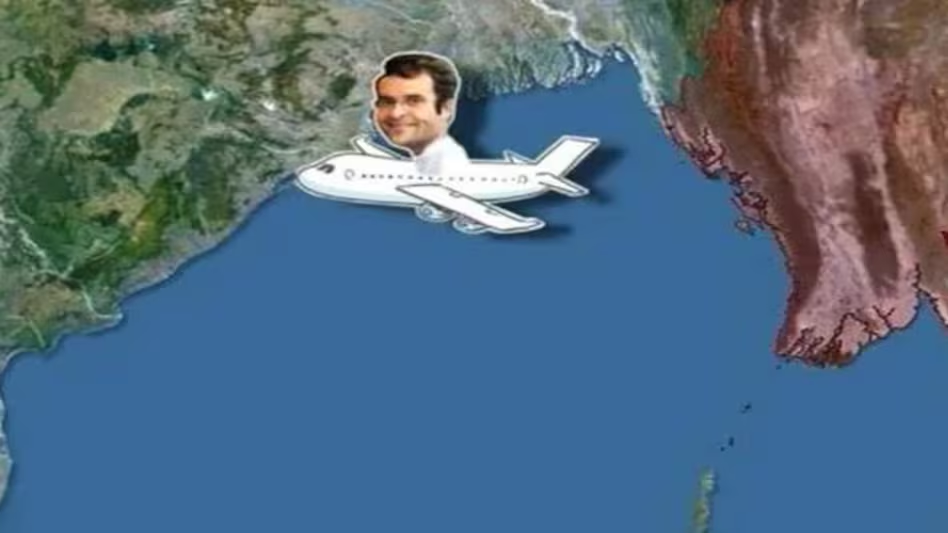
On September 4, Rahul Gandhi quietly departed Bharat without prior notice or official briefing. Within hours, two viral photographs surfaced from Malaysia — one showing him interacting with women in traditional attire, another capturing him riding a scooter. These images were enough to set social media abuzz, forcing the political narrative into overdrive.
Later, it was confirmed that Gandhi was indeed on a private visit to Malaysia. But what followed drew sharp reactions from the Central Reserve Police Force (CRPF). Its Director General reportedly wrote to both Rahul Gandhi and Congress president Mallikarjun Kharge, criticizing the lack of communication regarding Gandhi’s frequent travels abroad — six times in nine months — without sharing details with his security personnel. The letter questioned not only operational safety but also transparency, leaving Congress in a defensive spiral.
Congress Faces A Narrative Crisis

The CRPF letter hit the Congress at a vulnerable moment, amplifying doubts about Rahul Gandhi’s political seriousness. Critics within and outside the party began asking: What drives these unannounced tours? The party, caught off guard, appeared unprepared to handle the optics.
When October arrived, another trip began — this time to South America. Bound for Colombia, the Congress tried to act smarter. This time, spokesperson Pawan Khera openly declared Gandhi’s visit as an international outreach to students, political leaders, and business communities. Yet Congress’s attempt to pre-empt controversy only led to a much bigger blunder.
The Colombia Confusion

In Colombia, reports surfaced that Rahul Gandhi sought to meet President Gustavo Petro. But according to multiple sources, the Colombian president declined the meeting, citing lack of alignment in agenda and scheduling priorities. For Gandhi’s social media team, it was a setback that desperate optics soon tried to repair.
.@SupriyaShrinate ji, Please tell your IT Cell chamche that
Lidio García is not the President. He is the President of the Colombian Senate.. Like the Speaker in India.
The President of Colombia is Gustavo Petro, and he REFUSED to meet Rahul Gandhi pic.twitter.com/9yEoskXl1Z
— Gaurav Pradhan 🇮🇳 (@OfficeOfDGP) October 2, 2025
Shortly afterward, Congress leaders began circulating photographs of Rahul Gandhi meeting a Colombian official named Lidio García, who happens to be the Senate President — not the nation’s head of state. The team’s captions, however, claimed Gandhi had met “Colombia’s President.” Once cross-verified by journalists and fact-checkers, the truth emerged — the meeting was misrepresented. What was meant as an image-boosting exercise quickly became a PR embarrassment.
Digital Optics and Political Damage

In an age where social media narratives often overshadow ground realities, even a minor slip can spiral into a credibility crisis. The digital generation — particularly the politically aware Gen Z — spotted the mismatch instantly. Online users pointed out that Gustavo Petro, not Lidio García, is the Colombian president, turning Congress’s publicity exercise into a national laughingstock.
What was intended to display international statesmanship ended up reinforcing criticism that Rahul Gandhi is poorly advised and detached from geopolitical awareness. Worse, voices from Colombian media echoed concerns that the deceptive portrayal could be diplomatically disrespectful, undermining Bharat’s image abroad.
Rhetoric vs. Reality

Gandhi’s critics argue that his foreign tours have often been accompanied by damaging rhetoric about Bharat’s democracy and governance, statements that tend to echo opposition talking points abroad. This pattern, they claim, erodes his domestic credibility while alienating international leaders who prefer engagement with sitting governments. In contrast, Prime Minister Narendra Modi’s visits are backed by the formal weight of office and national representation, creating a global outreach that Rahul Gandhi’s informal trips cannot parallel.
When Gandhi’s team attempts to project symbolic diplomacy — using casual meetings as proof of political relevance — it often backfires. The perception that Congress manipulates global optics to stay politically afloat has now become a recurring theme in Bharat’s digital discourse.
A Lesson in Political Optics

Politics today lives under relentless scrutiny. Rahul Gandhi’s repeated missteps in foreign outreach highlight not just miscommunication, but misjudgment. His instinct for engagement may be valid — connecting with global youth, thinkers, and leaders is essential — but messaging must match political gravity. Optics without authenticity invites ridicule.
Congress’s IT team, by confusing a Senate leader for a head of state, didn’t merely commit a factual error; it compromised the party’s credibility at a fragile moment. In democratic politics, opposition leaders can and should maintain global connections — but those ties must be transparent, purposeful, and truthful.
Between Intent and Image
Rahul Gandhi’s Malaysia and Colombia episodes together narrate a cautionary tale. They underscore the widening gap between Congress’s intentions and its execution in public communication. While Gandhi’s outreach might stem from a desire to connect globally, his approach continues to fuel questions about leadership maturity and strategic awareness.
For a political party aspiring for national revival, substance must replace spectacle. The real challenge before Rahul Gandhi is not where he travels, but how those journeys are perceived — and whether he can shift from control.
