
Qatar amends Pakistan-Afghanistan ceasefire statement, removes ‘border’ ref

By Anjali Sharna
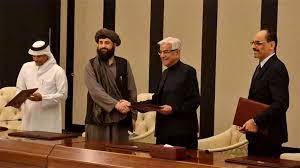
WASHINGTON – Qatari Ministry of Foreign Affairs on Monday updated its official statement on the recent ceasefire agreement between Pakistan and Afghanistan removed the word “border”, which had drawn widespread reaction from Afghan officials.
According to Tolo News, Afghan officials had linked the “border” reference to the Durand Line, which marks the boundary between Afghanistan and Pakistan.
Qatar’s Ministry of Foreign Affairs had expressed optimism that the ceasefire would help de-escalate tensions along the Pakistan-Afghanistan border.
“The Ministry of Foreign Affairs expressed the State of Qatar’s hope that this important step will contribute to ending tensions on the border between the two brotherly countries and form a solid foundation for sustainable peace in the region,” the statement read.
Qatar’s MoFA updated the statement, stated “The Ministry of Foreign Affairs expressed the State of Qatar’s hope that this important step will contribute to ending tensions between the two brotherly countries and form a solid foundation for sustainable peace in the region.”
The Ministry removed the phrase “on the border between the two brotherly countries” from the earlier version, replacing it with “between the two brotherly countries” in the revised statement.
Afghanistan’s Minister of Defence, Mohammad Yaqoob Mujahid, during an online press conference, who led the Afghan delegation to Doha for peace talks with Islamabad, said that no discussion took place on the Durand Line during the negotiations, pointing out that the issue is a matter between nations, Tolo News reported.
The Durand Line, established in the Hindu Kush in 1893, connected Afghanistan and British India via tribal lands.
It is a legacy of the 19th-century Great Game between the Russian and British empires in which Afghanistan was used as a buffer by the British against a feared Russian expansionism to its east.
The agreement demarcated what became known as the Durand Line was signed between the British civil servant Sir Henry Mortimer Durand and Amir Abdur Rahman, then the Afghan ruler, in 1893.
Abdur Rahman became king in 1880, two years after the end of the Second Afghan War, in which the British took control of several areas that were part of the Afghan kingdom. His agreement with Durand demarcated the limits of his and British India’s “spheres of influence” on the Afghan “frontier” with India.
The 7 clause agreement recognized a 2,670-km line, which stretches from the border with China to Afghanistan’s border with Iran.
Pakistan inherited the Durand Line with independence in 1947 and with it also the Pashtun rejection of the line and Afghanistan’s refusal to recognize it.
