
Putin Meets Tharoor, Not Rahul: What Gandhi’s Exclusion Really Signals
“Why Rahul Gandhi Was Left Out: Decoding the Politics Behind Putin’s Delhi Diplomacy”

Paromita Das
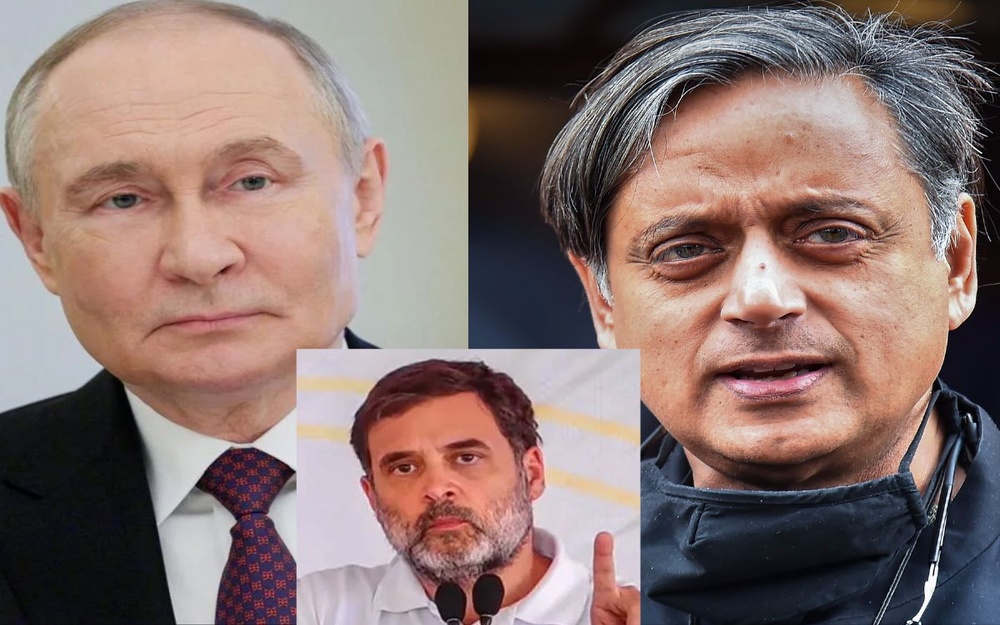
New Delhi, 8th December: When Russian President Vladimir Putin arrived in Bharat for a tightly curated diplomatic engagement, one detail drew more attention than the event itself: the empty chair that should have belonged to Rahul Gandhi. As the Leader of the Opposition in the Lok Sabha, Gandhi’s absence stirred immediate speculation—especially since fellow Congress leader Shashi Tharoor received an invitation.
But this wasn’t merely a matter of seating arrangements. It was a window into the shifting balance of political credibility, diplomatic expectations, and the evolving role of Bharat’s opposition leadership. Gandhi’s omission from such a critical meeting reveals more about today’s political realities than party statements or official protocols care to admit.
The Weight of Absence: When Presence Is a Political Statement
In recent years, Rahul Gandhi’s sporadic appearances at national events—most notably his absence from Independence Day ceremonies—have raised eyebrows even within his own political circle. The Leader of the Opposition occupies a pivotal role in the nation’s democratic architecture, one that demands visibility, consistency, and presence during symbolic moments.
Repeated absences erode political capital. They create the perception, fair or not, that Gandhi’s commitment wavers during critical national occasions. Diplomacy thrives on continuity, symbolism, and reliability—and optics matter as much as policy. When a leader is missing at home, doubts inevitably arise about their place on the global stage.
When Words Travel Across Borders
Another major factor shaping Gandhi’s exclusion is the controversy surrounding his public endorsement of former U.S. President Donald Trump’s claim that the Bharatiya economy was “dead.”
Political disagreements at home are part of democracy. But endorsing a foreign leader’s negative appraisal of one’s own country crosses into a sensitive space—especially in the realm of global diplomacy. Supporters saw Gandhi’s agreement as a critique of government policy. Critics interpreted it as a slight against Bharat itself.
What matters in diplomacy is perception—and this perception cost Gandhi political goodwill at a moment when nations are recalibrating alliances and projecting strength. Endorsing external criticism of one’s own nation rarely aligns with diplomatic etiquette, and such commentary inevitably shapes who is invited to represent Bharat at crucial international engagements.
Protocol or Preference? The Truth Behind Invitations
Contrary to popular belief, Bharat has no mandated rule requiring the Leader of the Opposition to participate in all diplomatic interactions. Invitations are strategic choices, not ceremonial obligations.
Thus, who is invited—and who isn’t—depends on expertise, international experience, and the image Bharat seeks to project to the world. In that context, Shashi Tharoor’s presence begins to make perfect sense.
A former diplomat, former UN Under-Secretary-General, and an articulate voice on global policy, Tharoor carries the kind of credibility required in conversations with a geopolitical heavyweight like Putin. His participation is not a slight against Gandhi but a calculated decision based on skill, substance, and suitability.
The Domestic–Global Divide in Rahul Gandhi’s Politics
Rahul Gandhi’s political voice resonates strongly in domestic debates—employment, inequality, polarization, social justice. This focus, however, has also limited his relevance in the increasingly critical terrain of foreign policy.
International meetings operate on different rhythms. They demand fluency in geopolitics, strategic nuance, and deep familiarity with shifting global power equations. Gandhi’s engagement in this sphere has been minimal, making his absence from such meetings neither surprising nor unprecedented.
His omission thus fits a larger arc: Gandhi’s political identity today leans toward activism at home rather than statesmanship abroad.
What This Means for the Opposition’s Role
Bharat’s democratic structure gives the Leader of the Opposition a formidable platform. But this platform does not automatically translate into a diplomatic role. Participation in international forums depends on political judgment, consistent engagement, and the ability to represent national interest beyond party lines.
The episode signals a recalibration of the expectations placed on opposition leadership. It pushes for a model where domestic advocacy must be matched by global competence. A leader who aspires to future national leadership cannot remain peripheral to Bharat’s foreign policy conversations.
A Moment of Reckoning for Rahul Gandhi
Rahul Gandhi’s exclusion from the Putin meeting is not simply a political snub—it is a moment of reflection. A leader aiming to shape Bharat’s future needs to be present in both arenas: the heated streets of domestic politics and the layered corridors of diplomacy.
His absence underscores a growing mismatch between the position he holds and the responsibilities it demands. The government’s preference for Tharoor demonstrates that credibility, discipline, and international fluency are non-negotiable in modern diplomacy.
More importantly, this episode shows that global politics is no longer a spectator sport. Bharat’s international posturing requires leaders who embody consistency, maturity, and a national-first approach—not merely a strong opposition voice within Parliament.
More Than an Empty Chair
Rahul Gandhi’s missing seat at the meeting with Vladimir Putin symbolizes more than protocol—it reflects how political credibility is earned, maintained, and assessed in a rapidly changing global landscape. His public endorsement of foreign criticism, his absence from national ceremonies, and his limited diplomatic engagement all contributed to this choice.
Meanwhile, Shashi Tharoor’s selection highlights how expertise and experience trump political hierarchy in moments of strategic importance.
In the end, diplomacy rewards readiness. And in this case, Rahul Gandhi’s absence speaks louder than his words—a reminder that leadership in a globalized world demands far more than parliamentary titles. It demands presence, perception, and purpose.
