
Prof. Satish Chandra Mittal: A Beacon of Nationalist Historiography

Dr. Kumar Rakesh
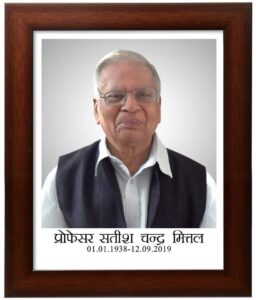
In the vast firmament of Bharatiya history, Prof. Satish Chandra Mittal shone like a brilliant star, whose writings brilliantly connected history with national consciousness. Moving beyond Western frameworks, he placed Bharatiya tradition, culture, and patriotism at the heart of historical scholarship, charting a new direction in historiography. Active until his final moments, he was not merely a historian but also a thinker, a karma-yogi, and a guardian of national duty. His works continue to inspire young historians and call for a redefinition of history from an Bharatiya perspective.
Life and Nationalist Vision
Born on 12 September 1938, Prof. Satish Chandra Mittal was a pioneer in the stream of Bharatiya historiography that centered Bharatiya perspectives in contrast to Western interpretations. As a senior professor of Modern Bharatiya History at Kurukshetra University, he not only excelled in teaching but also linked history with Bharatiya culture, tradition, and national sentiment. He served as a member of the Ministry of Culture’s Central Advisory Board, a member of the Bharatiya Council of Historical Research (ICHR), and was a Gurukul fellow.
Association with the All India History Compilation Scheme
Prof. Mittal was among the founding members of the All India History Compilation Scheme (Abhiy Yojana), an organization dedicated to authentic and nationalist historical writing in Bharat. He remained active as the national president of this initiative until his last days, living the spirit of the scheme’s guiding principle, “Navadridha Sankalpam”, throughout his life.
Thoughts and Contributions
Prof. Mittal’s research focused on the freedom movements in Punjab and Haryana. For him, history was not just a record of events; it was a carrier of national consciousness. He believed that Bharatiya history should be presented in its authentic roots, highlighting its heroes and its cultural identity.
Literary and Scholarly Works
Prof. Mittal authored over three dozen books and approximately 500 research articles. His notable works in English include Freedom Movement in Punjab (1905-1929), Sources on National Movement in India (1919-1920), India Distorted (three volumes), and Modern India.
In Hindi, he produced timeless works such as Bharat Mein Rashtriyata Ka Swaroop, Bharat Ka Swadhinata Sangram, 1857 Ki Mahaan Kranti Ka Vishva Par Prabhav, Swami Vivekananda Ki Itihaas Drishti, Samyavad Ka Sach, and 1857 Ka Swatantra Samar – Ek Punaravalokan. His writings were not merely chronicles of historical events but also documents capturing the vibrancy of the Bharatiya spirit.
Cultural and Educational Contributions
He was also involved in managing schools under Vidya Bharati in Haryana, believing that nationalist education and values were essential to guiding historical scholarship. He voiced strong opposition to factual inaccuracies in Wendy Doniger’s controversial book The Hindus: An Alternative History.
Personality and Inspiration
Throughout his life, Prof. Mittal embodied diligence, simplicity, and patriotism. He set benchmarks in the field of history that will continue to inspire future generations. The lines from the Abhiy Yojana, “Pragatipathan Nahi Vichlem, Parampara Sanraksham”, truly reflected the essence of his life.
Final Moments and Legacy
Prof. Mittal passed away on 12 September 2019. His departure marked an irreplaceable loss for nationalist Bharatiya historiography. Yet, his personality, scholarship, and tireless work remain an enduring source of inspiration. The tradition he began—history infused with Bharatiya consciousness and national sentiment—continues to thrive.
Prof. Satish Chandra Mittal was not merely a historian; he was a carrier of nationalist awareness, a guardian of culture, and a pioneer guiding history-writing in a new direction. His writings, ideas, and life remind us that history is not just a record of the past but a foundation for shaping the future. On his death anniversary, paying homage to him is also paying respect to the stream of Bharatiya historiography that places national consciousness at its core.
