
Prof. M.M. Goel Champions Ethical Integration of Law and Economics through Needonomics for Achieving Justice with Efficiency at RGNUL Workshop

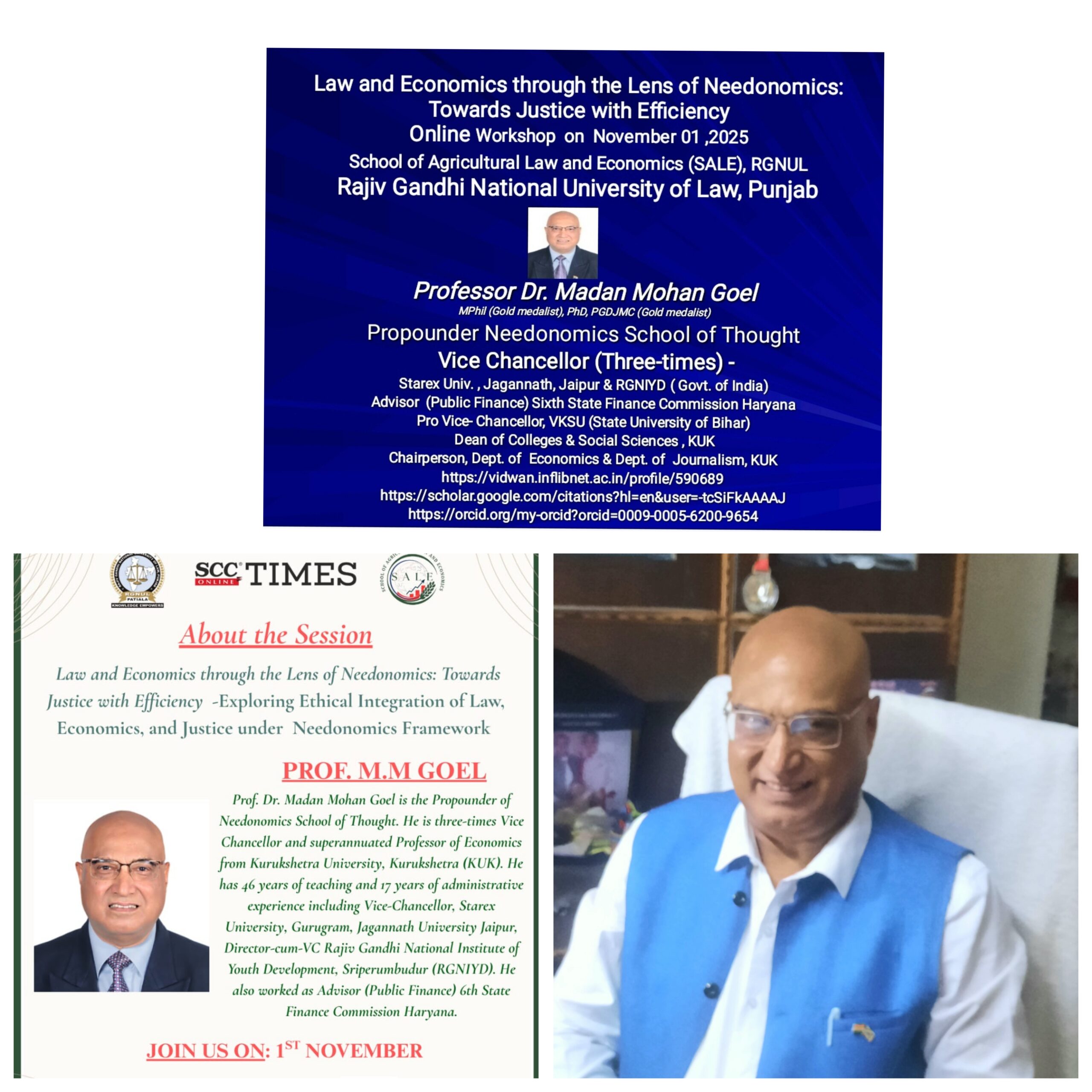
Patiala, 2nd November: The School of Agriculture, Law and Economics (SALE) at Rajiv Gandhi National University of Law (RGNUL), Punjab, organized a Workshop on Law and Economics today on the interconnections between justice and economic efficiency.
Prof. Madan Mohan Goel, Proponent of Needonomics Former Vice-Chancellor (Thrice), and Superannuated Professor of Kurukshetra University delivered a thought-provoking address on the theme “Law and Economics through t
he Lens of Needonomics: Towards Justice with Efficiency.” The session explored the ethical integration of law, economics, and justice within the Needonomics framework. Dr. Brindpreet Kaur presided over the event.
The workshop began with a welcome address by Mr. Gurmander Singh, Convener of the event, who also introduced Prof. M.M. Goel to the participants.
Prof. Goel expressed his gratitude to Ms. Eti Gupta, Co-Convener, for recommending his name for the invitation and acknowledged her contribution to promoting interdisciplinary discourse at RGNUL.
In his address, Prof. Goel emphasized that the Needonomics School of Thought (NST) envisions a transformative approach to understanding the intersection of legal systems and economic efficiency, guided by ethical imperatives derived from human needs rather than greed. He observed that while law and economics are two fundamental pillars of governance ensuring fairness, order, and prosperity, the absence of a value-based orientation can reduce law to an instrument of exploitation rather than justice.
The Needonomics framework, he explained, introduces an ethical correction by anchoring legal and economic interactions in the principle of need-based justice, thereby balancing efficiency with equity. Prof. Goel underscored that integration of economics and law is not merely academic but essential for sustainable governance in the 21st century.
Applying economic tools to legal frameworks, he said, can optimize resource allocation, foster innovation, and enhance justice delivery—provided that ethical and human considerations guide every decision.
Quoting the NST’s moral commitment—“We will not exploit anyone and we will not allow anyone to exploit”—Prof. Goel stressed that the healthy blending of duty and devotion, the outer and inner worlds, is necessary for law and economics to serve humanity effectively. He warned that efficiency without moral direction can become exclusionary, and called for grounding economic reasoning in the principles of moderation, equity, and compassion.
Under the Needonomics vision, law becomes an instrument of justice, economics a means of need-fulfillment, and together they form the foundation of a sustainable and humane society. Prof. Goel concluded that the future of policy, research, and education lies in fostering “Justice with Efficiency – the Needonomic Way.”
