
Prof. M. M. Goel Analyses Union Budget 2026–27 Through Needonomics Lens at Maharaja Agrasen PG College

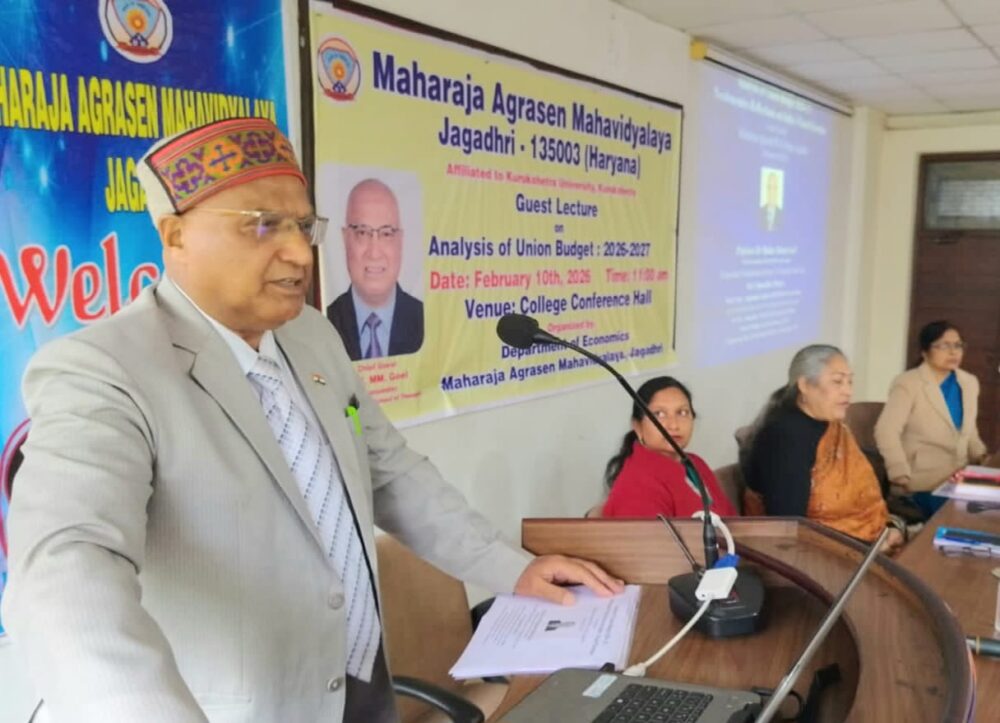
Jagadhri, February 10: Prof. Madan Mohan Goel, Propounder Needonomics School of Thought, former Vice-Chancellor (thrice), and superannuated Professor of Kurukshetra University, delivered an invited lecture on “Analysis of Union Budget 2026–27: Needonomics Reflections on India’s Fiscal Priorities ” at Maharaja Agrasen PG College, Jagadhri.
Principal, Dr. Karuna presided the programme . Prof. Punam Garg, HOD Economics, delivered the welcome address and introduced Prof Goel.
Vice President of the Management Committee Praveen Goel, Secretary Dr. Ashwini Goel, Member Ambika Prasad were also present in the program.
Prof. Goel provided a critical overview of the Union Budget 2026–27 of the size of ₹53,47,315 crore and acknowledged that the provisions were necessary but not sufficient for Viksit Bharat. Prof. Goel observed that excessive reliance on sops makes the intent appear “fishy” rather than transformative. Highlighting taxpayers’ contribution, Prof. Goel noted that income-tax payers constitute 2.2% of India’s population and should be recognized as a minority, deserving targeted benefits and institutional protection. Justifying the 15 percent increase in defence expenditure to ₹5,94,585 crore, Prof. Goel clarified that the focus should not be limited to external threats alone, but must also address internal challenges such as unemployment and under-employment, particularly in agriculture. He linked this approach to the spirit of “Jai Jawan, Jai Kisan.” Artificial Intelligence received special attention in the Budget speech of Finance Minister made eleven explicit references to AI, mentioned Prof. Goel. He described AI as a force multiplier for governance, service delivery, and economic inclusion, while underscoring the need for ethical oversight.
Addressing education financing, Prof. Goel stressed the importance of effective utilization of the education cess to help states meet the financial requirements to implement National Education Policy , calling it a crucial step toward achieving Viksit Bharat.
Prof. Goel defended gender budgeting, stating that while such allocations may not always involve direct spending on women, they ultimately promote women’s empowerment by reshaping policy priorities.
He emphasized that stakeholders (consumers, producers, distributors, traders, and exporters) must become street SMART (simple, moral, action-oriented, responsive, and transparent), to contribute towards Viksit Bharat.
On this occasion Dr. V.S. Dhillon, Prof. Gourav Bareja, Prof. Seema Jain, Prof. Ritu, Prof. Sapna, Prof. Sapna, Prof. Sheetal, Prof. Neeraj gave positive cooperation.
