
President Murmu Unveils Rajaji Bust at Rashtrapati Bhavan
Droupadi Murmu says icons like Rajaji inspire India’s journey towards Viksit Bharat 2047

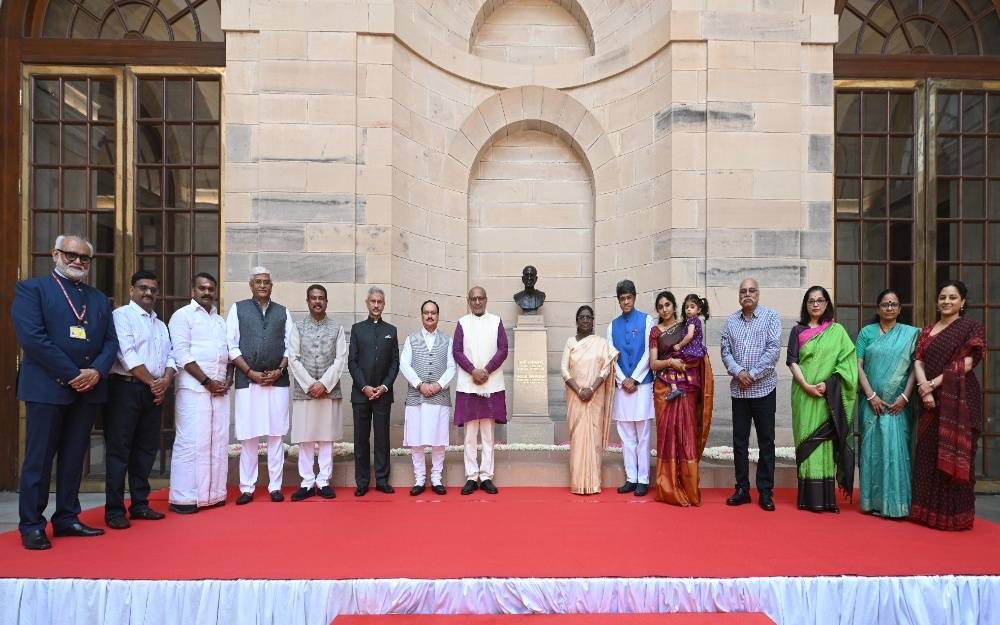
- Bust of Chakravarti Rajagopalachari unveiled at Rashtrapati Bhavan
- Replaces bust of British architect Edwin Lutyens
- President calls it a step towards mental decolonisation
- Rajaji exhibition open to public from February 24 to March 1
GG News Bureau
New Delhi, 23d Feb: President Droupadi Murmu on Sunday unveiled the bust of Chakravarti Rajagopalachari, the first and only Indian Governor-General of independent India, at Rashtrapati Bhavan, marking what she described as a milestone in shedding the vestiges of colonial legacy.
The bust, installed at the Grand Open Staircase near Ashok Mandap opposite the statue of Mahatma Gandhi, replaces the earlier bust of Edwin Lutyens. The initiative forms part of a broader effort to reinforce India’s civilisational confidence and national identity.
Addressing the gathering at the Rajaji Utsav held at the Rashtrapati Bhavan Cultural Centre, the President said that as India advances towards the goal of ‘Viksit Bharat’ by 2047, icons like Rajaji continue to inspire the nation with their ideals and vision.
She recalled that when Rajaji entered Government House—now Rashtrapati Bhavan—he placed portraits of Ramakrishna Paramahamsa and Mahatma Gandhi in his room, symbolising that Swaraj had already taken root in the hearts of Indians even while India was formally a Dominion. She described this as a powerful example of mental decolonisation.
The President highlighted that portraits of British officials who once lined the corridors of Rashtrapati Bhavan have now given way to the ‘Param Vir Dirgha’, honouring Param Vir Chakra awardees. She also noted the establishment of Granth Kutir to preserve India’s classical manuscripts and knowledge traditions.
Emphasising inclusivity, she said Rashtrapati Bhavan belongs to the people and has been opened, along with presidential estates in Shimla, Hyderabad and Dehradun, to citizens seeking to understand India’s democratic traditions and cultural heritage.
Recalling Rajaji’s multifaceted contributions—as a freedom fighter, jurist, writer, reformer and statesman—the President said his advocacy of Swadeshi and self-reliance continues to resonate in India’s present developmental journey.
Vice-President C. P. Radhakrishnan, who was present on the occasion, described the event as part of India’s ongoing transformation away from colonial influence across governance, law and national identity.
Among the dignitaries present were Union Ministers Dharmendra Pradhan and Gajendra Singh Shekhawat, among others.
A message from Prime Minister Narendra Modi was also read out, terming the installation of Rajaji’s bust at the historic courtyard a moment of pride and an important act of mental decolonisation.
An exhibition showcasing Rajaji’s life and work will remain open to the public from February 24 to March 1 at Amrit Udyan as part of the Rajaji Utsav celebrations.
