
PM Modi’s Stellar Vision: Tricolor to Fly on Bharat’s Future Space Station
“From the legacy of Aryabhata to the promise of Gaganyaan, PM Modi’s National Space Day 2025 speech shines as a declaration of Bharat’s cosmic confidence, its commitment to innovation, and its dream of building a home among the stars.”

Paromita Das
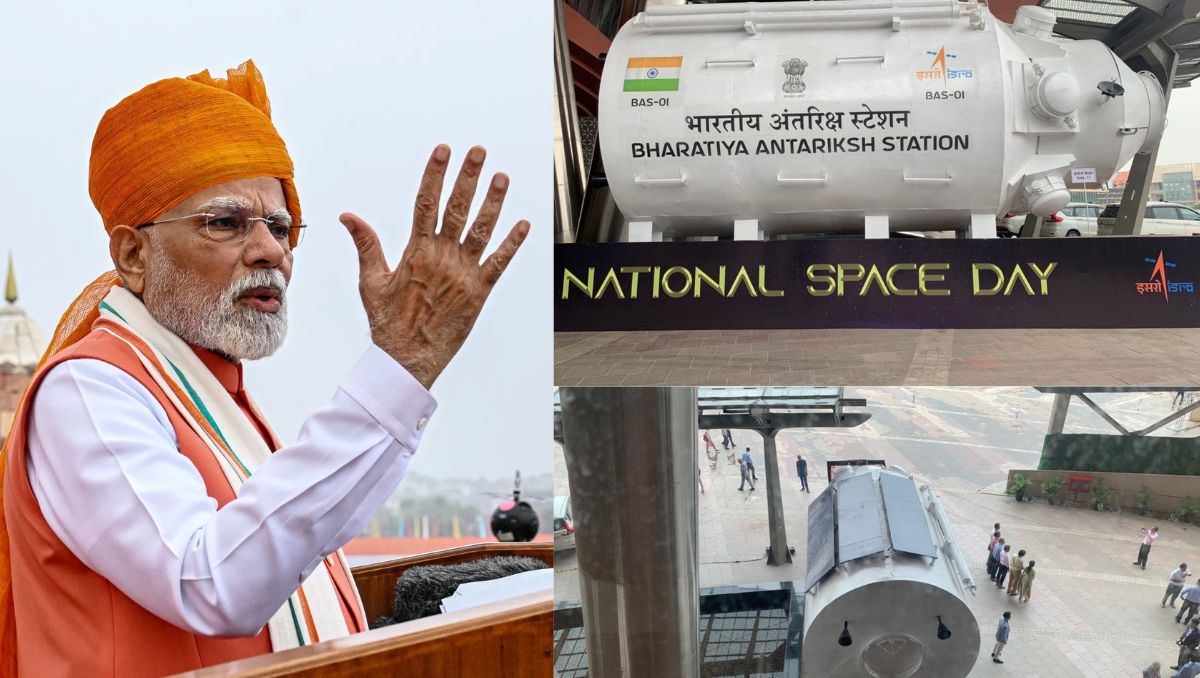
New Delhi, 26th August: When Prime Minister Narendra Modi addressed the nation on National Space Day 2025, the mood was unmistakably electric. Standing on the shoulders of Bharat’s space legacy, he announced the nation’s bold next step: an indigenous Bharatiya space station. The announcement came with a poetic theme—“Aryabhata to Gaganyaan: Ancient Wisdom to Infinite Possibilities”—a reminder of Bharat’s timeless curiosity about the cosmos and its new ambition to lead the next era of space exploration.
The Prime Minister’s speech was more than ceremonial; it was a roadmap of intent, fusing nostalgia with vision. By linking Aryabhata, Bharat’s first satellite, to the upcoming Gaganyaan human spaceflight, he painted a picture of continuity—a space journey that has only grown more daring over the decades.
Honoring a National Hero: Group Captain Shubhanshu Shukla
At the heart of the celebration was Group Captain Shubhanshu Shukla, who etched his name in history as the first Bharatiya astronaut to unfurl the Tricolour aboard the International Space Station (ISS). His achievement, Modi said, was more than symbolic—it embodied the “infinite dreams of New Bharat’s youth.”
The Prime Minister revealed plans for an “Astronaut Pool”, an initiative to systematically train and nurture future astronauts. By institutionalizing this pipeline, Bharat is preparing not just for one-off missions but for a sustained human presence in space.
The Space Station: Bharat’s Defining Milestone

The declaration of a homegrown space station marks a strategic leap. After successful lunar and Martian missions, this project positions Bharat among a small club of nations with ambitions for long-term space habitats. Modi’s words resonated with optimism:
“Bharat has reached the Moon and Mars; now, we must explore deeper into the cosmos. Soon, with the dedication of our scientists, Bharat will soar with Gaganyaan, and in the coming years, we will have our own space station.”
Such a project is not merely about national pride; it signifies scientific self-reliance, geopolitical stature, and the promise of new industries. From medical research in microgravity to advanced material studies, the applications are boundless.
Breakthroughs and Upcoming Missions

Modi highlighted semi-cryogenic engines, electric propulsion systems, and the readiness of the Gaganyaan mission as stepping stones to the space station. He emphasized that space exploration is not just a scientific pursuit but a key to solving human challenges—from climate change to sustainable energy.
Bharat’s earlier breakthroughs—like being the first to reach the Moon’s South Pole in 2023 and mastering docking technologies—are evidence that the nation has the technical maturity to push further.
Reform, Perform, Transform: Fueling the Private Space Ecosystem

The speech also carried a strong economic undercurrent. Over the past decade, reforms have opened Bharat’s space sector to private players, resulting in more than 350 startups driving innovation. Modi threw down a challenge:
- Can Bharat produce five space unicorns in five years?
- Can launch capacity scale from 6 to 50 missions annually?
He assured the private sector of full government support, hinting at the possibility of Bharat becoming a global space hub, powered not just by ISRO but also by entrepreneurs.
The upcoming launch of the first privately-built PSLV rocket and communication satellite further signals this paradigm shift.
Space Technology in Everyday Life

The Prime Minister reminded citizens that space is not an abstract frontier but an everyday enabler. From satellite-based crop insurance and fishermen’s navigation alerts to disaster management systems and infrastructure planning under the PM Gati Shakti initiative, space technology is deeply woven into daily life.
His assertion was clear: space is no longer confined to scientists—it belongs to the people.
Inspiring the Next Generation

Another highlight was Modi’s focus on youth. Initiatives like the Bharatiya Space Hackathon, Robotics Challenge, and hosting of the International Olympiad on Astronomy and Astrophysics are igniting curiosity among students. With medals already flowing in, Bharatiya students are stepping onto the world stage with confidence.
“The infinite expanse of space reminds us there is no final destination,” Modi declared, urging young innovators to see themselves as “torchbearers of the space revolution.”
Why This Moment Matters

Bharat’s ambition to build a space station is both timely and transformative. The global space race is no longer a duel between the U.S. and Russia—it’s multipolar, with China, Europe, and now Bharat asserting influence. For Bharat, this isn’t just about prestige; it’s about strategic autonomy, technological leadership, and economic opportunity.
By embedding space into agriculture, governance, and entrepreneurship, Modi has reframed it as a people’s mission, not just a scientist’s pursuit. The inclusion of private startups ensures that Bharat’s space journey will be sustainable, innovative, and competitive.
Yet, challenges remain: funding, talent retention, and the complexities of long-duration space missions. But if Bharat’s history of frugal yet impactful innovation is any guide, these hurdles may become stepping stones.
A Nation Rising Beyond the Horizon
From Aryabhata in 1975 to the upcoming Gaganyaan mission, Bharat’s space story has always been about achieving the improbable. PM Modi’s National Space Day 2025 address cements the idea that the sky is no longer the limit—it is merely the beginning.
With an astronaut pool, a thriving startup ecosystem, and the vision of a space station, Bharat is no longer a participant in the space race—it is shaping its very future.
The Prime Minister’s closing words captured the essence of this journey: Bharat’s march to the stars has only just begun, and the world would do well to watch closely.
