
PM Modi’s Five-Nation Tour: A Quiet Revolution in Bharat’s Global Diplomacy

Paromita Das
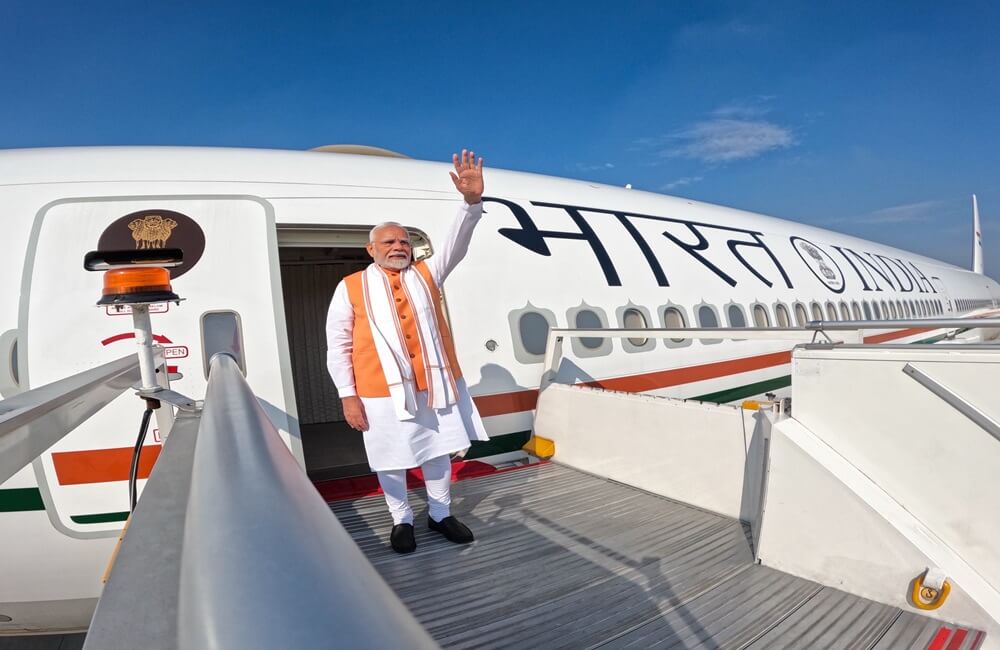
New Delhi, 3rd July: It is no small thing when the leader of the world’s most populous country steps onto the tarmac in Accra, Port of Spain, Buenos Aires, Rio de Janeiro, and Windhoek in the span of just a week. Prime Minister Narendra Modi’s latest five-nation tour is not just about photo opportunities, ceremonial addresses, or handshakes for the cameras — it is an unmistakable message that Bharat’s vision of its role in the world has shifted. And with it, so has the way smaller but vital nations look at Bharat as a partner of trust and substance.
In an age where the headlines are often captured by big-power rivalries between Washington and Beijing, or the tension points between NATO and Moscow, Bharat’s foreign policy is charting an altogether different course. It is quietly stitching together a fabric of partnerships across the Global South — from West Africa’s Ghana to the Caribbean’s Trinidad & Tobago, from Latin America’s Argentina to Africa’s Namibia — and reminding the world that true influence is built on enduring relationships, not just hard power or aid packages.
The Significance of This Journey
Ghana, Trinidad & Tobago, Argentina, Brazil, and Namibia may not command daily global headlines like G7 capitals do, but together they represent something critical: the Global South’s collective aspiration to stand on equal footing in shaping the world’s economic and political future.
By choosing Ghana as his first stop, PM Modi is reaffirming Bharat’s role as a credible partner for African nations that seek growth without the hidden strings that sometimes come with big-power investments. Ghana is not just a bilateral friend; it is a gateway to the African Union and ECOWAS — communities whose collective voice is gaining strength in global forums.
Trinidad & Tobago, meanwhile, is more than just an island nation in the Caribbean. It is home to a large and proud Bharatiya diaspora whose ancestors left Bharat nearly two centuries ago. This living bridge binds two distant shores in ways that trade or treaties alone never can. For Bharat, rekindling that bond recharges soft power where it matters: in hearts and communities.
Argentina and Brazil, the heavyweights of Latin America, are Bharat’s natural partners in diversifying trade, securing critical minerals, collaborating on energy security, and steering global economic governance through forums like the G20 and BRICS. Modi’s visit marks the first by an Bharatiya Prime Minister to Argentina in nearly six decades — a gap that speaks volumes about missed opportunities but also about Bharat’s revived urgency to engage beyond its immediate neighbourhood.
Namibia, with its shared history of anti-colonial struggle, is the final stop — but by no means an afterthought. Africa’s future is deeply tied to Bharat’s own growth story, and New Delhi’s promise is that it will stand by the continent as a partner that shares experience, not dictates terms.
Why Small Nations Matter in Bharat’s Big Picture
Some might wonder: why invest so much diplomatic capital in countries whose economies are, by global scale, relatively modest? The answer lies in how global power is no longer just about GDP or nuclear arsenals — it is about shaping consensus in multilateral bodies, securing critical raw materials, ensuring energy access, and, crucially, keeping the Global South from becoming the battleground for others’ rivalries.
Ghana’s minerals, Argentina’s lithium, Namibia’s rare earths — these resources are vital for Bharat’s green energy transition. Trinidad & Tobago’s ties to CARICOM open doors to the entire Caribbean. Brazil’s leadership of BRICS helps anchor the bloc’s credibility. In an era where even the biggest economies compete for stable supply chains and alternative partnerships, these so-called “small” countries are anything but peripheral.
Quiet Diplomacy, Loud Impact
In the theatre of global politics, Bharat has often been portrayed as a balancing power, careful not to lean too heavily on one camp or another. But this tour is more than fence-sitting — it is a declaration that Bharat is ready to lead where it can, listen where it must, and build durable coalitions that do not simply echo Washington or Beijing.
What makes this outreach powerful is that it is not transactional. Unlike certain powers that leave footprints of debt traps or backroom leverage, Bharat’s pitch is built on shared democratic values, development partnership, people-to-people connections, and mutual respect.
Of course, challenges remain. Bharat must deliver on its promises of technology transfer, capacity building, and fair trade. Grand speeches at parliaments and diaspora galas must be matched by timely investments, scholarships, training missions, and market access.
Bharat’s Quiet Reset
In a world tired of zero-sum rivalries, Bharat’s patient weaving of ties across the Global South may be its most underappreciated diplomatic asset. PM Modi’s five-nation tour is not about chasing headlines for the week — it is about shaping Bharat’s place for the coming decades.
By reminding Ghana, Trinidad & Tobago, Argentina, Brazil, and Namibia that Bharat is not just a distant giant but a trusted partner, Bharat is quietly shifting the chessboard. It is forging friendships that carry no hidden clauses and no overshadowing flags. If done right, this is the quiet revolution that will make Bharat not just the voice of the Global South — but its reliable anchor.
