
PM Modi in Japan: Strategic Boost with 13 Bilateral Agreements
India and Japan seal a 10-year joint vision, defence pact, Chandrayaan-5 lunar mission cooperation, and ₹5.5 lakh crore investment target.

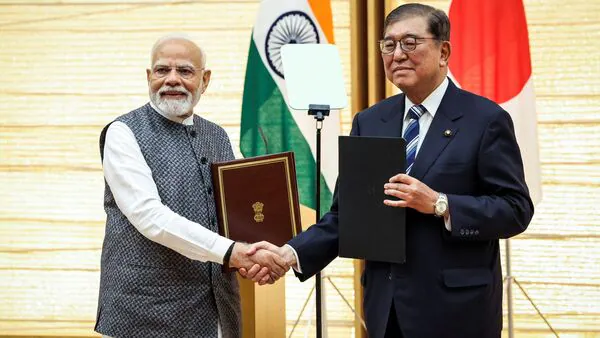
- PM Modi’s Japan visit delivers 13 major agreements across security, space, tech, clean energy, and culture.
- Chandrayaan-5 lunar mission to be a joint ISRO–JAXA effort.
- 500,000 human resource exchanges, including 50,000 Indian workers in Japan over 5 years.
- Japan commits JPY 10 trillion investment in India over next decade.
GG News Bureau
Tokyo, 29th Aug: Prime Minister Narendra Modi’s visit to Japan has culminated in a sweeping set of outcomes, cementing the India–Japan Special Strategic and Global Partnership with 13 formal agreements and several major initiatives. The accords span defence, technology, space, clean energy, critical minerals, people-to-people ties, and cultural cooperation.
A Decade-Long Strategic Roadmap
At the heart of the visit was the India–Japan Joint Vision for the Next Decade, setting priorities across eight sectors including economic partnership, security, technology, health, ecological sustainability, and people-to-people engagement.
A Joint Declaration on Security Cooperation was signed to enhance defence collaboration, reflecting shared concerns over regional security.
Mobility and Human Resource Exchange
India and Japan launched an Action Plan for Human Resource Exchange, targeting the movement of 500,000 people between the two nations, including 50,000 skilled workers from India to Japan in the next five years.
Additionally, a Next-Gen Mobility Partnership will foster collaborations in railways, aviation, ports, and shipping under the Make-in-India initiative.
Technology, Space and Digital Push
A new India–Japan Digital Partnership 2.0 will expand cooperation in digital public infrastructure, AI, semiconductors, and IoT. A joint AI initiative was launched to develop Large Language Models and build a trustworthy AI ecosystem.
In a historic step for space cooperation, ISRO and JAXA signed an implementing arrangement on Chandrayaan-5’s Lunar Polar Exploration Mission, a landmark in bilateral space ties.
Clean Energy and Sustainability
Agreements on the Joint Crediting Mechanism and Clean Hydrogen and Ammonia will promote Japanese investment in India’s decarbonisation efforts, while a Sustainable Fuel Initiative will boost R&D in biogas and biofuels.
The two sides also concluded MoUs on environmental preservation, wastewater management, and critical mineral supply chains, bolstering cooperation in green technologies and resource resilience.
Cultural and Academic Engagement
A MoU on Cultural Exchange and an agreement between the Sushma Swaraj Institute of Foreign Service and Japan’s Ministry of Foreign Affairs aim to deepen cultural understanding and diplomatic training.
Meanwhile, a joint statement of intent between India’s Ministry of Science and Technology and Japan’s MEXT will expand researcher exchanges and boost cooperation between scientific institutions, start-ups, and industries.
Major Investment and Economic Security
A key outcome was Japan’s pledge of JPY 10 trillion (approx. ₹5.5 lakh crore) in private investment in India over the next decade. Both countries also launched an Economic Security Initiative, targeting resilience in semiconductors, clean energy, telecom, and critical minerals.
A new India–Japan SME Forum and business councils with Kansai and Kyushu will further bolster trade and innovation.
People-to-People Linkages
The visit also agreed on high-level state-prefecture exchanges, with at least three delegations in each direction. Community-driven cultural and educational initiatives will further strengthen civilizational bonds.
