

Poonam Sharma
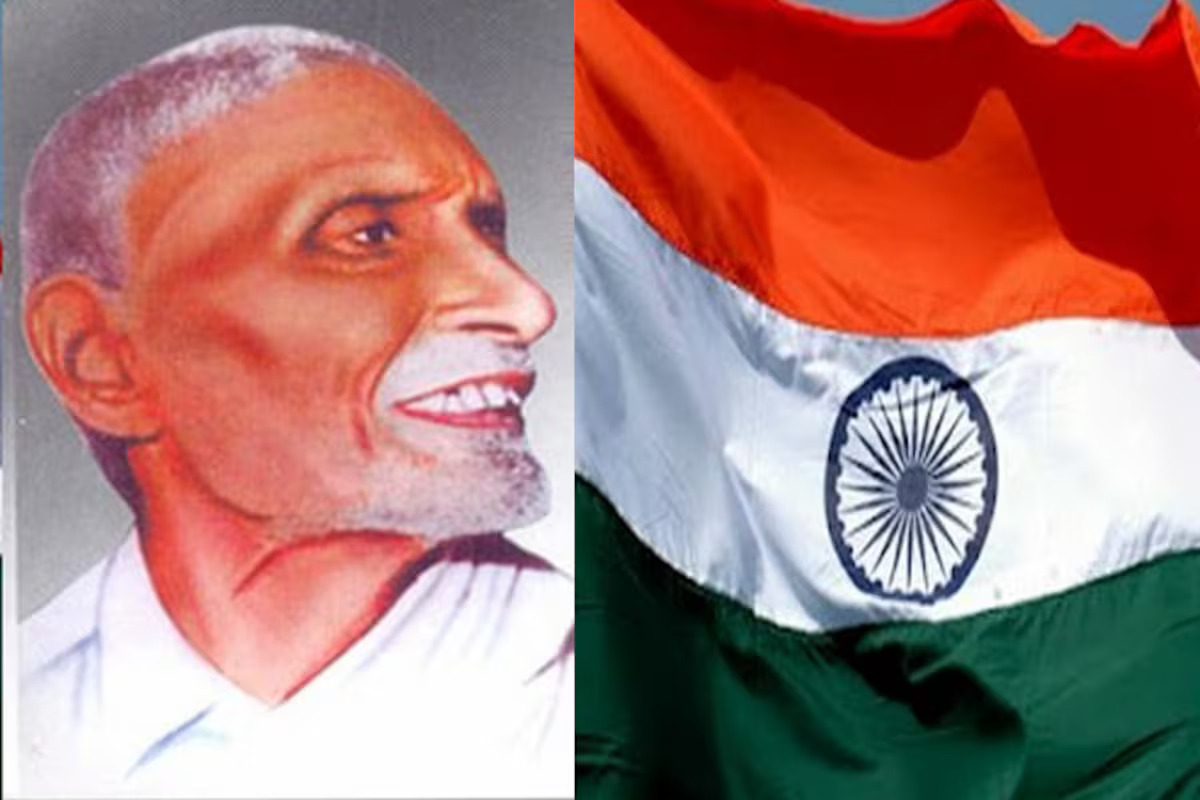
Every Independence Day, millions of Indians stand with pride, their eyes wet and hearts full of pride, as the saffron, white, and green Tricolour waves across the country. The Tiranga is not a flag—it is a vibrant embodiment of sacrifice, togetherness, and identity. But very few stop to remember the man who gifted us this holy symbol: Pingali Venkayya, scholar, soldier, Gandhian, and above all, a forgotten visionary.
From a Small Town in Andhra Pradesh to Cambridge University
Pingali Venkayya was born on August 2, 1876, in a Telugu Brahmin family, Machilipatnam, Andhra Pradesh. In contrast to many of his peers, his childhood was characterized by exceptional curiosity and intelligence. Following his schooling in Madras, he went to Cambridge University for higher studies, where he learned languages, science, and agriculture.
But Venkayayya’s genius didn’t end at textbooks. He possessed a remarkable linguistic talent, learning not just English, but also Japanese, Urdu, and various Indian languages. This, while his fascination with geology and agriculture prompted him to conduct in-depth studies—information that he would go on to employ for the improvement of farmers.
Railway Guard, Soldier, Scholar—The Many Faces of Venkayya
Upon his return from Cambridge, Venkayya worked briefly as a railway guard and subsequently as a government servant in Lucknow. But fate had grander designs. At the tender age of 19, he became an officer in the British Indian Army and was sent to combat in the Anglo-Boer War in South Africa.
It was here, amidst the chaos of battle, that Venkayya’s life took a decisive turn. He met Mahatma Gandhi, who was then leading the Indian ambulance corps in South Africa. Deeply inspired by Gandhi’s ideals, Venkayya returned to India with a new mission—not to serve the British Empire, but to dedicate his life to India’s independence.
“Why Should Indians Salute a Foreign Flag?”
This single question tormented Venkayya. Wherever he turned, Indians were compelled to salute the Union Jack, the prime symbol of colonial domination. He wondered: “Why should we, sons of Bharat, salute the flag of a foreign ruler? Shouldn’t India have her own flag—a symbol of our courage, sacrifice, and unity?”
Gandhi, noting his passion and intellectual ability, assigned the responsibility of creating a flag for India to him. Venkayya devoted the remainder of his life from that point onward for one purpose—coming up with a national flag representing the essence of freedom.
Years of Study, Dozens of Designs
In between 1916 and 1921, Venkayya studied flags from all over the globe extensively. He identified their colors, symbols, and interpretations, and came up with 30 different designs for India. His doggedness eventually yielded results when Gandhi and the Indian National Congress accepted his offer.
The initial design of the flag featured red, white, and green stripes later changed to saffron, white, and green. In 1931, the spinning wheel (charkha) in the middle was officially made the national flag of the freedom struggle as the Tricolour.
Lastly, on 22nd July 1947, weeks before India’s independence, the Constituent Assembly of India adopted Pingali Venkayya’s design—now altered with the Ashoka Chakra replacing the charkha—as the national flag of India. His dream, which he had harbored for four decades, was the living identity of an independent nation.
A Life of Sacrifice, A Death in Obscurity
One would think that a man who provided India with its most revered symbol would be hailed as a national hero, his name inscribed in every textbook, his life remembered by every generation. Unfortunately, this was not Venkayya’s destiny.
Though his enormity of contribution, he spent much of his later years in poverty and obscurity. He lived in a small hut, forgotten by the very leaders who acknowledged his creation. He died peacefully on July 4, 1963, in a thatched hut, unsung and unrecognized.
It was not until 2009, decades after his death, that India Post released a commemorative stamp in his name. Few Indians today remember the story of the man who created the Tiranga.
Why We Must Remember Pingali Venkayya
The irony is biting: every Indian kid recognizes the Tricolour, but few can identify the mastermind behind it. Pingali Venkayya embodies a greater truth about India’s freedom movement—the multitude of unknown heroes whose sacrifices were dwarfed by political titans.
Recalling him is not so much about paying tribute where it is warranted; it is about retrieving lost history. When we greet the Tiranga, we are greeting not only the sacrifices of our freedom fighters but also the vision of Venkayya, who envisioned an India of its own identity long before independence was attained.
Legacy of the Tiranga
Now, the Tiranga is one of the strongest national symbols of the world. Saffron means courage and sacrifice, white peace and truth, and green prosperity and faith. In the middle, the Ashoka Chakra represents eternal progress and dharma.
Each time the flag is unfurled—from the Red Fort on Independence Day to the humblest government school—it silently reminds one of Pingali Venkayya’s voice: “We Indians will salute only our own flag, never again a foreign one.”
Conclusion
Pingali Venkayya’s life reminds us that real patriotism frequently requires sacrifice without promise of reward. He bestowed on India its identity, its pride, and its most beloved symbol. But he passed away in a hut, with the country he had served so nobly forgetting him.
As we pay homage to the Tiranga, let us pay homage to Pingali Venkayya—the man whose dream still flutters in all the nooks and corners of India. For in all the strands of saffron, all the threads of white, all the weaves of green, and all the rotations of the Ashoka Chakra, lives the soul of a man who had envisioned a free India.
The Tiranga is not a flag—it is Pingali Venkayya’s eternal bequest to the nation.
