

Poonam Sharma
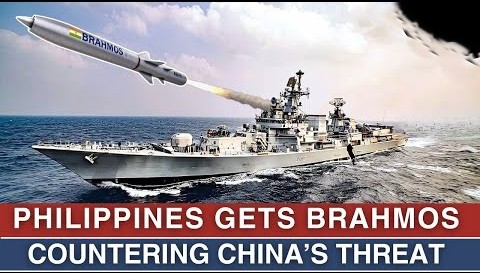
In the disputed waters of the West Philippine Sea, Manila’s strategic stance is being drastically rewritten. For decades, the Armed Forces of the Philippines (AFP) were inward-focused, preoccupied with counterinsurgency and internal security operations. Nowadays, the focus has turned to external defense — that is, preventing Chinese aggression in its maritime domain. Central to this adjustment is the purchase of anti-access/area denial (A2/AD) capabilities, led by the acquisition of the Indian-developed BrahMos supersonic cruise missiles.
This action is much more than a purchasing decision; it’s a geopolitical message. The BrahMos missile, which was a collaborative development with India and Russia, provides an affordable, land-based defense against aggressive naval intrusions. As much as the Philippines has had choices to purchase expensive submarines from France, Australia, or America, it has chosen instead a relatively cheap platform that is less complicated to maintain and can be fielded within its existing defense capabilities. This is rational military decision-making — spending on capabilities that can be rapidly activated instead of prestige items that will become hangar queens.
A Calculated Signal to China
As could be expected, Beijing responded with a strongly worded protest when Manila made its initial BrahMos purchase last year, and such protests can be anticipated as the second acquisition proceeds. But as Philippine defense strategists note, China’s view should not inform Manila’s defense policy. Defense of one’s territory is a sovereign issue. If deterrence succeeds, it succeeds exactly because potential attackers understand their actions will encounter credible opposition.
The deployment of BrahMos enhances that credibility. Land-based missile batteries along key coastal locations can exact costs on any prospective adversary entering the Philippines’ Exclusive Economic Zone (EEZ). That introduces a new dynamic where Chinese maritime coercion — ramming ships, cutting off resupply missions, or tailing Philippine patrols — will become more operationally costly.
Why India, Not Only the U.S.
Others wonder why Manila is procuring key systems from India — both a nation with the same unresolved boundary conflicts with China as the Philippines. The reason is cost, interoperability, and strategic balance. India provides favorable financing, simpler maintenance, and a partnership scheme that does not rely overly on a solitary supplier.
As significant, India is not a Western-style formal alliance partner. It is a “strategic partner” — an arrangement that enables selective cooperation in maritime security, defense technology, and industrial investment without committing Manila to mutual defense commitments beyond current treaties. This is important to a country like the Philippines that is attempting to modernize its military while needing to maneuver in a heavily congested strategic setting.
India’s balancing act has some useful lessons. As a member of both Quad (with the U.S., Japan, and Australia) and BRICS (with China and Russia), New Delhi engages with two power centers, benefiting from each without sacrificing strategic autonomy. The Philippines can learn some elements of this balancing act — keeping close security links with Washington while nurturing complementary alliances with India and other regional powers.
The Quad Question
If Manila signs a Status of Forces Agreement (SOFA) or reciprocal access arrangement with India — something being negotiated currently — it will have equivalent arrangements with all four Quad members. This opens up the intriguing prospect of a “Quad Plus” framework in which the Philippines is a functional partner in Indo-Pacific security efforts. While formal Quad membership is unlikely, deepening operational cooperation could advance Manila’s interests in promoting a “free, open, and inclusive” maritime order.
Geopolitics in Motion
The broader diplomatic context makes this maneuvering even more interesting. Philippine President Ferdinand Marcos Jr.’s outreach to India occurs at a time when New Delhi’s relations with Washington are facing friction — most visibly over India’s continued imports of Russian oil, which former U.S. President Donald Trump has denounced. Through its strengthening of relations with both nations, Manila finds itself positioned as a bridge and not a pawn, capable of gaining from the competition between its partners without being pushed to binary decisions.
This game of balance reflects India’s own strategy of great-power competition. New Delhi cooperates with the U.S. and its allies on security and actively participates in BRICS with China, and invests heavily in economic independence. For Manila, taking the same “multi-vector” foreign policy can avoid dependence on any one power but, at the same time, have access to the instruments necessary for effective deterrence.
Beyond Missiles: Economic and Industrial Dimensions
Security collaboration with India is not limited to defense equipment. The recent sealing of 18 business agreements between the two nations emphasizes the economic aspect of this collaboration. India’s status as the fourth-largest economy in the world and its technological, pharmaceutical, and industrial manufacturing prowess provide opportunities for Philippine development beyond the defense industry.
In fact, the BrahMos sale in itself might lead to closer industrial cooperation — possibly even local manufacturing or local assembly. This would be part of Manila’s larger vision of creating a sustainable defense industry base instead of constantly depending on foreign sources.
The Strategic Payoff
The BrahMos purchase is not a silver bullet; it will not in itself neuter China’s naval superiority. But as one component of a multi-level deterrence approach — including coast guard recapitalization, air surveillance capabilities, and regional alignments — it dramatically changes the math in the West Philippine Sea. China can no longer take for granted the inability of Philippine forces to exact costs in a crisis.
Concurrently, the decision signals a more mature strategic culture in Manila — one that seeks to transcend near-term threats to assess the geopolitical environment within which those dangers function. By funding low-cost, high-impact capabilities and cultivating relationships with a variegated array of partners, the Philippines is incrementally but effectively positioning itself as a more resilient player in the Indo-Pacific.
In a time when economics, security, and diplomacy are all merging into one another, this holistic solution could be Manila’s best opportunity. The BrahMos deal is not merely a missile acquisition — it is a message that the Philippines is choosing to chart its own course, even in the presence of greater powers.
