
Pharma, Trucks, and Tariffs: America’s Bold Push to Pull Industries Home
“The latest U.S. tariff wave, including a 100% duty on branded drugs, signals a deeper strategy: reshaping global production and forcing firms to localize in America. What does this mean for India and the future of global trade?”

Paromita Das
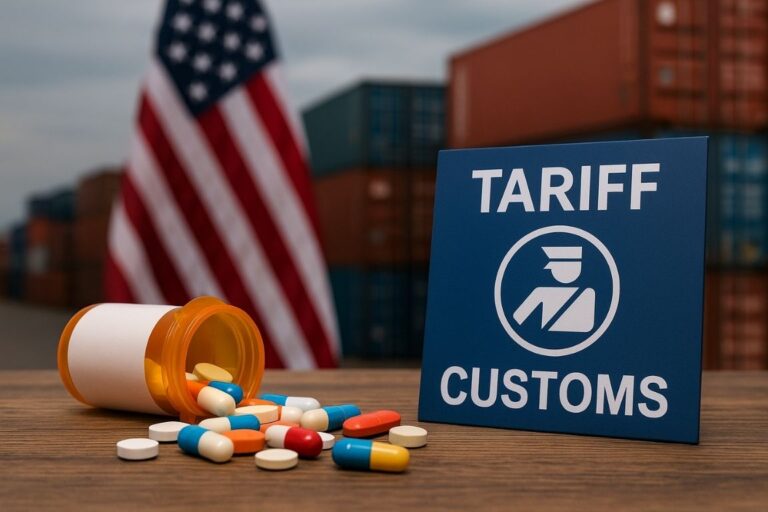
New Delhi, 1st October: Trade wars are often described as clashes over numbers — deficits, surpluses, and exchange rates. Yet, Washington’s latest salvo of tariffs reveals something more profound: an effort to redraw the map of global production. By slapping a 100% import duty on branded and patented drugs, alongside steep levies on heavy trucks and household furnishings, the U.S. has signaled that this is less about balancing books and more about pulling industries back home.
The message is blunt: companies can either invest in America or lose access to one of the world’s most lucrative markets. This marks a shift from short-term trade skirmishes to a long-term strategy of reshoring capital, talent, and innovation.
Beyond Price Wars: Tariffs as Industrial Policy
Pharmaceuticals stand at the heart of this shift. Unlike steel or textiles, medicines rely on complex webs of research, patents, regulatory approvals, and specialized manufacturing. By targeting branded drugs, the U.S. isn’t simply raising import costs; it’s signaling that future breakthroughs — from cancer therapies to advanced biologics — must be developed and produced on American soil.
Even though generic medicines are exempt, the precedent is powerful. It shows how tariffs can morph into a tool for directing high-value investment, ensuring that jobs and profits remain under domestic political control. This approach blends protectionism with industrial strategy, forcing multinational firms to rethink their global footprints.
The Political Economy of Loyalty
In this new trade order, supply chains are no longer judged only by cost or efficiency. Instead, they’re being filtered through the lens of political loyalty. Firms must now weigh whether access to the U.S. market is worth the price of relocating factories, research hubs, or even talent pools.
This reshaping of incentives has wider implications. If America can impose such sweeping conditions on life-saving medicines, it could easily extend similar demands to sectors like semiconductors, clean energy technologies, or biotechnology. For policymakers in Washington, the political payoff is obvious: every factory moved home is framed as a victory for American workers.
India’s Double Bind
At first glance, India’s direct exposure seems limited. Patented drugs make up only a small share of India’s pharmaceutical exports, which are dominated by cost-effective generics. But the ripple effects are already being felt. Markets in Mumbai tumbled as investors feared higher costs for contract manufacturing and worried about the possibility of tariffs spreading to other healthcare products.
Compounding the pressure, Bharatiya IT services — another pillar of export growth — are reeling from the recent $100,000 H-1B visa fee hike, which raises the cost of sending skilled professionals to the U.S. In one stroke, two of India’s most globally competitive sectors — IT and pharmaceuticals — face mounting headwinds.
The larger risk isn’t today’s tariffs, but tomorrow’s policies. If global corporations are compelled to localize not just manufacturing but also R&D in America, India’s climb up the value chain could slow, leaving the country boxed into lower-margin roles.
Strategic Choices Ahead for India
Bharatcannot afford to respond reactively with short-term fixes. Instead, it must craft a strategic response that strengthens its long-term competitiveness. Three areas stand out:
- Deepening Domestic Manufacturing Capacity – By improving infrastructure, ensuring reliable energy supply, and incentivizing local production, Bharatcan make itself a credible alternative hub.
- Streamlining Regulatory Approvals – Faster drug clearances and transparent rules can attract investment in pharmaceuticals and biotechnology, giving Bharata stronger foothold in advanced industries.
- Negotiating Smart Trade Deals – Bharatmust secure agreements that protect its critical sectors while ensuring market access for generics and IT services. Without such safeguards, it risks being outflanked by Washington’s aggressive economic nationalism.
A Dangerous Precedent
From an analytical perspective, Washington’s approach is bold but risky. By weaponizing tariffs to dictate where industries should locate, the U.S. risks fragmenting global supply chains that took decades to build. While the immediate political gains may be job creation and voter support, the long-term effect could be higher drug costs, slower innovation, and strained global alliances.
For India, the lesson is sobering. Globalization is no longer just about efficiency; it’s increasingly about political leverage. Unless Bharatadapts with strategic reforms and proactive diplomacy, it could find itself squeezed between America’s protectionism and China’s state-driven industrial push.
The Age of Economic Nationalism
The latest U.S. tariffs underscore a reality that can no longer be ignored: economic nationalism has moved from rhetoric to enforcement. This is not simply about protecting existing industries but about commanding the industries of tomorrow.
For companies, the choice is stark: localize or lose market access. For countries like India, the challenge is existential — adapt quickly, or risk being sidelined in the next phase of global trade.
The battle is no longer over prices; it is over who controls the future of innovation and production. And in that battle, the U.S. has just drawn new lines on the global map.
