
Pakistan Army Chief Issues Nuclear Threat to Bharat During US Visit
From Tampa to South Asia, Asim Munir’s unprecedented nuclear sabre-rattling on American soil exposes Pakistan’s strategic recklessness and Washington’s troubling silence.

Paromita Das
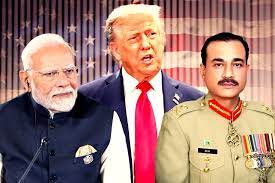
New Delhi, 12th August: In an unprecedented breach of diplomatic conduct, Pakistan’s Army Chief, Field Marshal Asim Munir, issued direct nuclear threats against Bharat — not from Islamabad, but from US soil. This alarming declaration, made during an official visit to America, marks the first time a Pakistani military leader has used such a platform to openly brandish nuclear rhetoric. The move, laced with hostility and devoid of the caution expected from a nuclear-armed state, has drawn sharp attention worldwide.
Munir’s remarks were delivered in Tampa, Florida, while attending the US Central Command (CENTCOM) Change of Command Ceremony. He praised outgoing Commander General Michael Kurilla and welcomed Admiral Brad Cooper, yet quickly shifted to incendiary language, targeting Bharat over the Indus River. He threatened to destroy any Bharatiya-built dam with “ten missiles” and chillingly added: “If we think we are going down, we’ll take half the world down with us.”
Calculated Messaging, Not an Outburst

This was no spontaneous emotional flare-up. The timing, location, and wording point to a calculated attempt to project Pakistan’s nuclear arsenal as a diplomatic weapon — a tool to influence Washington’s perception of Bharat-Pakistan tensions. By making these remarks in the US, Munir sought both to intimidate Bharat and to remind American policymakers of Pakistan’s strategic leverage.
Munir’s threats were not limited to infrastructure. Reports suggest he also referenced Bharatiya business tycoon Mukesh Ambani in a veiled attack, quoting Surah Al-Fil from the Quran, a chapter symbolising divine retribution. Such targeted rhetoric against a private individual is not only provocative but a dangerous precedent in military diplomacy.
Pakistan’s Nuclear Doctrine — A Tool for Blackmail
Pakistan’s strategic doctrine has long hinged on its nuclear capability, often used as a shield for cross-border aggression. From Kargil in 1999 to recurring terror attacks in Jammu and Kashmir, the Pakistani establishment has relied on the belief that Bharat’s response will be limited by the nuclear overhang. Unlike Bharat’s declared No First Use policy, Pakistan’s approach treats nuclear weapons not as a deterrent of last resort, but as an active instrument of foreign policy.

Munir’s comments reaffirm this dangerous pattern, signaling that Pakistan continues to view its arsenal as a bargaining chip rather than a stabilizing force. This strategic immaturity — coupled with Pakistan’s economic collapse, political instability, and internal insurgencies — makes its nuclear threats all the more alarming.
US Silence and the Hypocrisy Question

Perhaps the most glaring aspect of this episode is the lack of immediate condemnation from Washington. The United States, a vocal advocate of nuclear restraint and arms control, has historically been quick to criticize similar statements from other nations. Yet in the case of Pakistan — a country with a chequered record on nuclear security and a history of harboring terrorists — the response remains muted.
This selective diplomacy undermines Washington’s credibility and signals to Pakistan that such rhetoric comes without consequences. Bharat, a consistent US partner in counter-terrorism and global security, is unlikely to overlook this double standard.
Isolation, Desperation, and Strategic Risk

Munir’s rhetoric is not merely about foreign policy — it reflects Pakistan’s growing desperation. The country is grappling with economic bankruptcy, IMF dependence, and rising domestic unrest. In such crises, externalizing threats and invoking nationalism through anti-Bharat rhetoric becomes a tried-and-tested tactic for Pakistan’s military leadership.
Yet this strategy has diminishing returns. Internationally, Pakistan is under persistent scrutiny by the Financial Action Task Force (FATF) for terrorism financing. Its role in sheltering figures like Osama bin Laden remains a stain on its reputation. Nuclear brinkmanship under these circumstances only deepens the perception of Pakistan as an unstable custodian of its arsenal.
Bharat’s Response and the Road Ahead

Bharat must treat Munir’s threats not as empty bravado but as part of Pakistan’s larger strategic narrative. Diplomatic pressure, particularly on Washington, is essential to ensure that nuclear threats are not normalized in global discourse.
The US, for its part, faces a clear choice: uphold its own stated principles of nuclear responsibility by calling out Munir’s rhetoric, or continue indulging Pakistan for short-term geopolitical convenience. The stakes go beyond South Asia — allowing such statements to pass without censure risks encouraging similar behavior from other unstable regimes.
A Test of Global Resolve
Munir’s threats from US soil are not just an Bharat-Pakistan issue. They are a test of the international community’s resolve to uphold nuclear responsibility. If powerful nations remain silent in the face of such recklessness, the precedent set will erode the very norms designed to prevent nuclear escalation.
Bharat, with its consistent policy of restraint and commitment to international law, stands as the responsible actor in this equation. The world must recognize this — and make it clear that nuclear blackmail, no matter the source, will not be tolerated.
