
‘Operation Sindoor Showed Power of Indigenous Defence’: Rajnath Singh
Raksha Mantri urges DRDO to cut development timelines, boost collaboration and focus on speed in defence innovation

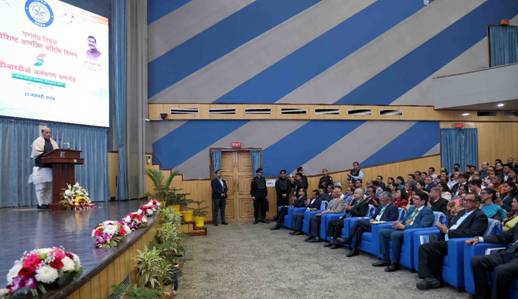
- Operation Sindoor showcased effectiveness of indigenous defence systems
- Rajnath Singh stresses ‘survival of the fastest’ in modern warfare
- Calls for faster transition from research to deployment
- Urges DRDO to deepen collaboration with industry, MSMEs and academia
GG News Bureau
New Delhi, 27th Jan: Raksha Mantri Rajnath Singh today said that Operation Sindoor demonstrated how indigenous defence systems are strengthening India’s operational readiness, underlining the growing impact of self-reliance in the defence sector.
Addressing DRDO’s Best Performing Scientists and Technical Persons, who witnessed the 77th Republic Day Parade as Special Guests, the Defence Minister said DRDO-developed technologies were effectively used on the battlefield during Operation Sindoor. He noted that self-reliance has become a national mindset under the leadership of Prime Minister Narendra Modi, with DRDO playing a central role in the rapid transformation of India’s defence ecosystem.
Highlighting the fast-changing nature of modern warfare, Rajnath Singh stressed the need to adopt the principle of “survival of the fastest”, not just “survival of the fittest.” He said countries that think, decide and deploy technology quickly will stay ahead in today’s technology-driven battlespace.
The Raksha Mantri urged DRDO to significantly reduce the time between research to prototype, prototype to testing, and testing to deployment, stating that timely induction into the Armed Forces should be the biggest performance parameter. He emphasised the need to bridge the gap between design and production by involving industry from the early stages through a co-development approach.
Calling for a shift from a monopolistic R&D model to a collaborative ecosystem, Rajnath Singh said DRDO must work closely with public sector undertakings, private industry, MSMEs, start-ups and academia to realise the vision of Aatmanirbhar Bharat. Citing the Light Combat Aircraft Tejas as a successful example of collaboration between DRDO and HAL, he said many more such achievements are possible through deeper partnerships.
The Defence Minister also highlighted the sharp rise in defence exports, which have grown from less than ₹1,000 crore in 2014 to around ₹24,000 crore today. He said the government has set a target of ₹50,000 crore in defence exports by 2029-30, and urged DRDO to factor in export potential at the design stage, particularly for drones, radars, electronic warfare systems and ammunition.
Describing scientists, engineers and technicians as the real strength of DRDO, Rajnath Singh said they must be given opportunities to learn, lead and innovate, while also being encouraged to take calculated risks. He stressed that failures in research should be treated as learning opportunities.
During the event, the Raksha Mantri presented awards under the DRDO Award Scheme 2024, including the Dr Bhagavantam Technology Leadership Award and the Dr Nagchaudhuri Lifetime Achievement Award. A book titled “The Unprecedented Success Story of the First Indigenous Supersonic Multi-Target Surface-to-Air Missile System – AKASH” was also released, chronicling the journey of the Akash missile system from concept to operational success.
Raksha Rajya Mantri Sanjay Seth, Secretary (Defence R&D) and DRDO Chairman Dr Samir V Kamat, along with senior scientists and their families, were present at the समारोह.
