

Anjali Sharma
GG News Bureau
UNITED NATIONS, 9th Feb. UN humanitarian and coordination office head Martin Griffiths on Thursday echoed widespread international fears about a further escalation of the conflict in the region after fighting across Gaza including reports of deadly airstrikes in Rafah governorate.
Mr. Griffiths said on X “As the war in Gaza encroaches further into Rafah, I am extremely concerned about the safety and well-being of families which have endured the unthinkable in search of safety”.
According to media reports he indicated that Israeli airstrikes overnight into Thursday in Rafah left 14 dead including five children.
OCHA reported the Israeli military on Wednesday announced “a temporary and tactical suspension of military activities in the western neighbourhood of Rafah between 10am and 2pm for humanitarian purposes”.
UN Secretary General Antonio Guterres also called for two-State solution.
He condemned the spreading violence in Gaza.
Guterres told Mermber States that he was “especially alarmed by reports that the Israeli military intends to focus next on Rafah where hundreds of thousands of Palestinians have been squeezed in a desperate search for safety”.
He reiterated that “nothing justifies” Hamas’s “horrific terror attacks” against Israel on 7 October that sparked massive bombardment and a ground operation in a speech to Member States as he outlined his priorities for 2024.
Guterres insisted only an “immediate humanitarian ceasefire and the immediate and unconditional release of all hostages” could help to bring about peace, along with
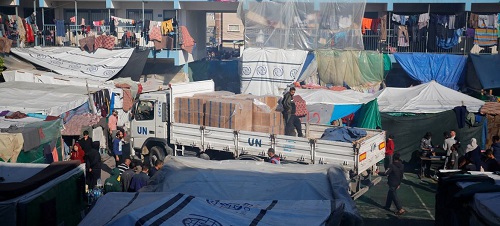
UN agencies and relief aid warned that further hostilities in Rafah governorate, where 1.4 million people now shelter, will very likely lead to the further loss of life.
Mr. Griffiths said “More than half Gaza’s population is crammed in Rafah, a town of originally 250,000 people right on Egypt’s doorstep.”
“Their living conditions are abysmal; they lack the basic necessities to survive, stalked by hunger, disease and death.”
He highlighted the increasing hopelessness felt by millions of Gazans uprooted by the violence -and the frustration of aid teams trying to help them.
Mr. Griffiths warned that any further spread of fighting could create even more obstacles to relief efforts already nobbled by Israeli forces’ repeated access restrictions and damaged infrastructure.
The latest nutrition assessments carried out by humanitarians indicated that the risk of famine in Gaza is increasing by the day.
WFP cited particular concerns “for an estimated 300,000 people in northern Gaza who have been predominantly cut off from assistance and where food security assessments show the greatest needs”.
The agency said that humanitarian aid reaching Gaza city in the north of the Strip is “not enough to prevent a famine”.
The agency added that “faster and sustained access” was urgently needed.
According to OCHA’s latest situation update UNRWA was able to carry out a food distribution in the north of Wadi Gaza on 23 January.
