

Poonam Sharma
Northeast India is not merely a geographical territory; it is the lifeblood of India’s biodiversity, indigenous culture, and natural resources. The Himalayan ecology, dense forests, pristine rivers, and hundreds of indigenous communities make this region unique. However, in recent years, the indiscriminate exploitation of resources in the name of energy projects, mining, and infrastructure has been carving a path of destruction disguised as “development.”
Proposed and under-construction hydropower projects, thermal power plants, mining operations, and pumped storage projects in Assam, Arunachal Pradesh, and Sikkim are pushing local communities toward displacement. The most critical question arises: when the peak electricity consumption of the entire Northeast is less than 5,000 MW, for whom is the production target of over 70,000 MW intended? It is evident that this model is not designed for local needs, but to satisfy large corporate interests and the demands of national and global markets.
The Guwahati Declaration: A Strong Foundation for Democratic Resistance
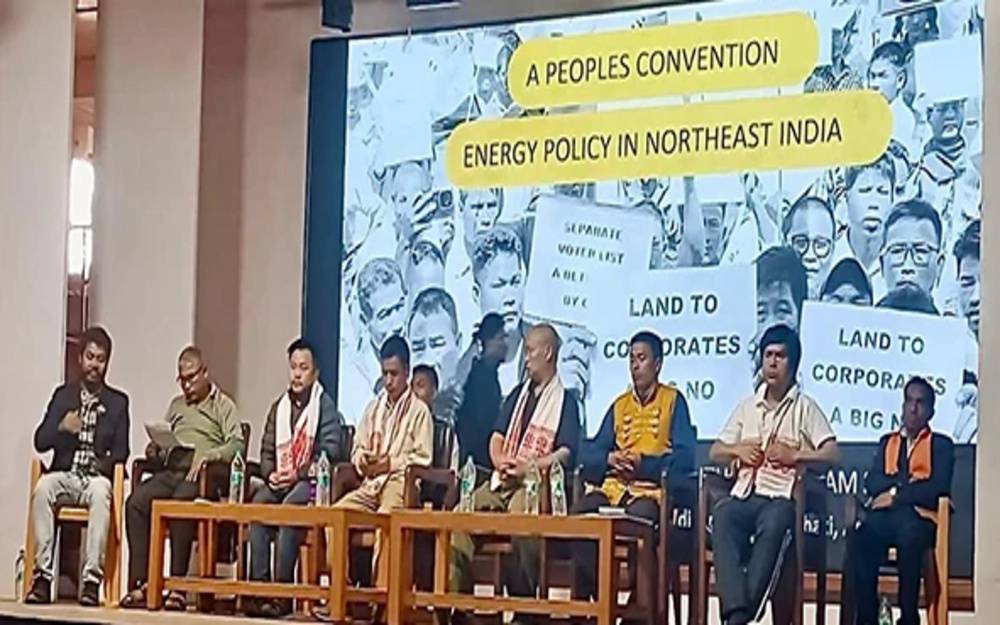
The People’s Council held in Guwahati and the resulting “Guwahati Declaration” represent a historic democratic intervention against this exploitative development model. This initiative is not just about protest; it presents an alternative vision for development—one where the environment, human rights, and community consent are central.
The declaration’s demand for the full implementation of constitutional and international provisions—such as the Sixth Schedule, Article 371, the Forest Rights Act, and FPIC (Free, Prior, and Informed Consent)—demonstrates that this movement is built on a constitutional and legal foundation rather than just emotion. The message is clear: development cannot be legitimate unless it respects the consent, safety, and rights of local communities.
This initiative is also significant because it brings together the struggling voices from various parts of the Northeast—Arunachal, Assam, Manipur, and Sikkim—onto a shared platform. This solidarity creates a moral and political pressure against the state-corporate nexus, something that scattered individual movements often fail to achieve.
Corporate-Centric Development vs. Environmental Justice
Today’s development model is anchored in private capital, PPP frameworks, and international financial institutions. Consequently, control over resources is shifting from the hands of the community to corporate entities. Amendments to forest conservation laws, exemptions in EIA (Environmental Impact Assessment) processes, and the dilution of labor rights indicate that “Ease of Doing Business” is being prioritized over “Ease of Living.”
The Baghjan oil blowout, the Teesta dam disaster, mining accidents in Meghalaya, and the anxieties surrounding the Lower Subansiri project prove that energy-driven rapid development is triggering environmental catastrophes. Local communities pay for these disasters with their lives, livelihoods, and culture, while the profits flow outward into corporate coffers.
The Guwahati Declaration is vital because it challenges the false promises sold under the guise of “Green Energy.” Mega dams and solar parks may appear “green” on paper, but for local ecology, they can be just as devastating as traditional industries.
The Path Forward: Participatory and Local-Centric Development
The roadmap for development in Northeast India cannot be a “top-down imposed model.” The region’s geographical sensitivity and cultural diversity demand a participatory approach based on local needs. Small-scale energy projects, community ownership, respect for traditional knowledge, and rigorous environmental assessments are the only ways to ensure a sustainable future.
The Guwahati Declaration is more than just a document; it is a warning. If the State and Central governments do not rethink their policies, this model of development will become an existential threat to the Northeast. This initiative reminds us that protecting the environment is not “anti-development”—it is the very foundation of true and just development.
This movement is not just for the Northeast; it is a lesson for all of India—that the primary right over resources belongs to those who have been their guardians for centuries.
