

By Harshita Rai
The controversy surrounding Bihar Chief Minister Nitish Kumar and an alleged gesture toward a woman’s hijab during a public programme is not merely about a few seconds of video. It is about power, optics, and the standards expected from those occupying the highest constitutional offices. In public life, facts matter—but so does perception, especially when dignity and religious identity are involved.
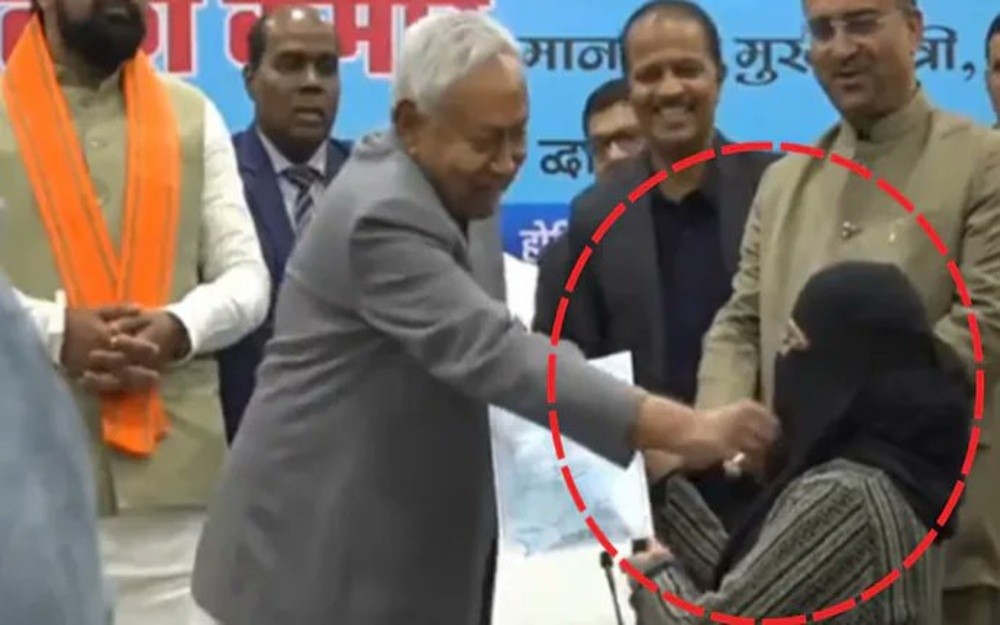
The incident occurred during an official interaction with beneficiaries, a setting where the power equation is unmistakably unequal. A video clip circulating widely shows Nitish Kumar reaching toward a woman’s headscarf, triggering allegations that he pulled or adjusted her hijab. While the clip is brief, the reaction has been anything but. Opposition parties immediately seized on the visuals, arguing that no context can justify a Chief Minister physically touching a woman’s attire in public.
RJD leaders described the act as “deeply inappropriate,” stating that public authority does not grant personal license. Congress leaders went further, saying the controversy reflects a “casual approach to women’s dignity” and demanded that the Chief Minister publicly clarify or apologise. AIMIM leaders pointed out that the hijab is not just clothing but a marker of faith, and any unsolicited gesture toward it carries symbolic weight in a country where minorities often feel scrutinised.
The ruling JD(U), however, has pushed back strongly. Party leaders insist that the incident has been misrepresented and that there was no malicious or disrespectful intent. They cite Nitish Kumar’s long political record: nearly two decades as Chief Minister, consistent electoral support from women voters, and policy decisions such as the bicycle scheme for girls, reservation for women in Panchayati Raj institutions, and expanded access to education for minorities. Their argument is factual and pointed—this is not the profile of a leader known for religious or gender insensitivity.
Yet, facts cut both ways. Intent may not have been proven, but neither can perception be dismissed. In contemporary politics, leaders are no longer judged only by their policy record but by their conduct in every public interaction. This is not new; similar controversies across parties have shown that even inadvertent gestures can cause political damage when they appear to cross personal or cultural boundaries.
What has intensified the episode is Nitish Kumar’s own silence. Unlike past instances where he has been quick to explain or correct himself, there has been no direct, detailed statement from the Chief Minister. In today’s political climate, silence is rarely neutral. For critics, it reinforces the charge of insensitivity. For supporters, it reflects a refusal to dignify what they call a manufactured controversy. Either way, the absence of clarity has allowed speculation to dominate the narrative.
There is also a larger, uncomfortable truth. Viral politics thrives on moments, not context. A few seconds of footage can outweigh years of governance. But the reverse is equally dangerous—allowing a strong political legacy to become a shield against legitimate questions of conduct. Accountability cannot be selective, nor can criticism become opportunistic outrage.
Ultimately, the Nitish Kumar hijab controversy exposes a hard fact of public life: authority demands restraint, not familiarity. Even well-intentioned actions can appear intrusive when filtered through the lens of power, gender, and religion. Leaders must internalise this reality, especially in a society as layered and sensitive as India’s.
This episode is a warning—not just to one Chief Minister, but to all those in power. Governance is judged in policies, but credibility is tested in moments. And sometimes, a single gesture can speak louder than a thousand speeches.
Author’s Note:
Harshita Rai writes on law, policy, and society. Her columns focus on the intersection of justice, governance, and public morality.
