
Nistha Niketan: A Unique ‘Honesty-Based’ Rural Market in Tripura That Could Be a Model for the Whole Country

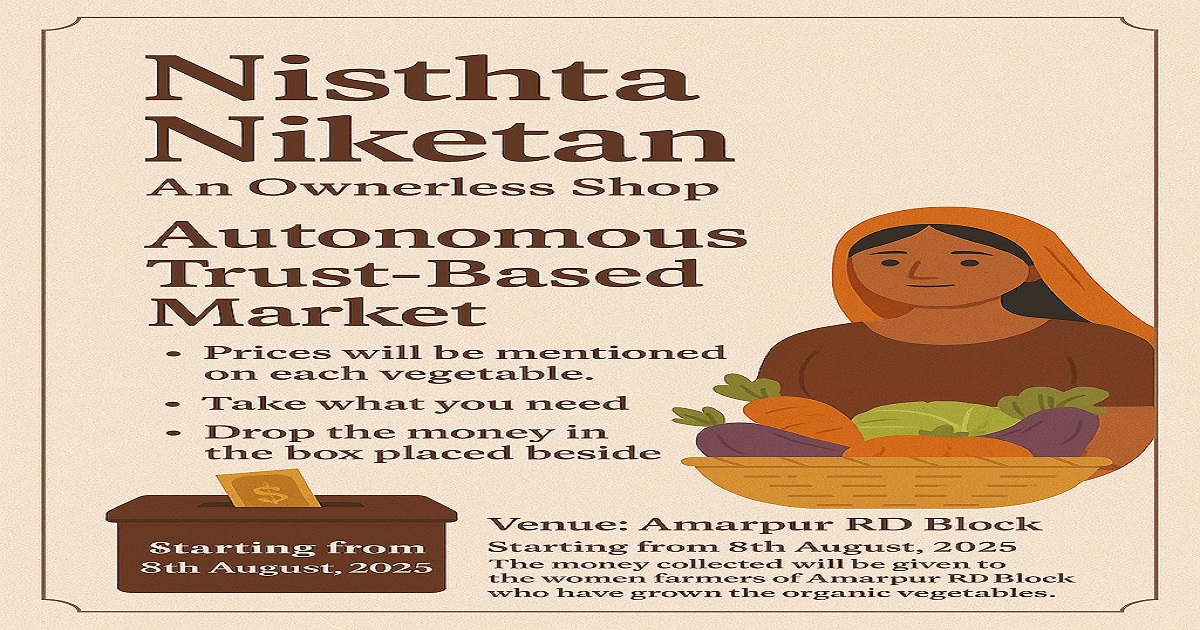

Tripura has implemented many e-governance projects like e-filing system, e-Cabinet, e-Assembly, and Task Monitoring System, which are undoubtedly helping in administrative efficiency. However, these projects are mainly part of central government schemes and are running in many other states too. For women’s self-reliance, projects like Lakhpati Didi and social services by Anganwadi centres are also commendable. But when it comes to exceptional, model social initiatives that leave a lasting impact on people’s hearts, the number in Tripura state is very small.
In this background, a unique rural market named ‘Nistha Niketan’ has been set up right next to the Amarpur RD Block office under Gomati Tripura district. It is an ‘honesty-based’ market, which could serve as a social example not only for other districts, sub-divisions, and blocks in Tripura, but also for other states in India. This market runs entirely on trust based, there are no shopkeepers, no bargaining, and no loud announcements like in modern shopping malls.
Related Posts
Every day, fresh, fragrant, and completely chemical-free vegetables, fruits, and flowers are neatly arranged on tables—such as brinjal, red spinach, bottle gourd, ridge gourd, radish, okra, cucumber, tomato, etc. Each item has a fixed price tag.
The vegetables are supplied by Agri CSP farmers and women farmers from self-help groups (SHGs) of different panchayats like Rangamati, Bampur, Paharpur, Dooluma, Sarbam, and others. These farmers and women’s groups take turns to supply their own produce daily.
Buyers simply take what they need and drop the exact amount of money into a collection box, there is no one monitoring them, no CCTV cameras. Yet everyone pays honestly. At the end of the day, the block administration directly hands over the collected money to the women farmers, without any middlemen.
This initiative ensures fair prices for farmers, strengthens bonds of trust in rural society, encourages organic farming, and plays a big role in empowering rural women.
If the Tripura government starts such ‘Nistha Niketan’ honesty-based rural markets beside every block office in the state, it could become as popular as Tamil Nadu’s ‘Amma Restaurant’, which serves lunch for just Rs. 4 only. Started during the tenure of late Chief Minister Jayalalithaa, this restaurant network has grown even more under the present DMK government, serving lakhs of people every day.
The Tamil Nadu government has also successfully implemented other public-friendly schemes—free bus services, free treatment and medicines in government hospitals, 42 free essential items in ration shops, affordable fish and meat, free school books and uniforms, subsidies on electricity bills, and low-cost clothing sales.
Other states in India also have popular people-oriented initiatives like Delhi’s Mohalla Clinics (free neighbourhood primary healthcare), Andhra Pradesh’s Annapurna Canteens (Rs. 5 meals for workers), Rajasthan’s Indira Rasoi Yojana (Rs. 8 nutritious meals), West Bengal’s Kanyashree Scheme (for girls’ education and preventing child marriage, with international recognition), Gujarat’s Janani Suraksha Yojana (safe childbirth and maternal health benefits), Haryana’s Ladli Scheme (financial help for girls’ education and savings), Maharashtra’s Shiv Bhojan Thali (Rs. 10 meals for urban workers), and Madhya Pradesh’s Ladli Laxmi Yojana (financial aid for girls from birth to education).
These examples prove that for any social initiative to become popular and successful, it needs proper planning, effective implementation, and also strong publicity. In Tripura, many social schemes exist, but due to lack of publicity, their benefits don’t reach rural people fully. Even for a small old age social pension scheme benefit, people still have to approach ministers directly, which reduces public trust in the administration.
Therefore, if the government expands the ‘Nistha Niketan’ market model across the state, promotes it widely, and involves the public in large numbers, it could become a model honesty-based social market not just for Tripura, but for the entire country.
Mr. Jayanta Debnath is a responsible journalist from Tripura with 34 years of experience in investigative journalism and is presently the editor of Tripura’s first and highest-viewed news portal, tripurainfo.com. He has authored more than 30 books on Tripura, covering its history, geography, quiz, general knowledge, current affairs, and various other subjects related to the state, aimed at students and unemployed job aspirants preparing for competitive exams. His work reflects a lifelong dedication to preserving and promoting the rich heritage and factual narrative of Tripura.
