
Unspoken Library: Nishikant Dubey’s Challenge to Gandhi Legacy

Poonam Sharma
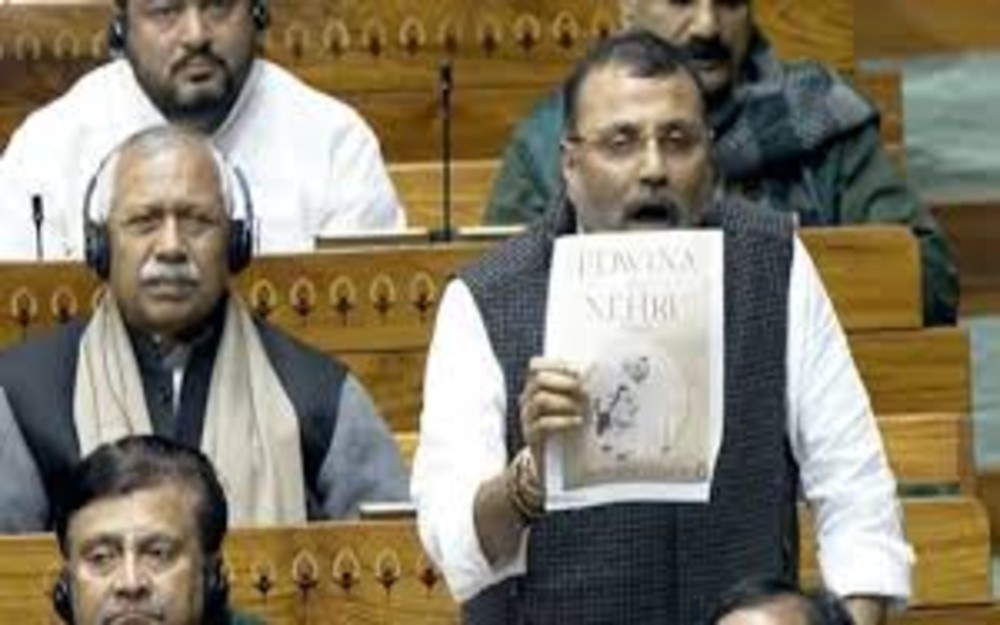
In a recent, high-octane parliamentary intervention, BJP MP Nishikant Dubey turned the hallowed halls of the Lok Sabha into a historical courtroom. His weapon of choice wasn’t just rhetoric, but a stack of banned and controversial books that he claims hold the “dark secrets” of the Gandhi-Nehru dynasty. Dubey’s speech wasn’t just a political rebuttal; it was an attempt to dismantle the moral pedestal upon which the Congress party has placed its leaders for decades.
A Battle of Narratives: The Constitution vs. The Emergency
The crux of Dubey’s argument centers on the irony of Rahul Gandhi’s frequent public displays of the Constitution. Dubey points out a historical “hypocrisy,” reminding the house that during the Emergency (1975-77), it was the Congress itself that significantly altered the Constitution through the Swaran Singh Committee. He argued that the very rights Rahul Gandhi claims to protect—freedom of the press and presidential powers—were once systematically dismantled by his own grandmother, Indira Gandhi. By citing books like India’s First Dictator, Dubey suggests that the Emergency wasn’t just a political phase but a fundamental betrayal of the Constitution designed by Dr. B.R. Ambedkar for the poor.
The “Banned” Truths
Dubey’s speech was particularly striking because he brought up literature that has long been suppressed or ignored in mainstream Indian discourse. He mentioned titles like M.O. Mathai’s memoirs (Nehru’s long-time secretary), which contain explosive personal allegations, and The Red Sari by Javier Moro.
His analysis suggests that these books aren’t just collections of “gossip” or “slurs” (as some critics claim), but historical accounts of how personal relationships and “backroom dealings” influenced India’s national policy. From the 1962 war debacle with China to the separation of Burma in the 1930s, Dubey links India’s geopolitical struggles directly to the decisions of the Nehru family.
Geopolitics and Corruption
The analysis takes a sharp turn into national security. Citing the Henderson Brooks-Bhagat Report on the 1962 Sino-Indian War, Dubey accused the Congress of hiding the truth about how much land was ceded to China. He framed the current issues in Ladakh and Arunachal Pradesh as “inherited problems” from the Nehru era.
Furthermore, he didn’t spare the later generations, bringing up the Bofors scandal via Chitra Subramaniam’s writings and the economic “paralysis” of the UPA era (2004-2014) described in Sanjaya Baru’s The Accidental Prime Minister. His point is clear: the history of the Gandhi family is a “treasure trove of corruption and mismanagement” that has stunted India’s growth, allowing China to race ahead while India lagged for decades.
The Conclusion
Nishikant Dubey’s speech is a demand for a “historical audit.” He argues that while Rahul Gandhi talks about the future, the nation cannot move forward without addressing the “ghosts” in these books. By calling for a formal discussion in Parliament on these suppressed texts, Dubey is attempting to flip the script—portraying the Gandhi family not as the architects of modern India, but as the authors of its most significant hurdles.
