
New FIR, Old Ghosts: National Herald Scandal Tightens Around the Gandhis
“Seventeen years after the first allegations, the National Herald scandal resurfaces—linking today’s FIR to Nehru-era concerns raised by Sardar Patel.”

Paromita Das
New Delhi, 3rd December: There are stories in Bharatiya politics that quietly simmer for years before erupting back into national focus. The National Herald case is one of them—a saga that stretches across generations of the Congress leadership, journeys through courtrooms, and brushes repeatedly against questions of political integrity. Its revival today, following a fresh FIR by the Economic Offences Wing (EOW) of Delhi Police based on an Enforcement Directorate (ED) complaint, is not just a legal development—it is the reawakening of a long-shadowed chapter in Bharatiya political history.
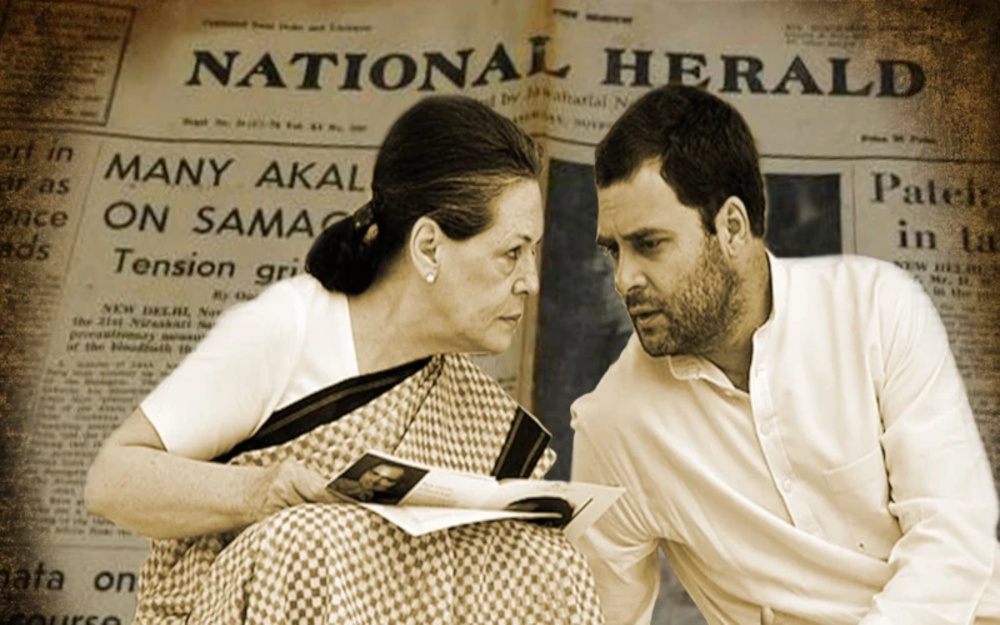
And once again, the names at the centre of the storm are familiar: Sonia Gandhi, Rahul Gandhi, and a company deeply intertwined with the legacy of the Nehru-Gandhi family.
A Web of Companies, Controls and Real Estate Worth Crores
According to the new complaint, Young Indian—a company in which Sonia Gandhi and Rahul Gandhi each own a 38% share—became the vehicle through which Associated Journals Limited (AJL), the parent company of the now-defunct National Herald newspaper, was allegedly taken over. The FIR notes that Young Indian received ₹1 crore from Dotex Merchandise, a Kolkata-based shell company. Shortly afterward, it acquired AJL’s massive debt of ₹90 crore in exchange for just ₹50 lakh.
That transaction opened the door to control real estate assets worth more than ₹2,000 crore spread across Bharat.
This isn’t a story of a distressed newspaper rescued from collapse—it is a story of assets, influence, and alleged political misuse. The lineage of the paper only adds to the complexity: the National Herald was founded by Jawaharlal Nehru and other freedom fighters as a voice against colonialism. Its emotional and political significance has never been small; its financial controversies continue to grow larger.
The saga took a legal turn in 2012 when BJP leader Subramanian Swamy filed a criminal complaint accusing the Congress leadership of cheating and criminal breach of trust. Over the last decade, the ED, Income Tax Department and courts have been repeatedly drawn into the case. Properties valued at ₹750 crore were attached. Rahul Gandhi sat through long interrogation sessions. Sonia Gandhi was identified as a principal accused. And yet, the matter seemed to drift into the background—until now.
A Forgotten Warning: When Sardar Patel Questioned the National Herald
As the case resurfaces, so too does an astonishing historical footnote that many Bharatiya remain unaware of. Over 70 years ago, another senior national leader raised concerns about the newspaper’s financial dealings.
That leader was Sardar Vallabhbhai Patel.
In 1950, Patel wrote a series of sharp, unsparing letters to Nehru, raising red flags about suspicious donations made to the National Herald by businessmen who had simultaneously received favourable government contracts. The contributions, he suggested, were anything but charity—they were connected to official favours.

Patel highlighted payments from individuals associated with Himalayan Airways, a company with dubious credentials that had unexpectedly obtained a lucrative government mail charter. He further exposed concerns about another donor, Husainbhai Lalji, who was under criminal investigation for cheating the Government of Bharat.

Patel warned Nehru that these transactions created a dangerous “vested interest” and opened the government to allegations of cronyism. Nehru’s responses, however, appeared evasive. He distanced himself from the newspaper’s finances, pointed at intermediaries, and attempted to minimize the problem as an issue of accounting rather than integrity.

Patel, frustrated by the persistent ambiguity, finally wrote:
“I feel it useless to pursue the matter further.”
History often repeats itself in ways we fail to recognise.
A Pattern That Outlived Generations
The striking part is that the criticisms being raises today—misuse of political influence, questionable funding, and lack of transparency—echo Patel’s concerns from 1950. Despite seven decades of political evolution, the core allegations surrounding the National Herald appear fundamentally unchanged.
The fact that the Nehru-Gandhi family has been linked to both the historic doubts and the modern-day controversy casts a long, uncomfortable shadow. The saga is not merely about a company—it is about political culture, accountability, and the expectations placed on national leaders who carry historical legacies.
As ED investigations evolved under the Prevention of Money Laundering Act, properties were attached, chargesheets filed, and the Gandhis repeatedly summoned. Yet Congress dismissed the case as political vendetta. Supporters called it harassment; critics labelled it proof of institutional rot.
The legal questions, however, now stand revived with renewed force.
The Case Is No Longer About a Newspaper—It Is About Integrity in Public Life
Whether or not the allegations ultimately hold up in court, the National Herald case raises a deeper concern: the persistent entanglement of political families with private ventures that benefit from the power they wield.
At a time when citizens expect transparency and ethical governance, such investigations cannot be brushed aside as partisan attacks. When a case has spanned 17 years, involved multiple central agencies, and carried forward despite political changes, it indicates more than mere political rivalry.
It hints at systemic issues that require honest scrutiny.
The resurfacing of Patel’s letters also serves as a reminder that the misuse of political proximity in financial dealings is not a new phenomenon—it has always been a moral fault line in Bharatiya politics. The difference today is that the institutions investigating these cases are far more empowered, public expectations of ethical conduct are higher, and historical privileges are increasingly questioned.
A Case That Refuses to Die—and a Legacy Under Scrutiny
The National Herald case has outlived political eras, governments, and even generations of leadership. It has reappeared not because of political convenience but because unanswered questions continue to surface with every new investigation.
What began as a financial inquiry has become a political litmus test—one that examines not only possible wrongdoing but also a family legacy, a party’s moral fabric, and the long shadow of past choices.
As the courts resume scrutiny and agencies pursue the case, the question remains:
Will this be the moment when a 75-year-old controversy finally reaches a transparent and conclusive end?
Or will it continue, like so many unresolved stories of Bharatiya politics, to haunt every decade until the truth is no longer avoidable?
Either way, the National Herald case stands today as more than a legal battle—it is a test of accountability in Bharatiya democracy.
