
From Nehru’s Heir to Bharat’s Hero: Modi’s Destiny Unfolds

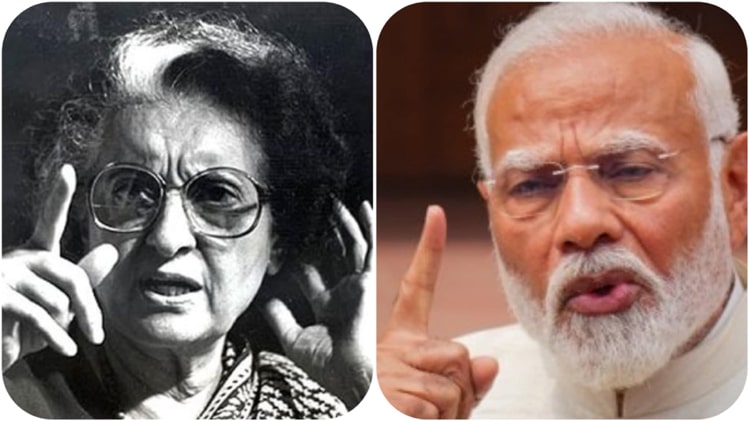
- Modi Surpasses Indira: With 4,078 uninterrupted days, Modi becomes India’s second-longest serving Prime Minister.
- Dynasty vs Destiny: Unlike Indira Gandhi’s inherited legacy, Modi carved his rise from the grassroots.
- From Tea Stall to World Stage: Modi transforms from a humble tea seller to a global statesman.
- Bharat No Longer Bows: Under Modi, India speaks with strength and is never taken for granted on the world stage.
Paromita Das
New Delhi, 26th July: Leadership isn’t only about holding office—it’s about defining eras. As of July 2025, Prime Minister Narendra Modi has surpassed Indira Gandhi in uninterrupted days in office, with 4,078 consecutive days, making him the second-longest serving Prime Minister in Bharatiya history. But beyond statistics lies a much deeper story—a tale of two vastly different journeys, visions, and the transformative arcs they shaped for Bharat.
Inheritance vs Individuality: Two Roads to Power
Indira Gandhi was born into power. As the daughter of Jawaharlal Nehru, Bharat’s first Prime Minister, she inherited a rich political legacy, access to leadership corridors, and a front-row seat to Bharat’s early years as a democracy. When she took charge in 1966, she carried forward not just Nehru’s ideas but the Congress party’s lineage—anchored in dynastic continuity.

Narendra Modi, by contrast, built his political world from scratch. From assisting his father at a tea stall to rising through the Rashtriya Swayamsevak Sangh (RSS) and Bharatiya Janata Party (BJP), Modi’s ascent is defined by grit, ideology, and mass connection. He carved out a self-made path to power, making himself not only a national leader but an internationally admired figure. Today, Modi is recognized as a “world guru,” a statesman whose words carry weight in global forums.

Bharat: From Being Taken for Granted to Taking a Stand
Under Indira Gandhi, Bharat was often viewed by the world through the lens of Cold War alignments and economic vulnerability. Despite her powerful presence on the domestic front, globally, Bharat was rarely a priority—often taken for granted, diplomatically reactive rather than assertive.
Fast forward to Modi’s era, and the contrast is striking.
Today’s Bharat doesn’t bow in fear—it stands tall in forums like the UN, G20, SCO, and Quad, projecting a clear, independent viewpoint. From championing climate action to shaping trade and geopolitical alignments, Modi’s Bharat is no longer a sideline participant—it’s a central force. Bharat today dictates its terms, stands firm on its principles, and refuses to be ignored or coerced.

This shift from being diplomatically passive to globally proactive marks a generational transformation in how Bharat perceives itself—and how the world perceives Bharat.
Electoral Power and National Vision
Indira Gandhi’s electoral strength, especially her landslide victory in 1971, was unmatched until the rise of Modi. Yet, Bharat doesn’t bow in fear—it stands tall in forums like the UN, G20, SCO, and Quad, a phase remembered for censorship, arrests, and suspended civil liberties. She left behind a legacy of both iron-willed governance and democratic disruption.
Narendra Modi, however, has won six consecutive elections as the face of his party—three in Gujarat and three at the national level. His victories in 2014, 2019, and 2024 represent not just political dominance but also the transformation of Bharat’s voter base. Modi appeals not only to the urban and rural masses but also to the aspirational middle class, women, and first-time voters—blending developmental politics with cultural pride.
Governance: Central Authority and Mass Communication
Indira Gandhi centralized power using state machinery. She depended heavily on her political acumen, bureaucracy, and a tight-knit circle to execute decisions. Her era was marked by landmark reforms—bank nationalization, war victories, and nuclear testing—but also by deep institutional challenges.

Modi centralizes power too, but through modern tools—digital platforms, direct mass engagement, and media optics. His Mann Ki Baat, consistent global outreach, and use of technology to deliver welfare schemes reflect a leader who governs through visibility, accessibility, and symbolism. He connects personally with people and positions himself as a doer—a man of action, not just words.

A Legacy Redefined
In the great ledger of Bharatiya politics, Indira Gandhi will always be remembered as a force of determination and disruption. But it’s Narendra Modi who redefined the scale and scope of Bharatiya leadership—shifting it from inherited legacy to self-made global statesmanship.
Modi’s rise signifies a new Bharat—confident, assertive, and ambitious. Under his leadership, Bharat doesn’t merely participate in global affairs—it shapes them. From the G20 presidency to Viksit Bharat 2047, his tenure is laying the foundation for Bharat’s next global leap.
Surpassing Indira Gandhi’s record is more than just a statistical achievement—it’s a symbolic closure of an old chapter and the continuation of a new one, where Bharat writes its own story—on its own terms.
