
Needonomics-Driven Multidisciplinary Research justified at International E-Conference Hosted by G.M. Vedak College of Science, Tala (Raigarh)

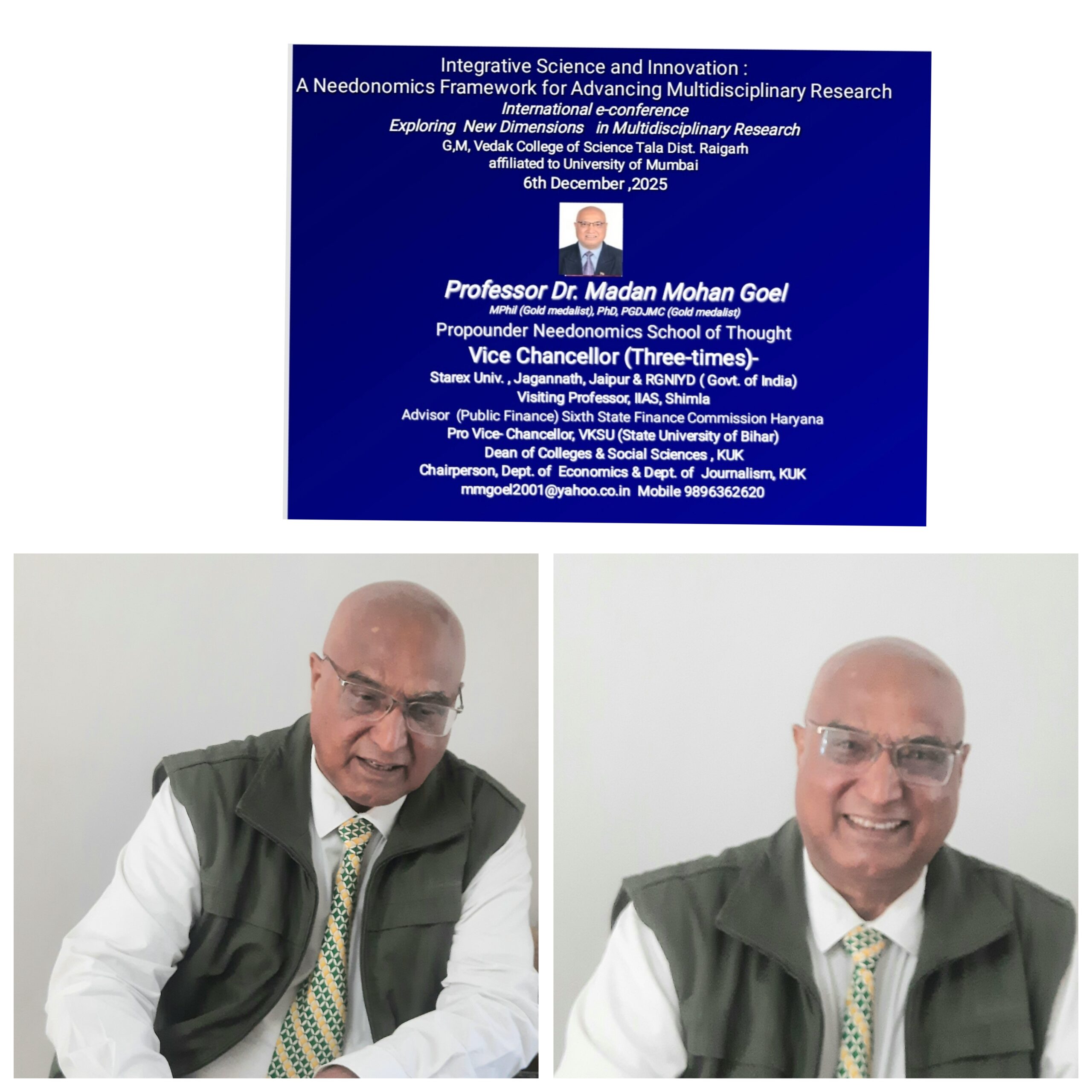
Tala (Raigarh), 6th December: Prof. Madan Mohan Goel, Propounder Needonomics , Former Vice-Chancellor (thrice) and superannuated Professor of Kurukshetra University , addressed the International E-Conference on “Exploring New Dimensions in Multidisciplinary Research” organized by G.M. Vedak College of Science, Tala (affiliated to University of Mumbai) in collaboration with Collaboration with Global Foundation, India today. Chief convener & Principal Dr S.S, Mirza Collaboration with
Global Foundation, India the welcome address. Dr SV Bangale introduced the speakers of the day. Mr Santosh P. Mane President
Global Foundation, India proposed vote of thanks .
In his address titled “Integrative Science and Innovation: A Needonomics Framework for Advancing Multidisciplinary Research,” Prof. Goel emphasized that scientific boundaries are rapidly dissolving in the 21st century. Innovation now emerges from the convergence of chemistry, life sciences, physics, mathematics, information technology, botany, and environmental science. He asserted that this convergence requires not just intellectual openness but also a value-based compass. Needonomics, he said, provides this compass by promoting need-based living, production, and research.
Prof. Goel stressed that Needonomics encourages research focused on genuine human and planetary needs such as health, sustainability, energy, biodiversity, and digital inclusion. He highlighted how each discipline benefits from this ethical lens—green chemistry and biotechnology for sustainable development, physics and mathematics for responsible technological advancement, and IT as an integrator and democratizer of scientific knowledge. Botany and environmental science, he said, must guide climate resilience and biodiversity protection.
He proposed a Needonomics Model for Scientific Institutions that includes value-based vision, interdisciplinary labs, need-driven funding, community-linked research, and ethical evaluation of outcomes.
Prof. Goel concluded that integrative research guided by Needonomics is essential for a sustainable, equitable, and humane scientific future.
