
NCERT’s New Class 7 Textbook: A Clearer Look at Mahmud of Ghazni’s Violent Campaigns
“Rewriting the Lens of Medieval History: What Students Will Now Learn About Ghazni and Beyond.”

Paromita Das
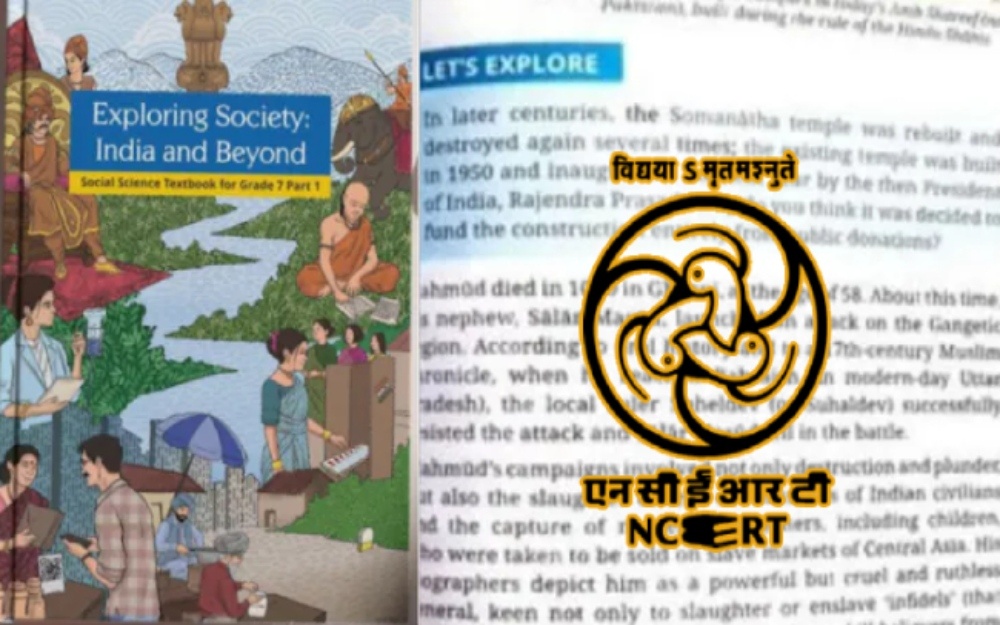
New Delhi, 11th December: History often sits quietly in our schoolbooks, reduced to a handful of tidy sentences that barely hint at the chaos, courage, fear and upheaval that shaped real lives. This year, NCERT has decided to open that window wider. The revised Class 7 Social Science textbook now dives deeper into one of the bloodiest and most transformative phases of medieval Bharat-the invasions led by Mahmud of Ghazni. For the first time in decades, students will not simply skim over this era but actually see it in all its complexity.
This decision is a signal that there is a change in the way Bharat wants young learners to understand their past-with clarity, honesty, and thoughtful sensitivity.
Why the Mahmud of Ghazni Section Matters Now
Until recently, there was only a bare paragraph or so on Mahmud’s raids. It now stretches to almost six pages, with illustrations, maps, and explanatory notes. The additional material reconstructs his campaigns over Mathura, Kannauj, and the famous Somnath temple, which left deep scars across regions and communities.
More importantly, the chapter does not reduce the invasions to a question of plunder. It explores the human cost of violence and cultural trauma that followed. Students learn herein that history is not just a chronicle of kings and battles but a record of ordinary people caught in crossfires.
The Brutal Reality of Ghazni’s Invasions
The new textbook does not mythologize Mahmud as a hero. He is projected as an excellent military strategist but a ruthless ruler who caused unprecedented brutality. His campaigns targeted temples and sacred sites along with civilian populations. Thousands were killed, children were taken captive, and their wealth was shipped off to Central Asia.
Special mention is given to the Somnath temple. Referring to Al-Biruni, the book discusses how the Shivalinga was smashed and its fragments taken to Ghazni. The chapter ties the narrative back to the present Bharat, mentioning how the temple was reconstructed in 1950 and inaugurated by President Rajendra Prasad—inviting reflection on cultural reconstruction and historical memory.
Religion, Power, and Historical Consequences
The textbooks underline the fact that Mahmud’s invasions were not mere economic raids but campaigns of which the impulse was religious zeal and political ambition. Hindus, Buddhists, Jains, and even rival Islamic sects faced his wrath. Violence changed the face of extensive parts of North Bharat with the demographic pattern as well as religious topography.
This is important context because it provides students with a way of thinking about history: not as a form of moral judgment, but rather as an investigation into power and ideology and consequences.
Voices from the Past: What Chroniclers Recorded
The extracts from contemporary writers like Al-Utbi, the court historian of Mahmud, serve to reinforce that even those close to the invader recorded the brutality-temple demolitions, mass killings, and the sale of captives. These accounts root the textbook in primary sources rather than modern reinterpretations.
For students, this provides a valuable lesson: historical evidence counts.
A Wider Medieval Landscape: Ghuri, Aibak, Khilji
The revised chapter doesn’t stop with Mahmud. It introduces students to Muhammad Ghuri, Qutb-ud-din Aibak, and Bakhtiyar Khilji—men who determined the future of the subcontinent long after Ghazni’s last raid.
Bakhtiyar Khilji’s destruction of the two greatest centres of Buddhist learning in the world, Nalanda and Vikramashila, is explained lucidly. The chapter also links their destruction with the decline of Buddhism in eastern Bharat, an important historical link which previous textbooks omitted to provide.
Resistance and Resilience
The book also does not depict medieval Bharat as helpless. It highlights how large parts of the south and sections of the north resisted Turkic expansion. Some Bharatiya rulers even formed alliances in order to protect their regions. Such a balanced approach gives students a fuller picture, acknowledging both loss and resilience.
Ghaznavid Raids in a Larger Story
The textbook locates the invasions in a wider political background, moving from Chalukyas and Rashtrakutas to Huns and early Arab incursions into Sindh, so that the invasions do not appear as isolated incidents. Nor is the intention to sensationalize violence but to realistically map the age.
Balancing Sensitivity with Truth
The “Word of Caution” section reassures the students that history usually emphasizes wars because conflict leaves more definite records. It reminds them that guilt about the actions of the past carries no burden today. This is a considerate step-one that allows candor with no animosity.
Why Honest History Matters
In my opinion, these changes were long overdue. Sanitizing the past does not heal old wounds; it only erases lessons that future generations deserve to learn. Children can handle historical truth when presented carefully—and the new NCERT books attempt exactly that. They neither demonize nor whitewash. They explain.
A society that hides its painful chapters cannot grow; a society that studies them with maturity can move towards progress with understanding and, thus, confidence. Teaching the Past Without Burdening the Present What the new NCERT Class 7 textbook does is important: it replaces the banality often imposed on a chapter with depth, asking the students to look back, query, and fathom. History might be uncomfortable at times, but to learn it honestly is the first step toward an informed, empathetic future.
