
“Nation First, Critics Be Damned”: VP Dhankhar Slams Idealism, Bats for Strategic Realism

GG News Bureau
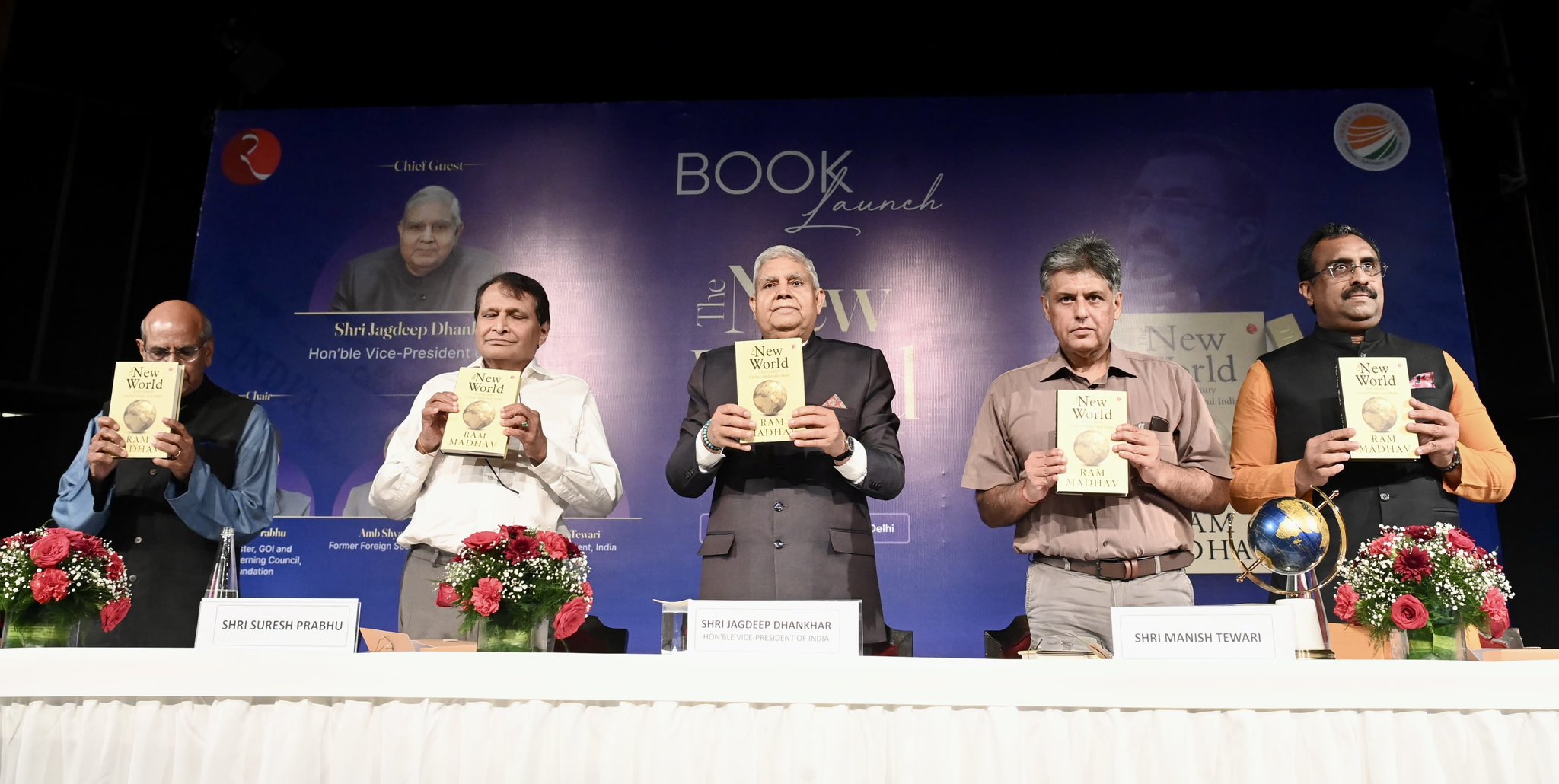
New Delhi, 23rd June: Vice President Jagdeep Dhankhar, while launching the book ‘New World: 21st Century Global Order in India’ by Ram Madhav in New Delhi, invoked the philosophy of freedom fighter and thinker Vinayak Damodar Savarkar to stress that nations act primarily in pursuit of self-interest, not idealism or international solidarity.
Referring to Savarkar as a “staunch realist,” the Vice President said, “He believed that countries must act to protect sovereignty through strength, not depend on utopian international institutions like the League of Nations or the United Nations, which failed to acknowledge one-sixth of humanity.” Dhankhar added that Savarkar’s worldview was prophetic in the context of recent global developments.
Asserting that “strengthening Bharat is the governing philosophy and resolve of this government,” Dhankhar said the country today speaks from a position of strength. “Let us not be misguided by who said what. The government and its people stand firmly for the nation — nation first and our nationalism,” he declared.
He cautioned against decision-making based on “momentary situations” and said that those who indulge in such practices are “not in the psych or groove of Bharat.” Emphasising a realist foreign policy, Dhankhar echoed author Ram Madhav’s call for India to shed romanticism and focus squarely on economic growth amid what he termed the “perpetual decline of global multilateralism.”
Rejecting earlier criticisms that India lacked strategic thinking due to its philosophical roots, Dhankhar said, “George Tanham once claimed India lacked strategic thought. But with Ram Madhav’s work, that theory stands corrected.” He cited examples from Indian traditions, such as Kautilya’s Mandala Theory and Ashoka’s Dhamma diplomacy, as proof of India’s rich legacy in statecraft.
The Vice President also touched on the growing misuse of public discourse, saying, “We live in times where hypocrisy can overshadow facts. Even the Fabian socialists of the 1950s would not disagree with India’s current trajectory. We are not creating Bharat anew; we are continuing its civilisational journey rooted in the ethos of ‘सर्वे भवन्तु सुखिनः, सर्वे सन्तु निरामयाः’ — may all beings be happy and free from illness.”
On contemporary geopolitics, Dhankhar noted that India has always stood for peace and never engaged in expansionism. He praised Prime Minister Narendra Modi’s leadership during India’s G20 presidency, highlighting the inclusion of the African Union as a full member — a “game-changing development” and a milestone for the Global South.
He warned, however, that India’s path to becoming a developed nation — Viksit Bharat — would require “careful navigation.” “There are external and internal forces seeking to divide us, even over something as rich and unifying as our languages,” he said, urging greater dialogue among political parties and policy convergence.
The Vice President concluded by calling for a reduction in political temperature and underscored the role of India’s intellectual and policy-making community in ensuring strategic clarity. “We have no enemies in this country. Those who appear so are often rooted in outside forces inimical to Bharat,” he cautioned.
