

Poonam Sharma
The slogan “Mullahs must leave” did not suddenly erupt on Iran’s streets. It is the product of a long and painful historical journey—one marked by rising expectations, broken promises, and growing disillusionment with clerical rule. To understand why this chant resonates so strongly today, it is essential to trace how religious authority entered Iranian politics, how it transformed into absolute power, and why large sections of society now reject it outright.
What we are witnessing today is not just anger over inflation or unemployment, but a deeper reckoning with a political system that has fused religion and state in ways many Iranians no longer accept.
Before 1979: Clerics as Moral Guides, Not Rulers
For centuries, Shiite clerics in Iran did not directly govern the country. Political authority rested with monarchs—from the Safavid and Qajar dynasties to the Pahlavi kings. The clergy played a very different role. They were religious scholars, interpreters of Islamic law, educators, and community leaders. Their power was social and moral, not executive.
In fact, clerics often acted as a counterbalance to royal authority, opposing tyranny, corruption, and foreign interference. This earned them considerable public trust, especially among ordinary people who viewed them as protectors of justice and Iranian identity.
A defining moment came during the Constitutional Revolution of 1905–1911, when many clerics supported limits on monarchical power and the creation of a constitution. This period cemented a powerful idea in Iranian political culture: religion should restrain power, not dominate it.
Westernisation and Backlash: The Seeds of Clerical Power
The relationship between state and religion changed dramatically under Reza Shah and later Mohammad Reza Shah Pahlavi. Their drive to rapidly modernise and Westernise Iran disrupted traditional society. Policies such as banning the hijab, abolishing clerical courts, and marginalising religious education alienated large sections of the population.
While cities modernised, many rural and conservative communities felt humiliated and excluded. Clerics seized this moment, presenting themselves as defenders of faith, culture, and national dignity against an authoritarian and Western-aligned monarchy.
This tension between forced modernisation and religious identity laid the groundwork for a mass movement that would eventually upend the monarchy.
1979: When Clerics Took the State
The Islamic Revolution of 1979 was initially a broad coalition. Leftists, liberals, nationalists, students, workers, and religious groups all united against the Shah. Many Iranians believed they were fighting for freedom, justice, and self-determination.
However, once the monarchy collapsed, Ayatollah Ruhollah Khomeini moved swiftly to consolidate power. Through the doctrine of Velayat-e Faqih (Guardianship of the Islamic Jurist), he fundamentally reshaped Iran’s political system.
This doctrine placed ultimate authority in the hands of a senior cleric—the Supreme Leader—above elected institutions. Unelected religious bodies gained veto power over laws, elections, and governance. Clerics were no longer moral guides; they became rulers.
For the first time in Iranian history, a full-fledged theocratic state was established.
Broken Promises and Early Disillusionment
The revolution had promised dignity, independence, justice, and freedom. Instead, many Iranians experienced the opposite. Political opponents were silenced, independent media shut down, and dissent criminalised. Mandatory hijab laws and cultural policing intruded into private life.
Clerics came to dominate not just politics, but the judiciary, the military, and key economic institutions. By the late 1980s, a growing number of Iranians felt that religion had been transformed into an instrument of control rather than liberation.
The moral authority that once protected the clergy began to erode.
Power, Wealth, and Corruption
Over time, clerical institutions and the Islamic Revolutionary Guard Corps built vast economic empires. Powerful foundations, known as bonyads, controlled major sectors of the economy, often operating beyond public scrutiny. Oil, construction, banking, and trade increasingly fell under semi-religious or military control.
For ordinary Iranians, daily life became harder. Jobs were scarce, inflation soared, and corruption appeared entrenched. The gap between ruling elites and the public widened dramatically.
As economic suffering deepened, anger shifted decisively toward clerics—not as religious figures, but as political rulers.
Protest Cycles That Shaped a Slogan
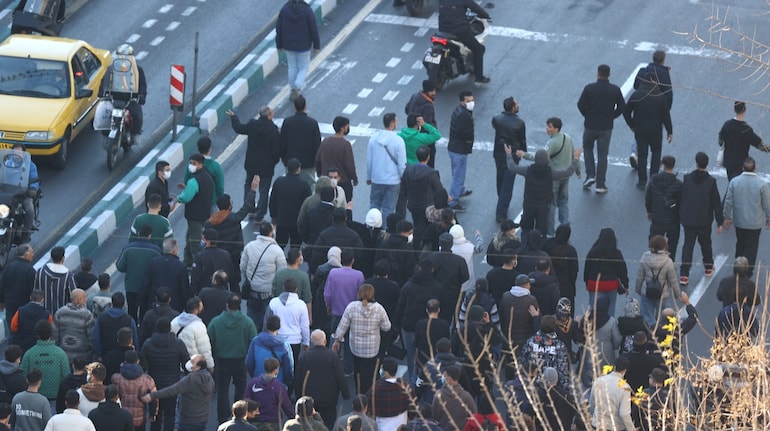
The chant “Mullahs must leave” evolved through repeated waves of protest.
In 1999, student demonstrations demanding press freedom were violently suppressed.
In 2009, millions joined the Green Movement, protesting election fraud and openly questioning the Supreme Leader’s authority.
By 2017–18, economic protests moved beyond reformist slogans to direct rejection of the system itself.
The real turning point came in 2022, after the death of Mahsa Amini in morality police custody. Protests erupted nationwide, with women and youth at the forefront. Slogans such as “Death to the dictator” and “Clerics get lost” signalled a profound cultural shift.
Fear had broken, and so had the illusion of reform from within.
Why the Chant Resonates Today
The power of “Mullahs must leave” lies in three deep realities.
First, religious legitimacy has collapsed. Many Iranians now view clerical rule as coercive, corrupt, and even anti-Islamic.
Second, there is a generational rupture. More than 60 percent of Iranians were born after 1979. They do not see the revolution as sacred or untouchable.
Third, daily survival has overtaken ideology. When people struggle to afford food, medicine, or housing, religious slogans lose their power.
More Than a Rejection of Religion
Importantly, the slogan does not reject Islam itself. It rejects political clericalism, unelected religious supremacy, and the fusion of mosque and state. At its core, it calls for a return to religion as belief and conscience—not governance.
Conclusion: History Turning Inward
Iran’s history has come full circle. Clerics once rose by opposing tyranny; today, they are challenged for embodying it. “Mullahs must leave” is not merely a chant—it is the voice of decades of accumulated disappointment.
Whether or not it brings immediate change, the slogan marks a profound shift in Iran’s political consciousness—one that the ruling establishment can no longer ignore.
