
Moscow sees world order turns ‘Multi-polar’, looks India as anchor says spokesman Peskov

By Anjali Sharma
WASHINGTON – Kremlin spokesperson Dmitry Peskov on Tuesday in a wide-range conversation with Indian journalist cast India as a “great friend” and a pivotal actor in a world where “rule of law has been ruined, trade norms broken” and the promise of globalization weakened.
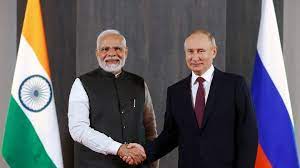
Russia signaled a sweeping ambition to reshape its partnership with India for what it describes as an emerging multi polar world, one defined, Moscow implied, as much by American unpredictability as by the rise of new centres of power. President Vladimir Putin prepares for a two-day state visit to New Delhi beginning December 4
In a wide-ranging conversation with Indian journalists on Tuesday, Kremlin spokesperson Dmitry Peskov cast India as a “great friend” and a pivotal actor in a world where “rule of law has been ruined, trade norms broken”, and the promise of globalization weakened.
He suggested that Russia and India, long-time strategic partners, could work together “to stabilize the whole world” as global power diffuses. “Something new is coming to the world,” he said at an event hosted by the Russian agency Sputnik. “A vision of a multi-polar order.”
His remarks came ahead of Putin’s first trip to India in several years, an event Moscow says will draw “global attention” as the two countries prepare to sign a slate of agreements spanning defense, nuclear energy and trade.
Peskov stressed that the India-Russia relationship needs to be shielded from outside influence, clearly underlining Washington’s growing pressure on New Delhi over its energy purchases from Moscow.
“We are very sensitive to any interference by third countries,” Peskov said, adding that Russia “cannot interfere” in India’s tariff tensions with the United States but views them as a factor in how it structures its own partnership with New Delhi. “We have to create an architecture free of any influence from any third country.”
His comments followed a year in which the United States imposed a punitive 50 per cent tariff on certain Indian goods, citing India’s discounted imports of Russian crude amid Western sanctions on Moscow.
Peskov praised India’s tradition of strategic autonomy. “We admire India’s sovereignty in defining its national interests,” he said.
He said one of the most closely watched items on the agenda is the possible Indian acquisition of Russia’s Su-57 fifth-generation stealth fighter, a proposal long discussed but not advanced. “The SU-57 is the best plane in the world,”
Peskov stressed that, “It will be on the agenda.”
The comment came as India’s parallel negotiations with the United States for the F-35 have faltered over technology-transfer concerns.
A Su-57 deal, if concluded, would give India access to advanced stealth technologies and potentially offer co-production or deeper integration into joint development, long-sought goals for New Delhi.
He said that additional S-400 air-defence systems and a new Reciprocal Exchange of Logistics Support pact, which would grant each country access to the other’s military bases and ports, expanding India’s reach from the Indo-Pacific to the Arctic and giving Russia a firmer logistical foothold in the Indian Ocean.
Russia, Peskov said, still accounts for 36 per cent of India’s military inventory, and both sides are now focused less on transactional arms sales and more on “advanced technological know-how” and co-development of complex systems.
On civil nuclear cooperation, a key pillar of the relationship since the Kudankulam project is to be elevated sharply.
Peskov said Russia is “the best manufacturer of small nuclear reactors,” called its experience “of real value” as India expands its own SMR program. Rosatom and India’s Department of Atomic Energy are advancing work on larger VVER-1200 reactors as well as small modular units that could anchor the next generation of India’s civilian nuclear capacity.
He said the agenda reflects a push toward serial construction and higher localization of components, a long-standing Indian goal.
Bilateral trade has soared past USD 63 billion, the highest on record, largely driven by India’s imports of discounted Russian oil, gold and minerals.
Both sides aim to reach USD100 billion by 2030. But the trade is sharply imbalanced.
“We are selling much more than we are buying from India,” Peskov acknowledged. To address that gap, Moscow plans to convene a new forum of Russian importers to expand Indian exports in services, investments and goods. At the heart of the economic discussion is a shared concern over American and European sanctions, which Peskov called “illegal” because they lack UN approval. Russia, he said, is determined to construct a trading order “secure from third-party interference,” a goal that has accelerated a shift toward rupee-rouble settlements and broader de-dollarization.
“The share of the US dollar is reducing,” he said. “Not as fast, but it is a trend.” The International North–South Transport Corridor, linking India to Russia via Iran, is central to that effort, expected to move millions of tonnes of cargo once fully operational. Asked about instability across South Asia, from youth unrest to political upheaval, Peskov said Russia is prepared to assist “in whatever way we can” to promote peace and prosperity. On Afghanistan, he noted that Moscow has increased engagement with the Taliban government. “Afghanistan has a de facto government,” he said.
“We understand that we have counterparts there, and we have joint interests in the region.”
He said the topic is likely to be a quiet but important element of the Modi-Putin discussions, with both countries concerned about terrorism spill-over, narcotics flows and the vacuum left by the US withdrawal.
India and Russia have framed their ties as a political constant amid geopolitical upheavals since the signing of the Strategic Partnership in 2000 and its elevation in 2010.
Peskov leaned heavily on that narrative, stated the relationship is “not merely a set of protocols” but grounded in longstanding mutual trust.
He asserted that whether that legacy can carry the partnership through a period of U.S.–China rivalry, financial sanctions, and divergent economic trajectories is now one of the most consequential questions facing New Delhi’s foreign policy.
Both sides appear intent on signaling that their partnership, forged in an earlier era, is being recalibrated to survive the next one as Putin prepares to land in New Delhi.
