

Poonam Sharma
A familiar political storm has once again erupted around the Rashtriya Swayamsevak Sangh and its chief, Mohan Bhagwat. Congress leader Rao accused Bhagwat of having only one agenda: turning India into a “Hindu Rashtra” and erasing Mahatma Gandhi’s legacy from national life. He alleged that even welfare schemes like MNREGA are under threat of being renamed by replacing Gandhi’s name with that of Lord Ram, calling on people to “fight” to stop such moves and warning that India, being a secular nation, can never become a Hindu country.
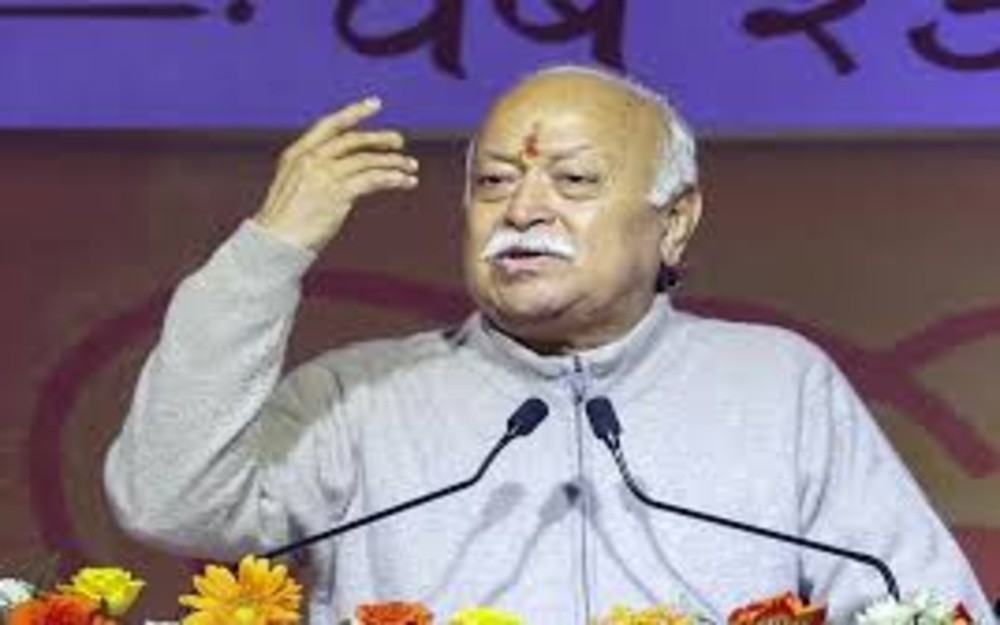
After a long while, Sri Mohan Bhagwat ji has delivered a speech that restores a spirit many felt had faded from public discourse.. Yet, when placed alongside what Mohan Bhagwat actually said in Hyderabad, the contrast is striking. The RSS chief did not speak about dismantling the Constitution or erasing history. He spoke about civilisational responsibility, cultural resurgence, and India’s role in a deeply fractured world.
Bhagwat said that India must once again work towards becoming a Vishwaguru, not out of dominance or ambition, but because the world today is in moral, social, and spiritual turmoil. According to him, this responsibility arises from India’s civilisational ethos, rooted in Sanatana Dharma—a way of life that has survived invasions, colonisation, and ideological assaults over thousands of years.
Referring to a declaration made nearly a century ago by Yogi Aurobindo, Bhagwat recalled the belief that the resurgence of Sanatana Dharma was part of a larger historical process. Yogi Aurobindo had said that this resurgence was not merely a human plan, but something that history itself was moving toward. Bhagwat asserted that the moment described then has now arrived.
Predictably, his statement that Bharat, the Hindu nation, Sanatana Dharma, and Hindutva are synonymous . Such reactions often ignore a fundamental truth: Sanatana Dharma has never been a narrow religious code. It has been a civilisational framework—one that absorbed diversity rather than suppressing it, one that allowed different paths, philosophies, and beliefs to coexist.
What Bhagwat emphasised was organisation. He spoke about the efforts of the Sangh in India and Hindu Swayamsevak Sanghs across the world to organise Hindu society—not to attack others, but to create a community that is socially conscious, ethically grounded, and capable of standing up for itself. His vision was of a society that leads by example, showing the world how religious and moral life can coexist with modernity.
This message becomes particularly important when viewed against the disturbing reality unfolding in Bangladesh. Over recent months, reports of violence against Hindus there—attacks on temples, homes, and livelihoods—have repeatedly surfaced. Hindu families have spoken of fear, insecurity, and abandonment. These are not abstract ideological debates; they are lived realities for people whose only fault is their identity.
History teaches a harsh lesson: communities that remain fragmented and silent in the face of hostility often become easy targets. The suffering of Hindus in Bangladesh is not an isolated tragedy; it is a reminder of what happens when a community lacks social cohesion, political voice, and cultural confidence.
In this context, Bhagwat’s call should be understood not as a push for domination, but as a warning against complacency. Self-defence does not always mean physical confrontation. Often, it begins with unity, awareness, cultural self-respect, and the willingness to assert one’s rights through lawful and democratic means.
For decades, Hindus have been conditioned to believe that any assertion of identity is dangerous, while silence is virtuous. Yet silence has not protected Hindu minorities in neighbouring countries. Silence has not prevented the steady erosion of their numbers, their rights, or their security.
The debate over secularism also needs honesty. Indian secularism was never meant to demand cultural amnesia from the majority. It was meant to ensure dignity and safety for all. When the vulnerabilities of Hindus—especially outside India—are dismissed or ignored, secularism begins to look selective rather than principled.
Mohan Bhagwat’s speech, therefore, carries a deeper message. It urges Hindus to stop being apologetic about their civilisation. It asks them to organise socially, preserve their cultural memory, and ensure that future generations are not left defenceless—physically, psychologically, or culturally.
It is a call to recognise that civilisations survive only when their people take responsibility for their continuity. In a world where identity-based violence is rising, pretending that Hindus are immune to such threats is both naïve and dangerous.
As violence against Hindus in Bangladesh reminds us, the cost of disunity is paid by the weakest first. Bhagwat’s words, whether one agrees with them or not, are a reminder that dignity, security, and survival are not guaranteed by slogans alone. They require awareness, organisation, and the courage to stand firm—peacefully, lawfully, and without fear.
In that sense, the message is not political. It is civilisational. And for many Hindus watching events unfold beyond India’s borders, it feels less like an ideology and more like an urgent warning.
