
Modi–Putin Viral Car Photo Sparks Debate in US Congress
Democrat warns Trump’s tariffs are driving India toward Moscow, harming strategic trust

GG News Bureau
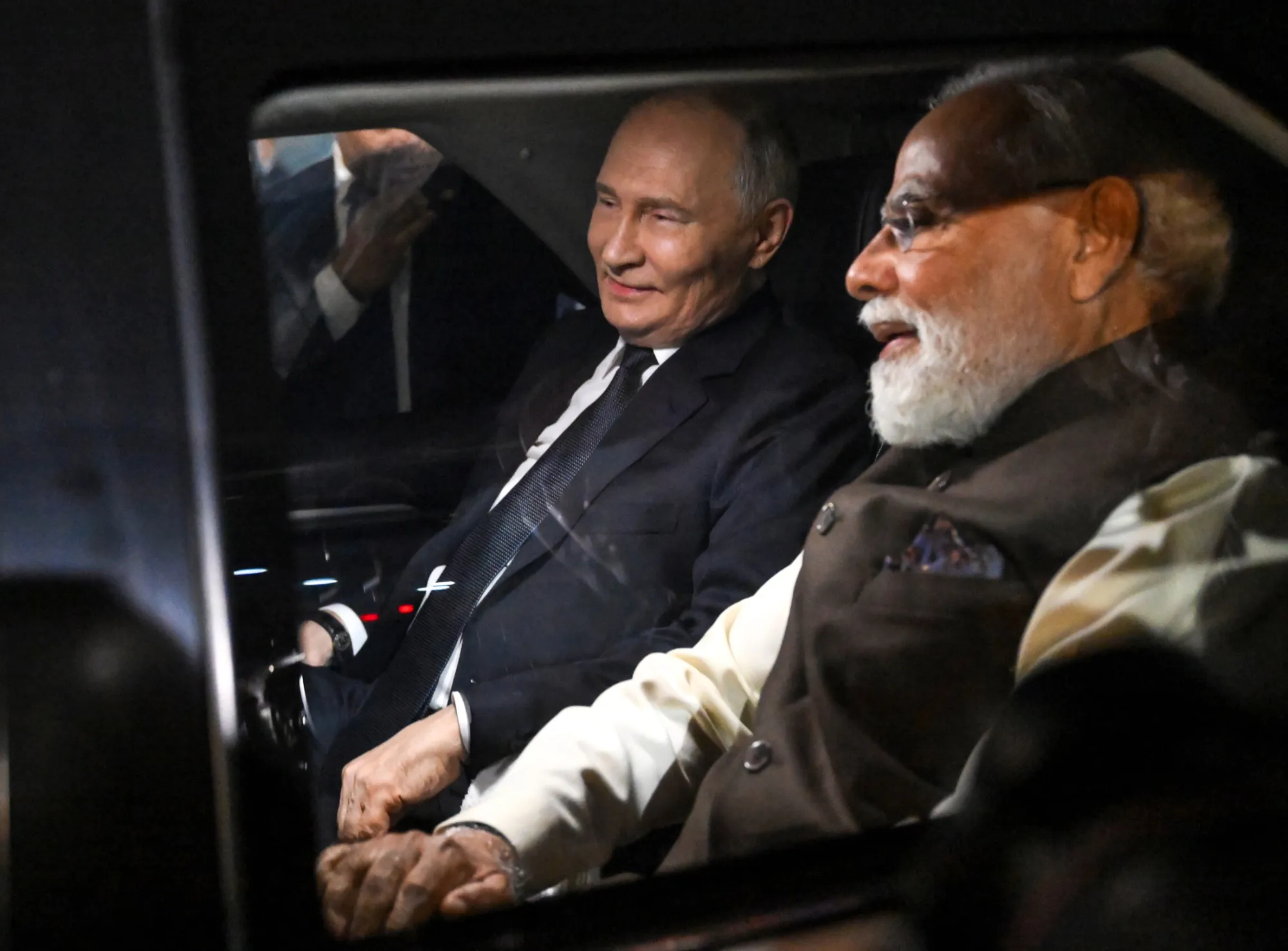
Washington DC, 11th Dec: The now-viral photograph of Prime Minister Narendra Modi and Russian President Vladimir Putin sharing a car during the latter’s recent visit to India made a dramatic appearance in the United States Congress, used by a Democrat lawmaker to warn that President Donald Trump’s tariff-heavy approach is driving India closer to Moscow.
During a House Foreign Affairs Subcommittee hearing on the US–India strategic partnership, Democratic Ranking Member Sydney Kamlager-Dove held up a poster of the Modi–Putin image and declared that it was the United States—not India—that was undermining the relationship.
“Trump’s policies towards India can only be described as cutting off our nose to spite our face,” she said. “Being a coercive partner has a cost, and this poster is worth a thousand words.”
Kamlager-Dove accused Trump of unravelling decades of bipartisan progress, warning, “Unless he changes course, Trump will be the American President who lost India.” She argued that Biden had handed Trump a strong relationship—marked by a revitalised Quad, expanding defence technology ties and trusted supply-chain cooperation—only for it to be, as she put it, “flush, flush, flush down the toilet.”
Central to the congressional criticism were Trump’s 25 per cent “Liberation Day tariffs” on Indian imports, followed by an additional 25 per cent levy on India’s imports of Russian oil—creating a total tariff burden of 50 per cent.
“The tariff rate on India is currently higher than the tariff rate on China,” Kamlager-Dove said, calling the policy “self-defeating.”
Tensions escalated further after Modi personally received Putin at Delhi airport during the Russian president’s visit last week, with both leaders later sharing a car ride to the Prime Minister’s residence. The gesture—framed by Delhi and Moscow as a sign of personal warmth—heightened alarm among US lawmakers concerned about India’s strategic drift.
She also criticised Trump for imposing a $100,000 fee on H-1B visas, 70 per cent of which are held by Indians, calling it “a rebuke of the incredible contributions Indians have made to the US.”
Dhruva Jaishankar of ORF America testified that negotiations on a trade agreement had made substantial progress earlier in the year and suggested that a solution was “at hand” if political will existed in Washington.
Other witnesses cautioned that escalating tariffs were overshadowing urgent strategic priorities—including countering China, strengthening supply chains and maintaining a stable Indo-Pacific partnership.
“This has been a low-cost, high-benefit partnership for the United States,” one expert told the panel. “It would be strategic malpractice of the highest order to discard the trust we have built.”
The hearing made clear that the tariff confrontation has become the most politically charged issue in the US–India relationship, with lawmakers warning that mishandling ties with New Delhi could carry far-reaching consequences—not only for bilateral ties but for broader Indo-Pacific strategy.
The Modi–Putin photo, once a moment of diplomatic warmth, has now become a potent symbol in Washington’s heated debate over foreign policy, tariffs and America’s future in the world’s most consequential democratic partnership.
