
Modi–Putin Breakthrough: India–Russia Unveil Their Most Powerful Strategic Shift
“Modi–Putin Summit: A New Strategic Chapter Begins With Symbolism, Big Deals and a Nuclear Future.”

Paromita Das
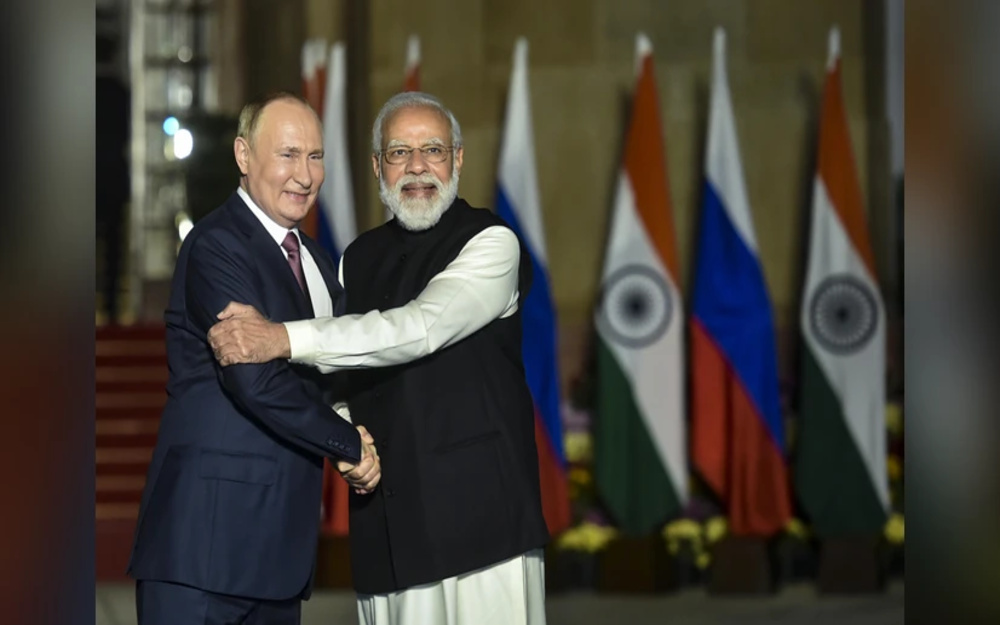
New Delhi, 6th December: At a time when the global order is shifting faster than ever, Prime Minister Narendra Modi and Russian President Vladimir Putin have scripted one of the most consequential chapters in modern Bharat–Russia relations. Amid geopolitical tensions, sanctions, and global power realignments, the two leaders met in New Delhi with a clarity of purpose that went far beyond diplomatic courtesy.
While headlines captured the moment Modi presented Putin a copy of the Bhagavad Gita, what unfolded behind the scenes—and later in official statements—was far more significant. From defence and energy to employment, nuclear expansion and a proposed “no-limits partnership,” this visit was anything but symbolic. It revealed Moscow’s deeper strategic interests and Bharat’s growing centrality in the Asian balance of power.
A Visit Watched by the World—Literally
Putin’s travel to Bharat wasn’t a routine diplomatic trip. With the International Criminal Court issuing a warrant against him, his aircraft was tracked online by nearly 48,000 people—a number unheard of for any foreign leader’s movement.
The route itself reflected geopolitical calculations: flying over Kazakhstan, Turkmenistan, Iran, Afghanistan, and even Pakistan before entering Bharatiya airspace. When Putin stepped off the aircraft at Delhi’s Palam Airport, Modi broke protocol to receive him personally—an unmistakable message of trust amid Western pressure.
Behind the Gita Gift: Symbolism with Strategy
The moment President Putin held the Bhagavad Gita in his hands became instantly viral—not just in Bharat but across parts of the Islamic world. The image was powerful: a Russian President embracing Bharat’s civilizational text at a time when many global powers are engaging in cultural diplomacy battles.
Putin reportedly told Modi that Bharatiya philosophy has stood as an anchor for global peace—comments that carry strategic meaning when viewed against current world tensions.
But beyond the symbolism, the summit produced concrete, large-scale agreements that will reshape Bharat’s economic and strategic position for decades.
Major Deals That Define the Modi–Putin Meeting
- Bharat–Russia’s Mega Nuclear Leap
The highlight was the forward movement on nuclear cooperation.
Bharat and Russia confirmed progress on Asia’s largest nuclear power complex at Kudankulam, Tamil Nadu. Even before Putin returned to Moscow, a fresh consignment of Russian nuclear fuel had already reached Bharat—signalling acceleration in the project timeline.
- A Game-Changing Move in Fertilizer Production
Bharat currently imports large amounts of urea from Russia. But now, both nations will jointly manufacture urea, reducing Bharat’s dependence and stabilising agricultural input prices—a significant economic shift.
- Russia to Offer High-Salary Jobs to Bharatiya Professionals
With American and European companies cutting jobs, Moscow has agreed to recruit more Bharatiya workers with higher pay packages and simplified work rules. This opens a new corridor for skilled Bharatiya talent.
- Cooperation in Health and Medical Education
The two leaders signed agreements covering health services and medical education—an area where Bharat already has global strengths and Russia has emerging needs.
- The Maritime Defence Pact
Perhaps the most strategically sensitive deal is the new maritime cooperation agreement. Under it, Bharat and Russia will assist each other in critical oceanic security situations.
This means:
If Pakistan or even the US attempts any maritime manoeuvre against Bharat, Russia is obligated to back Bharat.
The Proposal That Could Change Asia: Russia Wants a ‘No-Limits Partnership’
In a dramatic strategic turn, Russia has asked Bharat for a “no-limits partnership”, a relationship without policy restrictions.
This is the same model Russia once signed with China under compulsion during the Ukraine war.
But Putin now wants to shift his long-term bet to Bharat because:
- China is staking claims on Russian territories
- Beijing’s ambitions in Central Asia unsettle Moscow
- Bharat offers a more stable, democratic, and trusted long-term partnership
A no-limits partnership with Bharat could fundamentally alter the Asian power equation—and will certainly unsettle Beijing.
Energy, Sanctions and a Message to the West
Putin openly challenged the United States’ criticism of Bharat’s Russian oil imports, saying:
“America itself buys our oil. Then why question Bharat?”
This was a direct signal that Moscow views Bharat as a sovereign partner—not one to be pressured by Western sanctions. Bharat continues to buy discounted Russian crude, insulating itself from global price shocks.
Bharat’s Gift to Russia: Visa Liberalisation
Modi also offered something valuable to Russian citizens:
free 30-day e-tourist visas and group tourist visas.
This is seen as a major boost to people-to-people ties and tourism.
Putin acknowledged the gesture, noting that Russians have long admired Bharatiya culture and heritage.
A Strategic Realignment in Motion
This summit should not be read as a routine diplomatic exchange. It signals a long-term strategic realignment in Asia. Russia, facing sanctions and seeking stable partners, is pivoting toward Bharat in a way it has never done before.
Bharat, meanwhile, is leveraging this moment to strengthen its defence, energy security, employment avenues, and global influence.
The Modi–Putin chemistry is often debated, but the outcomes of this summit leave no room for doubt: both leaders see each other as indispensable in the emerging world order.
The Beginning of a New Bharat–Russia Era
From nuclear power to maritime defence, from economic collaboration to cultural symbolism, the Modi–Putin summit marks the beginning of a new era in Bharat–Russia relations.
A partnership once rooted primarily in defence now spans energy, technology, jobs, agriculture, tourism, and geopolitics.
And as President Putin returned to Moscow—with the Bhagavad Gita in hand and new agreements in place—one message was clear:
Bharat and Russia are preparing for a future where their cooperation shapes the Asian balance of power.
