
Modi’s Historic Temple Ritual Bridges 1000-Year Civilisational Gap

Paromita Das
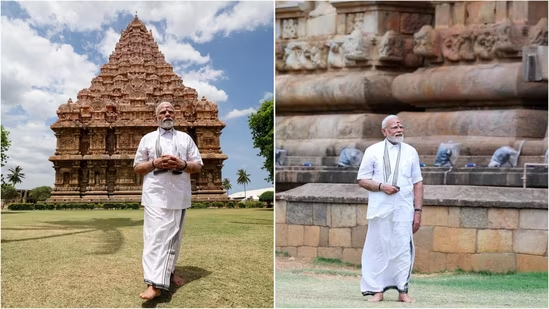
New Delhi, 31st July: When Prime Minister Narendra Modi offered Ganga jal at the grand temple of Gangaikonda Cholapuram on July 27, 2025, he did more than perform a ritual. He reignited a civilisational memory long buried under political apathy and ideological hostility. In a moment that transcended the language of politics, Modi stood at the very site where, a thousand years ago, Rajendra Chola I—emperor, devotee, and builder—had brought the Ganga to the Tamil land, connecting South Bharat with the spiritual lifeblood of Bharat.

Much like his earlier intervention that spotlighted Lakshadweep tourism in the wake of the “India Out” campaign in the Maldives, Modi’s visit to Tamil Nadu’s spiritual heartland wasn’t just a political move. It was an assertion of cultural confidence, a reclaiming of heritage, and a civilisational outreach designed to remind every Bharatiya—especially Tamils—that their pride is inseparable from the roots of Hindu Dharma.
A Civilisational Reunion, Not Just a Political Tour
The timing was poignant. Marking the 1000th anniversary of Rajendra Chola’s consecration of the temple with Ganga water, Modi’s act of abhishekam was a deliberate echo across a millennium. In doing so, he became the first Prime Minister to participate in this ritual at Gangaikonda Cholapuram, not merely as a leader of a party, but as a messenger of continuity—joining past and present in a sacred chain of devotion.


He followed the act by unveiling a commemorative coin in Rajendra Chola’s name and announcing statues of both Rajaraja and Rajendra Chola in Tamil Nadu—signals not of political tokenism, but of civilisational anchoring. These were acts of national homage to a legacy that had, for too long, been disowned or diluted by ideological filters.
Rajendra Chola: The King Who United Bharat in Spirit
Built after a victorious campaign to the Gangetic plains, the city of Gangaikonda Cholapuram—literally “the city of the Chola who brought the Ganga”—was more than an imperial capital. It was a statement. Rajendra Chola’s act of transporting sacred water from the Ganga to Tamil Nadu was a profound unification—of geography, faith, and polity. It was a spiritual synthesis of north and south under the broader embrace of Sanatana Dharma.

The Brihadisvara Temple that still stands there today is one of Bharat’s most resplendent architectural wonders—a 13-foot Shiva Lingam, towering vimanas, and intricate sculptures singing the story of Tamil Nadu’s role in Bharat’s soul. In Modi’s abhishekam, it was not just water that flowed from north to south—but memory, reverence, and unity.
DMK’s Erasure vs Modi’s Remembrance
In stark contrast, the current ruling establishment in Tamil Nadu, led by the DMK, continues to undermine these very links. The party that once sneered at the Ganga as a “north Indian river” today finds itself cornered by history. The temple that Rajendra Chola built in devotion to Lord Shiva is the same that modern Dravidian ideologues sideline in school textbooks.

By resisting the National Education Policy (NEP), which aims to reintroduce forgotten Hindu rulers like the Cholas into academic discourse, the DMK reveals its discomfort not with history—but with heritage. Its narrative has long attempted to pit Tamil identity against Hindu identity, promoting anti-Brahmin, anti-North, and anti-Hindu rhetoric that bears little resemblance to the Cholas’ own legacy.
Modi’s visit has challenged this narrative head-on.
A Temple as Testament to Unity
To the people of Tamil Nadu, the Chola temples are not relics—they are living institutions of devotion. Gangaikonda Cholapuram stands today not only as a UNESCO-recognized marvel but as a spiritual beacon. The same waters that once flowed from the Himalayas to this site a thousand years ago were brought once again—not for spectacle, but for sanctification.

This act was not just about reconnecting with ancient rituals; it was about asserting that Tamil Nadu is not a fringe of Bharat—it is its sacred centre. It was a reminder that Bharat’s story cannot be told without the Cholas, without the temples, without the dharma that binds north and south in shared sanctity.
Modi’s Message: Tamil Pride is Hindu Pride
Modi’s invocation of the Chola legacy was not accidental. In a state where Periyarist ideologues have spent decades rejecting Hindu civilisational heritage in favour of divisive identity politics, the Prime Minister’s message was stark: “Your greatness is not in rejecting dharma, but in reclaiming it.”

This is why his words resonated. He did not arrive bearing political slogans. He came with Ganga jal, with coin, with tribute—and most importantly, with recognition. Recognition that Tamil Nadu’s soul was never meant to be isolated from the rest of Bharat. That its temples are not regional monuments but national treasures. And that its ancient kings were not rebels but revered emperors of Dharma.
A Spiritual Reunion for a Nation at Crossroads
In a time when ideological fault lines attempt to fragment Bharat into regions, castes, and linguistic enclaves, PM Modi’s visit to Gangaikonda Cholapuram was a profound act of civilisational healing. By offering the Ganga back to Shiva in the heart of Tamil Nadu, he did not just perform a ritual—he completed a circle.
The abhishekam was a message to every Bharatiya: our strength lies in our unity of culture, not our division of identity.
Tamil Nadu’s pride is not in political resistance, but in civilisational reverence. Rajendra Chola’s legacy has not been forgotten—it has been reborn. And in that rebirth lies the promise of a Bharat that remembers not only where it is going, but where it came from.
