
The Modi Doctrine—Power Without Noise
The Silent Strategist: Why Modi’s India Speaks Softly But Strikes Hard

Poonam Sharma
In a fast-shifting geopolitical landscape where global alliances are being redrawn, India under Prime Minister Narendra Modi is not just surviving — it is thriving. While much attention is often drawn to confrontations with giants like China or diplomatic skirmishes with Turkey, it is Modi’s subtler and more calculated moves that are reshaping India’s global standing. In a deep dive of his diplomacy, one finds a long-term policy of not noise but quiet leverage, strategic alliances with small resource-endowed nations, and an unwavering knowledge of the weak points of the globe. It is not just foreign policy. It’s Chanakyan statecraft at work — well-planned, well-timed, and tactically operated.
Blueprint in 21st-Century Diplomacy
Prime Minister Narendra Modi’s foreign policy strategy reflects the timeless wisdom of Acharya Chanakya, particularly his four cardinal principles for defeating adversaries: patience and self-control, waiting for the right moment, understanding the enemy’s weakness, and forging strategic alliances.
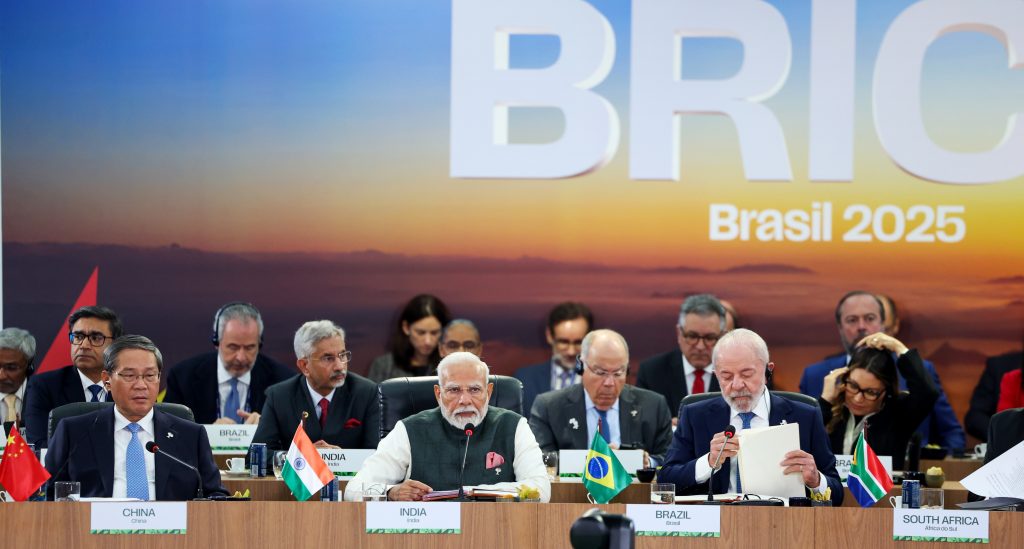
Nowhere is this more evident than in India’s calculated approach to Turkey. Even as Turkey resorted to repeated provocations — from its vocal endorsement of Pakistan on the question of Kashmir, criticism of India’s abrogation of Article 370, and anti-India positions in international forums — Modi never responded in terms of hostility or loose talk. On the contrary, he was marked by great restraint, refusing to take on directly Turkish President Recep Tayyip Erdoğan’s belligerent posturing. That self-restraint reached its peak in a diplomatic coup at the July 6-7 BRICS Summit in Rio de Janeiro. As Turkey forcefully lobbied for BRICS membership to project its status as a voice for the Islamic world, India went quietly about its work with fellow member countries to keep Ankara out. Meanwhile, India gave unambiguous support for the inclusion of Saudi Arabia — Erdoğan’s geopolitical rival. This move not only dealt a heavy blow to Turkey’s ambitions but also shifted the balance of influence in the Islamic world without a single public confrontation. Modi’s approach was a textbook demonstration of Chanakya’s statecraft — exercising restraint, striking at the most opportune moment, and leveraging diplomatic alliances to isolate and weaken an adversary. Far from theatrics, this is foreign policy as subtle power: calculated, targeted, and expansive.
Turkey’s BRICS Debacle: A Strategic Victory for India
Turkey’s President Recep Tayyip Erdoğan has two key desires: To be the Great Leader of the Muslim world ,To join influential global blocs like BRICS in order to legitimize that status
Turkey has long advocated for causes such as Uyghur Muslims in China – something even Pakistan will not have the courage to talk about. Erdoğan wishes to be regarded as a strategic and moral leader among Muslims globally, frequently bucking Saudi Arabia’s traditional hegemony. But India, knowing Turkey’s opportunism and hostility, waited out the long game. It allowed Erdoğan to gain momentum and hubris. Then, at the exact international moment, India made sure that Turkey’s bid to join BRICS stalled. In collusion with China — ironically, India’s own competitor — both countries rejected Turkey’s membership. They had different motives (China is angry at Erdoğan’s criticism on Xinjiang, India for his backing of Pakistan), but the outcome was the same.
Turkey was pushed aside.Saudi Arabia was embraced.And the internal pecking order of the Islamic world was reordered — with much credit due to India.
Global Minerals War: China’s Blockade and India’s Response
As geopolitical one-upmanship grabs headlines, another war is also under way — but a quieter, resource-based conflict. One that concerns the essential minerals of the modern economy: rare earths, lithium, cobalt, and graphite — key to semiconductors, electric cars, missiles, and clean energy systems.
China dominates more than 60% of global rare earths and more than 80% of the refining capacity. It’s a monopoly it’s willing to turn into a weapon.
When India-China relations turned bitter after Galwan, Beijing stopped exporting rare earth minerals to India. The threat to India’s tech and defense infrastructure was huge.
But again, Modi showed prudence. Rather than panicking, Modi went quietly about preparing. India had short-term minimal impact owing to reserves, but Modi realized that a long-term solution was indispensable.
Five-Nation Tour: Constructing the New Supply Chain
Modi set out on a five-country tour, strategically visiting nations that are rich in key mineral reserves—South American Lithium Triangle nations (Argentina, Bolivia, Chile) and African nations with rich rare earth reserves.
The aim? To diversify India’s supply chain ,To sign bilateral mining and technology partnerships ,To develop refining facilities within India .And to prevent dependence on adversarial powers such as China
This was not diplomacy. This was strategic building of infrastructure—laying the groundwork for India’s next-generation technological ascendance without blackmail from abroad. When the U.S. and Europe are attempting to build “friendshoring” networks, India is establishing its own mineral cartel, directly with the source nations.
India’s Role Between Superpowers India today holds a unique global position:
It is a central member of BRICS, speaking for the Global South It is consistently invited to G7 Summits, in league with Western democracies .It is a member of Quad, which is dedicated to counterbalancing China in the Indo-Pacifi ,It is fast becoming a important voice in G20, having hosted the summit in 2023 with pride
Modi has strategically ensured that India never falls into either camp. Unlike in Cold War-era alignments, India now has strategic autonomy.
While China is assertive, and the U.S. selectively transactional, Modi is making India deep-engaged with both — but on its terms.
When China restricted rare earths, Modi looked towards Latin America and Africa.When the U.S. expressed concern over India’s increasing independence, Modi kept engaging without overcommitting. It is not neutrality; it is independence and indispensability.
The Erdoğan Contrast: India’s Gain, Turkey’s Pain
The contrast between India and Turkey could not be clearer.Turkey attempted to ascend by attacking India, by collaborating with Pakistan and Malaysia on an Islamist axis, and by confronting China over the Uyghur question. But this alienated nearly all of the great powers.
India, by contrast, ascended by: Exercising restraint Bricking enemies at multilateral venues, rather than in public rhetoric , Quietly forging alliances with the emerging powers ,Securing resource security before crisis,Positioning itself as a bridge, not a wedge,Where Erdoğan employed ambition, Modi employed architecture.Operation Dost and Diplomacy Without Expectation when a destructive earthquake struck Turkey, and India provided immediate humanitarian relief under “Operation Dost,” there was no acknowledgment by Erdoğan.
India did not respond. No diplomatic demarche. No insult campaign.
This very silence was strategic.Modi knows that acts of kindness do not need approval. Neither does India today need approval from the West or the Islamic block for its humanitarianism. It just keeps moving forward.
The Quiet Rise of a Global Power
While the dust settles on the BRICS conference and Erdoğan’s illusions shatter, India stands taller than ever.
Modi’s approach is proving that a nation does not need to shout to be heard. Through patience, partnerships, and preparation, India is becoming not just a regional heavyweight—but a geopolitical swing power the world must engage with.
At a time when global powers are fraying at the edges, India is weaving its own path—one that is inclusive, calculated, and firmly nationalistic.
As Chanakya would put it: “The wise man waits in silence. When the time comes, he strikes—not with force, but with consequence.”
Narendra Modi is living that wisdom. And the world is finally starting to no
