
Mexico’s New Tariff Shock: How a 50% Duty Spike Rewrites Bharat’s Trade Equation
“Mexico’s steep new tariffs on Asian imports reveal a deeper geopolitical tightrope—one shaped by US pressure, domestic politics, and the shifting balance of global trade power.”

Paromita Das
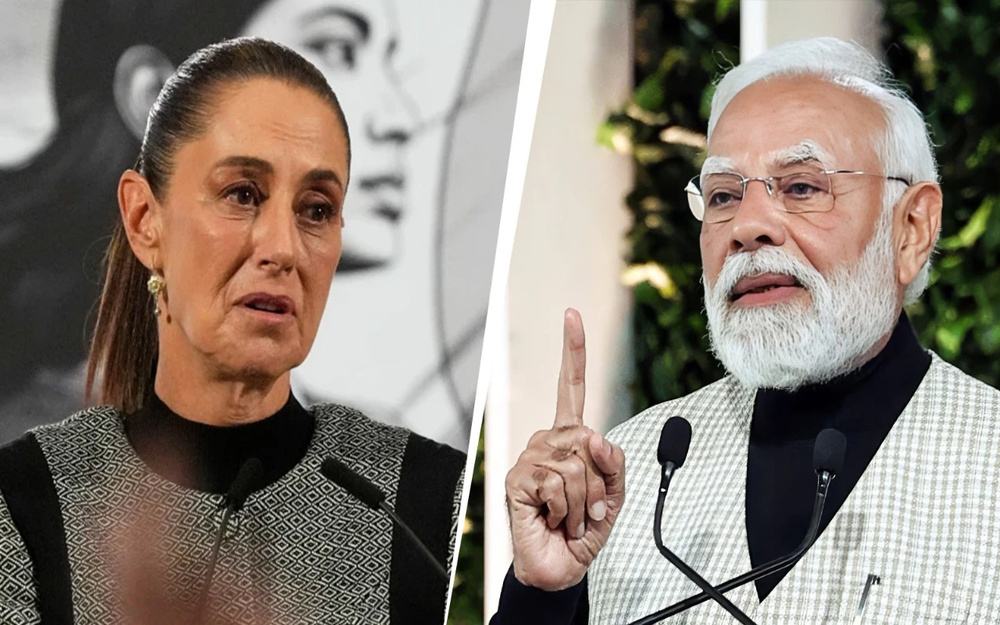
New Delhi, 13th December: The global trade landscape has entered yet another turbulent chapter. What began as a tariff war between the United States and its economic rivals has now spiralled into unexpected territories. This time, Mexico—a country often seen as a bridge between North America and the Global South—has fired its own tariff salvo. In a move that stunned many observers, Mexico has imposed duties of up to 50% on a vast range of imports from Bharat, China, South Korea, Thailand, and Indonesia.
For Bharat, this announcement feels like déjà vu. Only days earlier, the United States raised its tariffs on certain Bharatiya goods to 50%. And now, another American ally has followed suit. This is not just another policy decision; it is a signal that Bharat must navigate an increasingly hostile global trade order where political alignments matter as much as economic logic.
Why Mexico Pulled the Trigger
At first glance, Mexico’s decision appears to be a domestic economic move—an attempt to protect local industries, build manufacturing strength and reduce import dependency. But scratch beneath the surface, and the timing tells a far more interesting story.
President Claudia Sheinbaum is under visible pressure. With the 2026 review of the US-Mexico-Canada Agreement (USMCA) approaching, the United States—Mexico’s biggest partner and biggest critic—has been tightening the screws. President Donald Trump has repeatedly accused the Mexican government of failing to curb fentanyl smuggling. He has threatened tariff after tariff: 50% duties on steel and aluminium, a 25% levy on top of that, and even a blunt 5% tariff linked to a decades-old water-sharing treaty.
In short, Mexico has been cornered.
This new tariff decision, then, fits into a broader political choreography. By targeting Asian economies like Bharat and China—countries without preferential trade agreements—Mexico signals alignment with Washington’s protectionist worldview. It also sends a strategic message: Mexico is willing to shift its import landscape to reduce friction with Washington ahead of a crucial trade treaty review.
Economically, the Mexican government expects to earn nearly $3.76 billion in additional revenue next year. Politically, it hopes to buy goodwill from the White House. Whether it succeeds—or finds itself isolated later—is a question only time will answer.
The Impact on Bharat’s Growing Trade Presence
For Bharat, Mexico was not just an export destination; it had quietly become an important and fast-growing market. Bilateral trade reached a record $11.7 billion in 2024. Bharat enjoys a sizeable trade surplus, exporting almost $8.9 billion while importing just $2.8 billion.
Bharatiya automobiles, auto components, passenger vehicles, pharmaceutical formulations, textiles, and plastics form the backbone of this export basket. The Tata Motors–Mexico equation alone has been one of Bharat’s most successful global auto stories, with Bharatiya vehicles steadily capturing market share.
A 50% tariff changes that equation overnight.
Bharatiya manufacturers now face the possibility of:
- Declining demand
- Lost competitiveness against countries with preferential agreements
- A potential slowdown in new investments
- Disrupted supply chains across the Americas
Mexico was Bharat’s gateway to North America without the baggage of US-China tensions. Now, that gateway has become narrower, costlier, and politically unpredictable.
But the impact is not one-sided. Mexican consumers and Mexican automobile retailers will also face higher prices and reduced choices. Bharat’s auto and engineering goods are competitively priced and reliable—any reduction in imports will inevitably raise costs for Mexican businesses.
The Broader Geopolitical Undercurrent
Viewed from a distance, this is not a Bharat–Mexico story. It is a story of a world where globalisation is no longer driven by economic efficiency but by strategic alliances. Trade policy has become an extension of foreign policy.
The United States remains the centre of gravity in this realignment. Any country geographically or economically tied to Washington now finds itself pulled into its protectionist orbit. Mexico, heavily dependent on US markets, supply chains, and labour flows, simply cannot afford a full-blown trade confrontation with Washington.
And so, the tariff gun is pointed at the next easiest target—Asian exporters without free trade protections.
This is not unlike the early phases of the US-China trade war, where smaller economies were compelled to pick sides. Bharat now finds itself on a familiar battlefield, without firing a single shot.
A Wake-Up Call for Bharat’s Trade Diplomacy
Bharat has long spoken of reshaping global value chains. But moments like this highlight how vulnerable even fast-growing economies are to political shocks. If Mexico—a strategic partner in Latin America—can suddenly impose 50% tariffs, Bharat must rethink its approach to trade agreements.
For decades, Bharat has been cautious in signing bilateral and regional FTAs. That caution has protected its farmers and small industries, but it has also left exporters exposed to the whims of global politics. Mexico’s decision should serve as a reminder that without strong trade alliances, even successful export markets can disappear overnight.
Bharat cannot fight tariffs one country at a time. It needs a broader, more confident trade strategy—one that secures footholds in regions where geopolitical winds shift quickly.
A Decision With Wider Ripples
Mexico’s tariff hike is more than a trade policy—it is a moment of realignment in an increasingly fractured global order. By targeting Asian economies, Mexico signals both economic caution and political calculation. For Bharat, the impact will be immediate but not insurmountable. What matters now is how New Delhi responds—with stronger diplomacy, smarter trade partnerships, and a long-term vision for its exporters.
Whether Mexico’s move wins President Trump’s favour or damages its ties with Asian partners remains to be seen. But one thing is clear: in a world where politics dictates trade, countries like Bharat must be ready to navigate sharper turns and tougher storms.
