

GG News Bureau
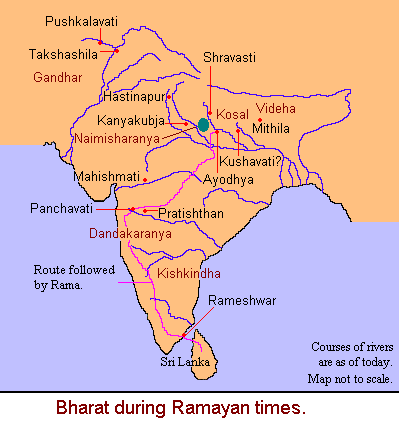
New Delhi, 19th Jan.Shri Ram, Lakshman, and Sita traveled to the jungle approximately nine lakh years ago. He travelled from Ayodhya to Chhattisgarh, Madhya Pradesh, and Rajasthan before crossing the sea from Dhanushkoti in Tamil Nadu, South India, to Sri Lanka. According to the Valmiki Ramayana, Shri Ram discovered Dhanushkodi before Rameshwaram, which is easily accessible from Sri Lanka. Carbon dating of various areas in Bharat and Sri Lanka, particularly the Nuwara Eliya mountain range, has confirmed that many of these sites date back to the Ramayana period.
Tamsa River flows like a rainy river, around 25 kilometres away from Ayodhya. Millions of years ago, this river must have been so large that Shri Ram, Sita, and Lakshman needed a boat to cross it. Rishi Chyavan’s ashram is also located on the riverbank. This is two kilometres inside the Ayodhya-Lucknow Highway. Nowadays, there is still an antique Shiva mandir here. Shringaverpur, located on the Ganga’s banks near Tamsa, is around 20-22 kilometres from Prayag. The narrative of Nishadraj is recorded in Shri RamCharitmanas. Kurai hamlet lies ahead of Shringverpur, and Shri Ram spent the night there with his younger brother and wife.
After this, Shri Ram, Lakshman, and Sita arrived at Maharishi Bhardwaj’s ashram at Prayagraj
Bundelkhand is established by uniting sections of Madhya Pradesh and Uttar Pradesh, and it includes Chitrakoot. Lord Ram traveled from Chitrakoot to Satna to reach Atri Rishi’s ashram. Although Anusuiya’s spouse, Maharishi Atri, lived in Tapovan, Chitrakoot, Shri Ram also dwelt in Ramvan, Satna. Following this, we enter Dandakaranya. Ramkatha aficionado Acharya Rajesh Thakur, an Ayodhya local, claims that Shri Ram arrived in the deep forest after leaving Chitrakoot. Even now, this area is covered in forests. Shri Ram’s exile began here.
Dandakaranya was the name given to some areas in Madhya Pradesh, Chhattisgarh, and Maharashtra. This area was formerly a lush forest, and it still contains the most green space. Dandakaranya encompasses the majority of Chhattisgarh, Odisha, and Andhra Pradesh. Dandakaranya extends from this side of the Mahanadi in Odisha to Godavari. This Dandakaranya includes the city of Bhadrachalam, Andhra Pradesh. This city, located on the banks of the Godavari River, is well-known for its Sita-Ramchandra Mandir. This mandir is located atop Bhadragiri Mountain. Shri Ram is supposed to have spent some days on this Bhadragiri peak during his exile. Following Sita’s abduction, Ravana and Jatayu fought in the skies of Dandakaranya. It is thought that this is the sole Jatayu mandir in the world. After a few days in Dandakaranya, Lord Shri Ram continues on his journey. He arrives in the ashram of Agastya Muni, the great saint of South Bharat. August Muni’s ashram is located in Nashik’s Panchvati region, on the banks of the Godavari River. Lakshman amputated Shurpanakha’s nose here. That is why this place is still known as Nashik today. Shri Ram and Lakshman engaged Khar-Dushan in battle here. Shri Ram’s friendship with Jatayu, the vulture king, also occurred here. Ravana kidnapped Sita and killed Jatayu after Shurpanakha’s nose was severed, and Khar, Dushan, and Marich were murdered at Nashik, Maharashtra. Its remembrance is being kept at Sarvatirtha in Taked village, around 56 kilometers from Nashik. Jatayu died at Sarvatirtha, which is located in Taked village, Igatpuri tehsil, Nashik district. Here is where Laxman had drawn the line.
In addition, the Khammam district of Andhra Pradesh is related with the narrative of Lord Rama. Bhadrachalam is a village in Khammam district. Parnashala, located approximately an hour from Ramalaya, is also known as Panshala, Pansala, and so on. It is likewise situated on the banks of the Godavari River. Some academics believe Ravana’s Pushpak Viman landed at this location.
The old Ram-Sita mandir still stands here
According to Vishwa Hindu Parishad leader Ashutosh Srivastava, extensive research has been conducted on the locations associated with Lord Shri Ram, and his woodland journey path has been determined as a result. He claims that after seeing Sarvatirtha and Parnashala, Rama and Lakshmana traveled to the Tungabhadra and Kaveri rivers in search of Sita Maa. He continued to explore throughout the Tungabhadra and Kaveri river basins in pursuit of Sita Maa.
Mata Shabari lived in Kerala
After completing Lord Shri Ram Jatayu’s dying rites, he moved to Rishyamook peak and then to Shabari Ashram near the Pampa River in present-day Kerala. Shabari belonged to the Bhilani caste and was known as Shramana. The Pampa River, also known as Tungabhadra in antiquity, flows through this area, on whose banks Hampi is located. The Ramayana mentions Hampi as the capital of Kishkindha, the monkey kingdom. The famed Sabarimala or Sabarimala mandir pilgrimage in Kerala is also located on the banks of this river.
Shri Ram met Hanuman at Mount Rishyamuk
It falls when crossing the sandalwood forests ahead of the Malay Mountains. After meeting Hanuman and Sugriva, he saw Sita Maa’s jewelry, which is where Bali was killed. Rishyamook Mountain and Kishkindha Town are located in Hampi, Bellary District, Karnataka. The surrounding hill is referred to as Matang Parvat. Matang Rishi, Hanumanji’s guru, had his ashram here.
Further ahead lies Tamil Nadu’s vast coastline, which stretches for over 1,000 kilometers. Kodikarai Beach is located south of Velankani, between the Bay of Bengal in the east and the Palk Strait in the south. Shri Ram’s army camped here, and the army met in Kodikarai to discuss matters. After assessing the area, the army determined that the sea could not be bridged from here and that this location was unsuitable for building a bridge, therefore Shri Ram’s army marched towards Rameshwaram.
The sea of Rameshwar is considered calm
Rameshwaram is considered a quiet beach, and the water is shallower. After arriving there, Lord Shri Ram worshiped Mahadev Shiva. According to the Valmiki Ramayana, after three days of searching, Shri Ram located Dhanushkodi ahead of Rameshwaram, from which one can easily reach Sri Lanka. Carbon dating of various areas in Bharat and Sri Lanka, notably the Nuwara Eliya mountain range, has confirmed that many of them date back to the Ramayana period.
