
Mahatma Gandhi 2.0: Truth and Non-Violence in the Age of Tweets
“Reimagining Gandhi’s Principles in a Digital Age of Misinformation and Outrage”.

Paromita Das
New Delhi, 2nd October: Every year on October 2nd, Bharat bows in remembrance of Mahatma Gandhi—the apostle of truth, simplicity, and non-violence. His birthday, now observed worldwide as the International Day of Non-Violence, offers a moment to reflect on his enduring legacy. Yet, as we scroll through our social media feeds filled with outrage, disinformation, and divisive rhetoric, one wonders: What would Gandhi say in an age where tweets replace debates and anger travels faster than truth?
Gandhi was a man who believed in the power of words, but more importantly, in the discipline of silence. Today’s digital world thrives on noise. The tension between Gandhi’s philosophy of ahimsa and the aggression of online culture raises a profound question: Can non-violence survive in the age of social media?
Truth in the Age of Fake News

For Gandhi, satya—truth—was not negotiable. He once said, “Even if you are a minority of one, the truth is still the truth.” But in today’s digital ecosystem, truth often drowns under the weight of viral falsehoods.
From political propaganda to manipulated images, the sheer scale of misinformation poses a challenge Gandhi never faced. Yet, his insistence on personal integrity remains deeply relevant. Gandhi’s method of confronting lies was not with louder voices but with transparent living and moral courage. If applied today, his philosophy would call for digital responsibility—fact-checking before sharing, pausing before reacting, and using online spaces for dialogue rather than conflict.
Ahimsa in the Age of Online Aggression

Social media platforms are battlegrounds of opinions. Troll armies, hate speech, and cyberbullying dominate much of the discourse. Gandhi’s principle of ahimsa was not merely the absence of violence but the presence of compassion. He saw opponents not as enemies to be destroyed but as humans to be persuaded through patience and love.
Imagine Gandhi on Twitter. He would not retaliate with insults but with restraint, perhaps even with silence when necessary. His example suggests that digital non-violence means resisting the impulse to dehumanize others online, choosing empathy over aggression, and recognizing that every screen name belongs to a real person with dignity.
Simplicity Versus Consumerism

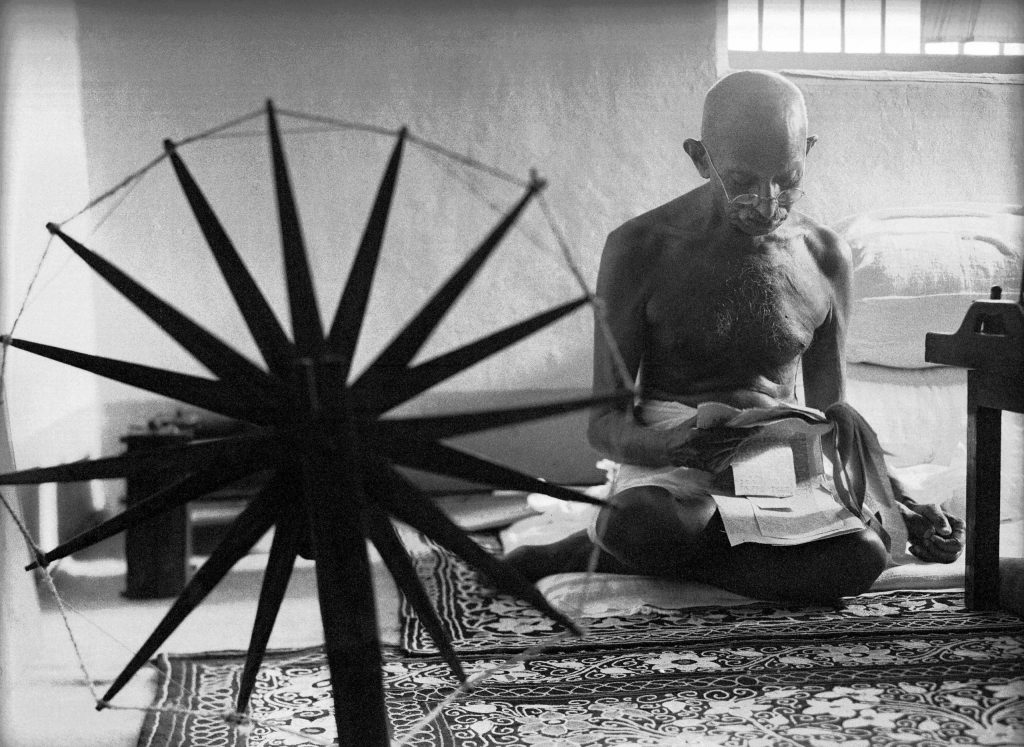
Gandhi’s life was his message. His handspun khadi, his sparse possessions, and his rejection of excess reflected his belief in simplicity. Today’s digital landscape is defined by consumerism—endless ads, influencer lifestyles, and the pressure to curate a perfect online image.
In this context, Gandhi’s philosophy speaks volumes. He would remind us that technology should serve humanity, not enslave it. To embrace Gandhi’s digital simplicity would be to use technology mindfully, resisting constant comparison, and focusing instead on authenticity.
Gandhi’s Global Resonance in a Connected World

Although Gandhi lived in a pre-digital age, his influence transcended borders. Leaders like Martin Luther King Jr. and Nelson Mandela drew strength from his philosophy. In today’s hyper-connected world, where a single tweet can mobilize millions, Gandhi’s non-violent activism offers a blueprint for digital movements.
The Arab Spring, #MeToo, and climate activism movements have all shown how social media can amplify voices for justice. Gandhi would likely embrace these platforms—but urge activists to remain rooted in non-violence, truth, and dignity, even when facing provocation.
Gandhi’s Silence is the Message We Need

The irony of our times is that we have infinite platforms for speech, but little space for silence. Gandhi often practiced maun vrat—a vow of silence—to conserve energy and reflect. In the digital age, perhaps his silence is the most radical lesson of all.
Choosing not to react, not to engage in online hostility, and not to chase endless validation is a form of digital ahimsa. In an ecosystem designed to reward outrage, practicing restraint may be the truest way to honor Gandhi’s teachings today.
Can Ahimsa Survive Social Media?
The question remains—can Gandhi’s ahimsa survive in the digital age? The answer lies not in the platforms themselves but in how we use them. Gandhi’s principles of truth, compassion, simplicity, and restraint are not relics of the past; they are urgent tools for navigating the present.
In a world where algorithms profit from division, Gandhi reminds us that humanity cannot thrive on hostility. His legacy calls us to reclaim the digital space as one of dialogue, empathy, and dignity.
As we celebrate his birthday, perhaps the truest tribute to the Mahatma would be to practice non-violence not only in our streets but also on our screens.
