

By Anjali Sharma
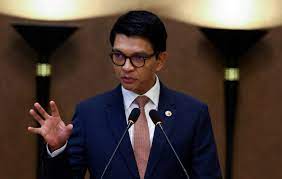
WASHINGTON – Madagascar’s President Andry Rajoelina on Tuesday has fled the country, become the latest world leader pushed out after a wave of Gen Z-driven unrest swept across multiple continents including Nepal and Bangladesh.
Media reported that the exit–reportedly aboard a French military aircraft–marks the third government collapse.
News media reported Siteny Randrianasoloniaiko, the opposition leader in Madagascar’s parliament, confirmed that Rajoelina left the country on Sunday after parts of the army joined the protesters.
“We called the staff of the presidency and they confirmed that he left the country,” he said. Rajoelina’s current location remains unknown.
Rajoelina addressed the nation via a Facebook video, insisting he had relocated to a “safe location” for his own protection. Though he refused to reveal where he was, he appeared defiant, stated “I will not allow Madagascar to be destroyed.”
According to a diplomatic source, Rajoelina has so far refused to resign.
The military sources stated that the president departed Madagascar, a former French colony, aboard a French Army CASA aircraft on Sunday. French radio outlet RFI reported that the evacuation followed a deal with French President Emmanuel Macron.
Macron spoke in Egypt after a Gaza ceasefire summit, said he could not confirm France’s role in Rajoelina’s departure.
He emphasized that “constitutional order must be preserved in Madagascar,” adding that while France recognizes the grievances of the country’s youth, those grievances should not be manipulated by military forces.
According to the military source, the extraction operation was swift. A French Casa aircraft landed at Sainte Marie airport, and minutes later, a helicopter transferred a single passenger–believed to be Rajoelina–onto the plane, as per Reuters.
The protests that triggered Rajoelina’s departure began on September 25, sparked by widespread water and power shortages.
They quickly evolved into a broader movement fueled by anger over corruption, poor governance, and a lack of basic services.
Rajoelina’s grip on power weakened significantly over the weekend when CAPSAT–an elite military unit that had previously helped him seize power in a 2009 coup–sided with the demonstrators.
CAPSAT declared it would no longer fire on protesters and instead escorted thousands through the capital, Antananarivo.
The unit announced it was taking control of the military and appointed a new army chief. In response, Rajoelina warned on Sunday of what he described as an attempted power grab.
The momentum shifted when a faction of the paramilitary gendarmerie also defected.
That group named its own chief in a formal ceremony attended by senior government officials, according to media reports.
The rapid political unraveling, the president of the Senate–another symbol of public anger–was removed from his position.
Jean Andre Ndremanjary was appointed interim Senate leader. Under Madagascar’s constitution, if the presidency becomes vacant, the head of the Senate temporarily assumes the role until new elections are held.
Thousands gathered again in Antananarivo’s central square, saying, “The president must quit now.”
UN reported that at least 22 people have been killed in clashes between protesters and security forces since demonstrations began, Reuters reported, cited the UN.
Madagascar, home to 30 million people, has a median age of under 20 and some of the highest poverty rates globally.
According to the World Bank, the country’s GDP per capita fell by 45 per cent from independence in 1960 to 2020.
Rajoelina issued pardons on Sunday for several individuals, including two French nationals convicted over a failed 2021 coup attempt.
The pardons were granted through an internal document and a source within the presidency.
Paul Maillot Rafanoharana and Francois Marc Philippe had been found guilty of plotting against the state.
