
Life Breathed into Stone: Ayodhya’s Grand Pran Pratishtha Unites Tradition and Technology

Paromita Das
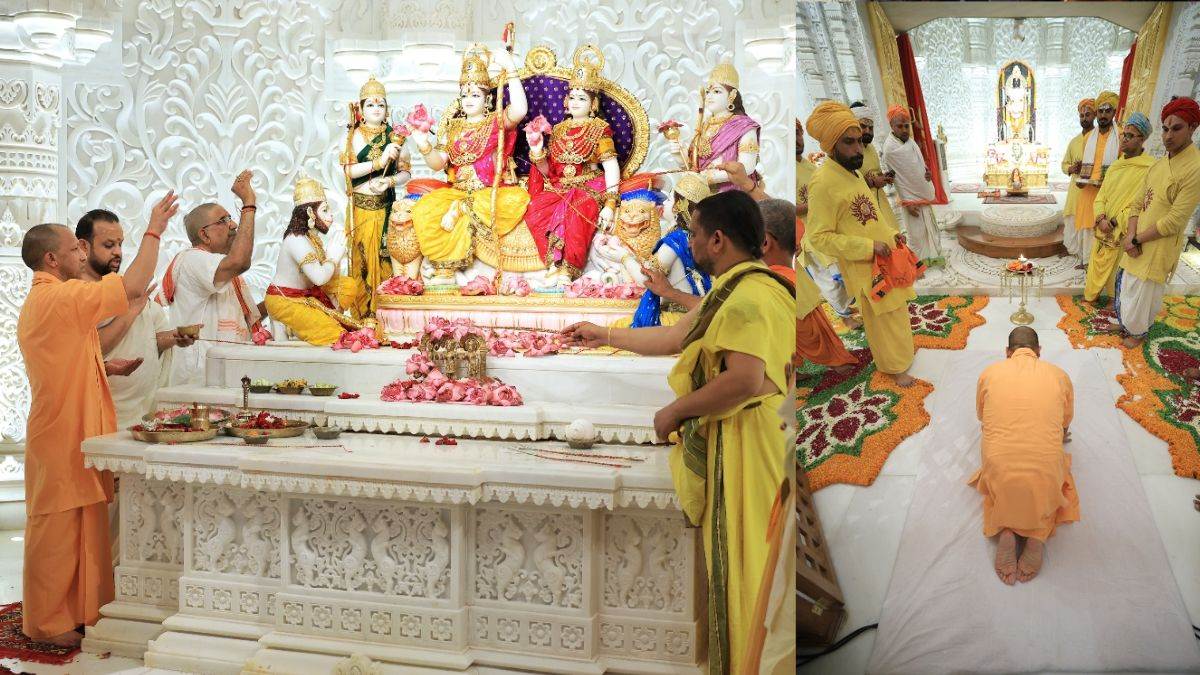
New Delhi, 6th June: The city of Ayodhya, steeped in mythology and ancient reverence, bore witness to a momentous spiritual event on Ganga Dussehra as the three-day-long Pran Pratishtha ceremony for the Ram Darbar and other deities concluded at the grand Ram Janmabhoomi temple complex. Unlike routine religious gatherings, this event marked the symbolic and ritual completion of a massive spiritual and cultural revival—an endeavor blending centuries-old Vedic traditions with the capabilities of modern India.
What unfolded was not merely a series of consecration rituals, but a holistic spiritual celebration that brought together thousands of devotees, scholars, saints, and dignitaries from across the nation and abroad. The temple, which has stood at the heart of India’s socio-religious consciousness for decades, took a decisive leap toward becoming a pan-Hindu spiritual nucleus, embodying both sacred continuity and new beginnings.
Sacred Completion on Ganga Dussehra
The choice of Ganga Dussehra—a festival commemorating the descent of the Ganges River from heaven to Earth—as the culminating day for the rituals added spiritual depth to the proceedings. Rivers, in Hindu belief, are not merely water bodies but living deities, and invoking their grace at a major consecration magnifies the sanctity of the temple space. Adding further grace to the moment was the coincidence of Uttar Pradesh Chief Minister Yogi Adityanath’s birthday with the final day of the rituals. His participation in the worship and havan underscored the seamless relationship between spiritual responsibility and administrative commitment in modern-day temple culture.
The day also coincided with the Trayodashi Janmotsav of the Saryu River, another spiritually significant marker in the region, enhancing the aura of divine convergence.
Pran Pratishtha: The Heartbeat of a Temple
Central to the event was the age-old Hindu ritual of Pran Pratishtha, which literally means “establishing life force.” This is the transformative moment when an idol ceases to be mere sculpture and is imbued with the living spirit of the deity. With synchronized chanting of Vedic mantras, homas (sacrificial fire rituals), and purification rites, the process turns a physical temple into a spiritual powerhouse.
The June 2025 rituals were a continuation of the temple’s inauguration in January 2024, when Ram Lalla was consecrated in the main sanctum. This second phase extended divine embodiment to eight more deities, including Lord Shiva, Sheshavatar, Hanuman, Ganesh, Surya Dev, Maa Bhagwati, and Annapurna Mata. Each idol was installed at a geometrically and spiritually significant location, following the architectural codes of the Agama Shastras, ancient scriptures governing Hindu temple design.
What distinguished this ritual from past traditions was the inclusion of multiple sects—Vaishnav, Shaiva, Shakta, tribal, and Bhakti—making the Ram Janmabhoomi complex a truly pan-Hindu space. This gesture was both symbolic and unifying, underscoring Hinduism’s inherent diversity and its ability to find oneness amidst a multitude of spiritual paths.
Melding the Ancient and the Modern
Perhaps the most impressive element of the three-day ceremony was its seamless integration of tradition with technology. Using real-time monitoring systems and satellite synchronization, multiple shrines within the temple complex were aligned in timing and ritual sequence. This was not just a logistical achievement, but a spiritual statement: that Vedic India and Digital India can walk in harmony.
To ensure the safety of attendees—who numbered in the thousands—security was elevated to a multi-agency operation. The Anti-Terrorism Squad (ATS), Central Reserve Police Force (CRPF), Provincial Armed Constabulary (PAC), and local police operated under a coordinated plan, enhanced by facial recognition and drone surveillance technologies.
Ayodhya’s Transformation: Numbers Tell the Story
The scale of Ayodhya’s physical and spiritual transformation is staggering. Since 2017, over ₹32,000 crore has been invested in infrastructure, including road widening projects, the beautification of the Saryu riverfront, improved transportation networks, and the development of tourism-friendly public spaces such as Ram Katha Park. Ayodhya airport—built to accommodate international spiritual tourism—is nearing completion, signaling India’s intent to position the city as a global pilgrimage hub.
This transformation isn’t just physical. The temple project has revived long-forgotten rituals, brought traditional crafts and Vedic scholarship into the limelight, and sparked a renewed pride in indigenous spiritual practices.
The Spiritual Reawakening
What is unfolding in Ayodhya is more than the return of Ram Lalla or the completion of a temple. It is the restoration of India’s civilizational memory. For decades, Ayodhya was mired in legal battles, ideological strife, and political posturing. Today, it stands as a beacon of reconciliation, cultural resurgence, and spiritual aspiration.
Critics may argue that religious events of this scale risk politicization or exclusion, but the inclusive nature of the Pran Pratishtha—embracing multiple Hindu traditions and inviting participation from across the social spectrum—offers a counter-narrative. It emphasizes unity, not division.
The blend of heritage and high-tech also sets a blueprint for future temple projects in India, demonstrating that tradition does not have to resist innovation. Rather, the two can co-exist to serve a deeper cause.
A Temple Reborn, A Nation Recentered
As the final aarti lit up the Ayodhya sky and the community bhandara brought strangers together as equals, what emerged was not just a completed temple, but a renewed spirit. The Ram Janmabhoomi complex is now more than stone and sanctums—it is a pulsating center of India’s collective faith.
By completing the Pran Pratishtha of the Ram Darbar and associated deities, Ayodhya has not only honored its mythological past but has positioned itself as the heart of a spiritually confident, modern India. In doing so, it offers a powerful message to the world: that tradition, when rooted in inclusivity and evolved through purpose, remains the most potent force in shaping a nation’s soul.
