
Kaleshwaram Fallout: Telangana’s Mega Irrigation Dream Under Fire

Paromita Das
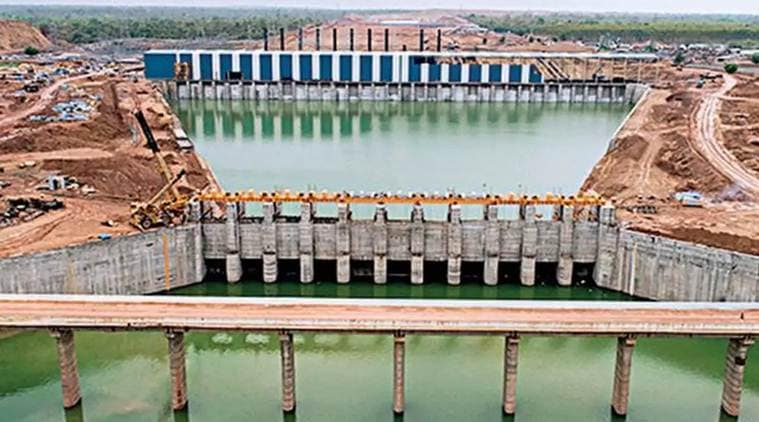
New Delhi, 21st June: In 2019, Telangana’s then Chief Minister K. Chandrashekar Rao (KCR) proudly launched the Kaleshwaram Lift Irrigation Project (KLIP)—an ambitious, multi-stage engineering marvel aimed at transforming the state’s arid landscape into a green belt of prosperity. Designed to irrigate over 37 lakh acres across 21 districts, KLIP was touted as one of the largest and most advanced lift irrigation schemes in Asia. It involved an intricate network of canals, pumping stations, barrages, and reservoirs that promised to redefine water management in Telangana.
Yet, just a few years later, KLIP is no longer just a showcase of engineering ambition—it has become a lightning rod for political allegations, financial scrutiny, and intense debate. What began as a symbol of Telangana’s progress now sits under the scanner for alleged corruption, poor execution, and economic imprudence.
Congress Government Opens Pandora’s Box
Since coming to power, the Congress-led government under Chief Minister A. Revanth Reddy has raised pointed questions about how the project was conceived, approved, and executed. According to Reddy, in the 96 Cabinet meetings held during BRS’s 10-year rule, KLIP was barely discussed beyond its cost escalations. This, he alleges, shows a disturbing lack of transparency in how decisions were made.
The Chief Minister has promised to submit a detailed dossier to the Justice P.C. Ghose Commission of Inquiry by the end of June 2025, suggesting that not just bureaucratic lapses but also political improprieties may have taken place. These developments paint a picture of a high-value infrastructure project executed without adequate institutional deliberation.
KCR Defends Legacy Amidst Charges
KCR, now in the opposition as BRS president, has not taken the allegations lightly. Appearing before the Commission on June 11, he spent nearly an hour defending his flagship project. He insists that KLIP was a necessity born out of Telangana’s water scarcity and that the Congress is indulging in political vendetta rather than offering viable alternatives.
KCR is also mobilizing his party’s senior leadership to counter what he calls “defamation by design.” For the BRS, this isn’t merely about a project—it’s about defending a legacy and a narrative that brought it to power and kept it there for a decade.
Structural Failures and Financial Woes
However, the problems go beyond political finger-pointing. Telangana’s new Irrigation Minister, N Uttam Kumar Reddy, has stated bluntly that the project failed to build a sustainable irrigation network. Despite nearly ₹94,000 crore in investment—most of it borrowed from high-interest commercial sources—the results have been paltry.
Two major barrages have collapsed, the targeted ayacut (irrigated land) remains incomplete, and farmers have seen minimal improvements. With such vast funds invested, the returns have not just been disproportionate—they’ve been dismal.
CAG Audit: An Alarming Assessment
The most damning critique came from the Comptroller and Auditor General (CAG), whose 2024 audit declared the project “economically unviable.” The audit exposed glaring discrepancies in the Detailed Project Report (DPR). It found that costs had been underestimated while benefits were exaggerated to inflate the benefit-cost ratio.
Even with conservative cost estimates, the project’s benefit-cost ratio stood at 0.75. In real terms—factoring in the expected final cost of ₹1.47 lakh crore—the ratio plummeted to just 0.52. That means for every rupee spent, only ₹0.52 in benefits are returned. For a project of such magnitude, this is not just inefficient—it’s disastrous.
Between Vision and Vanity
The Kaleshwaram Project illustrates a broader issue plaguing large infrastructure ventures in Bharat: the blurred line between ambition and accountability. No one questions the need for irrigation in Telangana. Water scarcity has crippled agricultural development for decades. But good intentions don’t justify flawed execution or opaque governance.
KCR’s vision was grand, but its implementation appears riddled with gaps—technical, financial, and ethical. On the other hand, the Congress’s current attack on KLIP, while necessary, risks being perceived as politically motivated unless accompanied by constructive alternatives. Public trust depends not only on exposing the past but also on offering a better future.
What stands out most is how a project meant to uplift farmers and empower rural communities has now become a political battlefield. The farmers—its intended beneficiaries—are once again left waiting.
What Lies Ahead for KLIP and Telangana
As the Justice P.C. Ghose Commission continues its investigation and the CAG’s findings resonate across the legislative corridors, the Kaleshwaram Project stands at a crossroads. Its success, once assured by political will and public funding, now hinges on accountability, restructuring, and perhaps a reimagining of its scope.
The coming months will be critical. Will KLIP be salvaged and made functional through renewed effort and honest governance? Or will it remain a cautionary tale—another ambitious dream brought down by poor planning and political rivalry?
One thing is certain: KLIP’s legacy will not be defined by its scale, but by its outcomes. Telangana’s leaders, irrespective of party, owe it to their people to ensure that this colossal investment doesn’t go to waste.
