
Judiciary Halts Mamata’s OBC Push in Stunning Blow
“High Court freezes Bengal’s expanded OBC list, calling it unconstitutional and politically engineered, triggering a major debate on reservation, identity and governance.”

Paromita Das
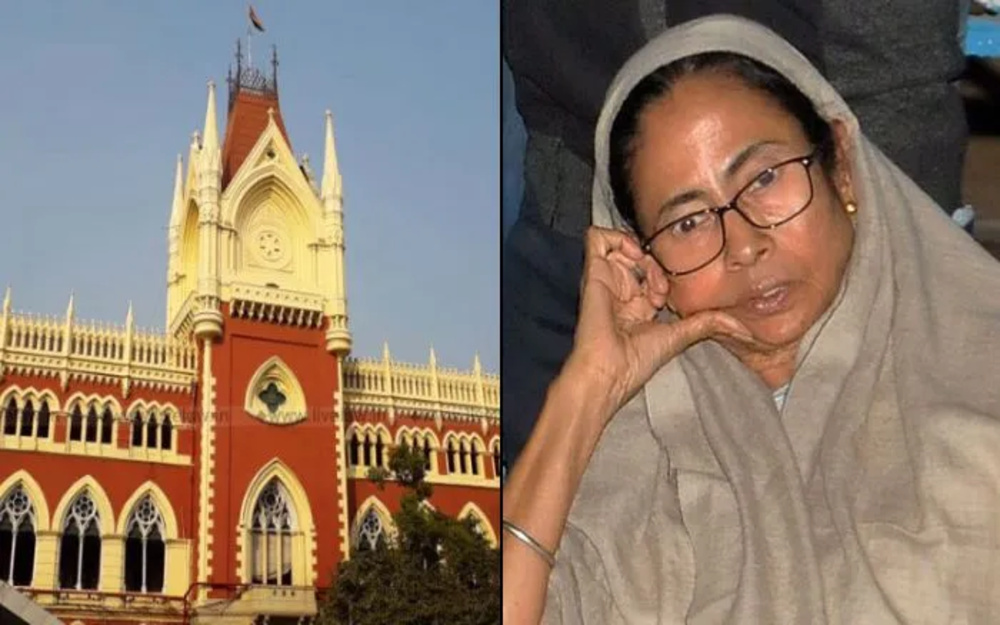
New Delhi, 8th December: There are moments in the life of a state when a courtroom verdict becomes more than a legal pronouncement—it becomes a mirror. The Calcutta High Court’s sweeping decision to freeze the West Bengal government’s expanded OBC list is one such moment, a verdict that reflects not only the state of governance but also the political instincts shaping it. Mamata Banerjee’s administration, which has long been accused of bending social justice to fuel its electoral strategy, now stands publicly confronted by the judiciary. And the blow is heavy enough to shake her political fortress.
The Court’s order does not merely halt a list—it halts a long-running political pattern. The judges made it clear that this new OBC list, prepared by the Bengal government, was unconstitutional, discriminatory and alarmingly tailored to favour a single religious bloc. For a government that prides itself on being the champion of marginalised communities, this verdict hits at its core claim.
A Question of Data—and Intent
Before 2010, West Bengal had 66 OBC communities, of which 55 were Hindu communities and 11 belonged to the minority community, accounting for roughly 20% of the OBC share. But under the Mamata Banerjee government, this share shot up dramatically, climbing to over 55%, altering the social balance of backward-class categorisation.
Then came the explosive twist.
On 3 June 2025, the Bengal government released a new list of 140 OBC groups, adding 76 fresh entries. Out of these 76 newly inducted groups, 67 belonged to one specific community, roughly 88% of the new list. Hindu communities, meanwhile, received a mere 7% of representation in the additions.
The statistics paint their own story. The political subtext makes it louder.
The High Court didn’t mince words. It said the government had attempted to smuggle back communities already declared illegal in earlier judgments and had done so with full knowledge of past judicial rulings. This, the Court implied, was not social justice—it was political engineering dressed as empowerment.
Two Categories, One Pattern
West Bengal divides OBCs into two groups:
- Category A (Extremely Backward)
- Category B (Backward)
Of the 35 communities placed under Category A, 33 were from a single community, with only two Hindu castes included.
Among the 41 communities placed in Category B, 34 belonged to the same bloc, while just seven were Hindu groups.
Combine both categories, and the disparity becomes stark. The state’s OBC architecture had been tilted so heavily that the High Court called it a direct violation of the constitutional principle that reservation cannot be granted on the basis of religion.
Yet the government argued it was an exercise in inclusion.
The Court saw it differently. It called it manipulation.
Reservation as a Political Toolkit
The Mamata government’s attempt to raise OBC reservation from 7% to 17% on 3 June 2025 was not coincidental—it was timed to deliver immediate benefits to the newly included groups, most of whom formed a consolidated vote bank.
This, critics argue, was not governance but electoral calibration.
The Court’s order also pointed out a pattern extending beyond the state machinery. In March 2024, the West Bengal government had attempted to push 83 communities into the Central OBC list, of which 73 were from the same religious community. The intention, as interpreted by many, was clear: extend influence beyond state jobs and reservations into central employment and educational avenues as well.
That attempt failed then. And the High Court has now ensured it fails in the state as well.
A Blow to Mamata’s Political Project
This verdict hits Mamata Banerjee at a time when her government is already navigating criticism over law and order, appeasement and institutional overreach. Her political brand has always been built on minority outreach, sometimes aggressively so, and the opposition has repeatedly accused her of transforming West Bengal into a laboratory of ideological appeasement.
By calling out the OBC expansion as unconstitutional and community-centric, the Court has now lent judicial weight to what was once merely political rhetoric.
The ruling tightens scrutiny over the state’s reservation decisions and questions the legitimacy of Mamata’s larger narrative of “inclusive development”.
When Social Justice Becomes Selective
Reservation is meant to uplift communities historically denied opportunities. It is not meant to be sculpted along religious lines or used as a tool of voter consolidation. When a government begins to treat constitutional categories as electoral currency, the very idea of social justice gets corrupted.
The Bengal government’s approach appears less like an effort to uplift backward groups and more like an attempt to stabilise a dependable vote bank. And once social justice becomes selective, it ceases to be justice at all.
The High Court’s intervention is therefore more than a legal correction—it is a moral one.
A Verdict with Long Shadows
The Calcutta High Court’s decision will shape the political discourse in West Bengal for months, if not years. It forces the state government to re-examine its policies, re-calibrate its strategies and perhaps even rethink its relationship with identity-based politics.
This ruling also serves as a reminder to all governments—reservation is not a playground for vote-bank strategy. It is a constitutional instrument of equality that must be handled with precision, fairness and transparency.
As Bengal moves forward, the question is not whether Mamata Banerjee will defend her policies—she certainly will—but whether the people of the state will accept a system where political gain overrides constitutional integrity.
In the end, the verdict is clear, the message sharper: appeasement can win votes, but it cannot withstand the Constitution.
