
Joel Mokyr, Philippe Aghion, Peter Howitt gets Nobel in Economics for innovation growth research

By Anjali Sharma
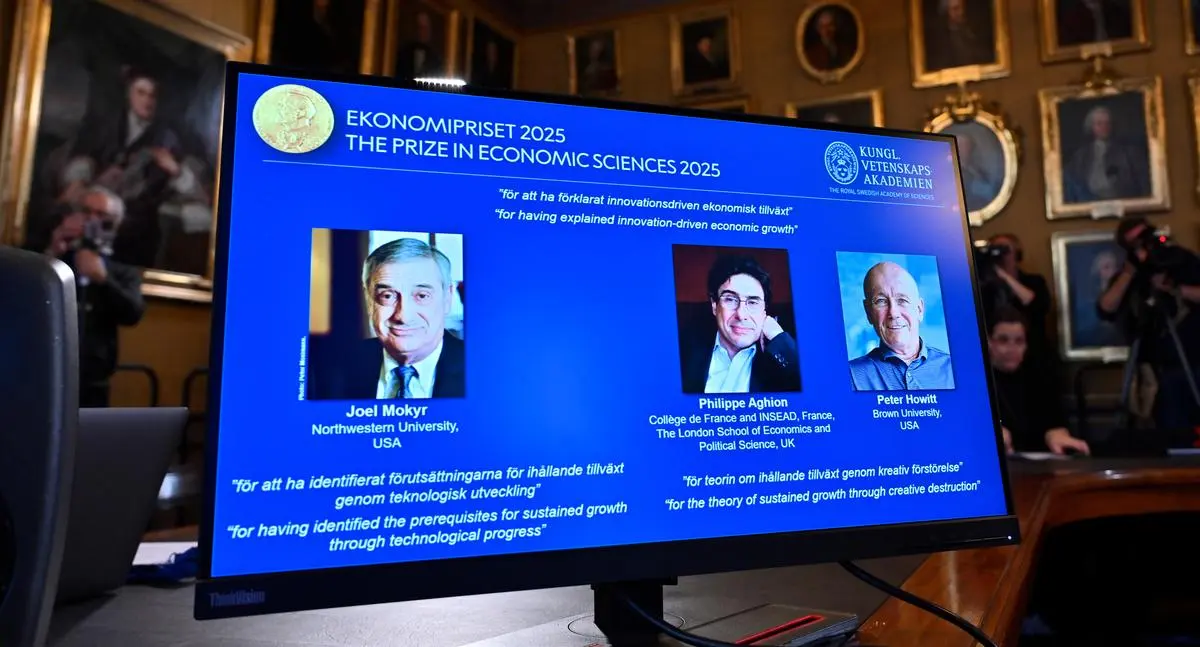
WASHINGTON – According to the Noble committee on Monday announced that Joel Mokyr, Philippe Aghion, and Peter Howitt won 2025 Nobel Prize in Economics for innovation-driven growth research.
The 2025 Nobel Prize in Economic Sciences has gone to three scholars whose ideas help explain how innovation keeps the world moving forward.
The Royal Swedish Academy of Sciences announced that Joel Mokyr, Philippe Aghion, and Peter Howitt are this year’s laureates.
Half of the prize goes to economic historian Joel Mokyr for identifying the conditions that make long-term growth possible through technological progress, it said.
The other half is shared between economists Philippe Aghion and Peter Howitt.
They developed the influential theory of creative destruction. The process explains how innovation fuels growth by constantly replacing old ideas with new ones.
Joel Mokyr’s work bridges history and economics. He asked a simple but profound question: why did the Industrial Revolution happen when and where it did, and why did its effects not fade away like earlier bursts of innovation?
Mokyr’s answer lies in what he calls useful knowledge. He distinguishes between two kinds of knowledge. Propositional knowledge is for understanding why something works such as scientific explanations or natural laws. Prescriptive knowledge is to know how to make it work.
Aghion and Howitt’s work on the power of creative destruction
Mokyr looked to the past for explanations, Philippe Aghion and Peter Howitt built a theory that helps explain how innovation drives growth today.
In 1992, the two economists developed a mathematical model showing how companies invest in innovation to stay ahead in a competitive market. But innovation is a double-edged sword. When new ideas succeed, older ones become obsolete. Businesses that once dominated may fall behind.
This dynamic is what they called creative destruction. This concept was first introduced by economist Joseph Schumpeter and later refined by Aghion and Howitt. It is creative because it fuels progress and raises living standards. But it is also destructive because it replaces the old with the new.
In the words of the Nobel Committee, their work explains why growth, once rare and fragile, has become the “new normal”.
